
Free Pre-Start Checklist (Lab Oven) Template
Download our free Pre-Start Checklist (Lab Oven) Template. This structured DOCX & PDF resource helps formalise equipment safety checks. Get started today.
Free Pre-Start Checklist (Lab Oven) Template
DOCX • 125 KB + PDF
Updated Oct 2026
No signup required
Purpose of the Free Pre-Start Checklist (Lab Oven) Template
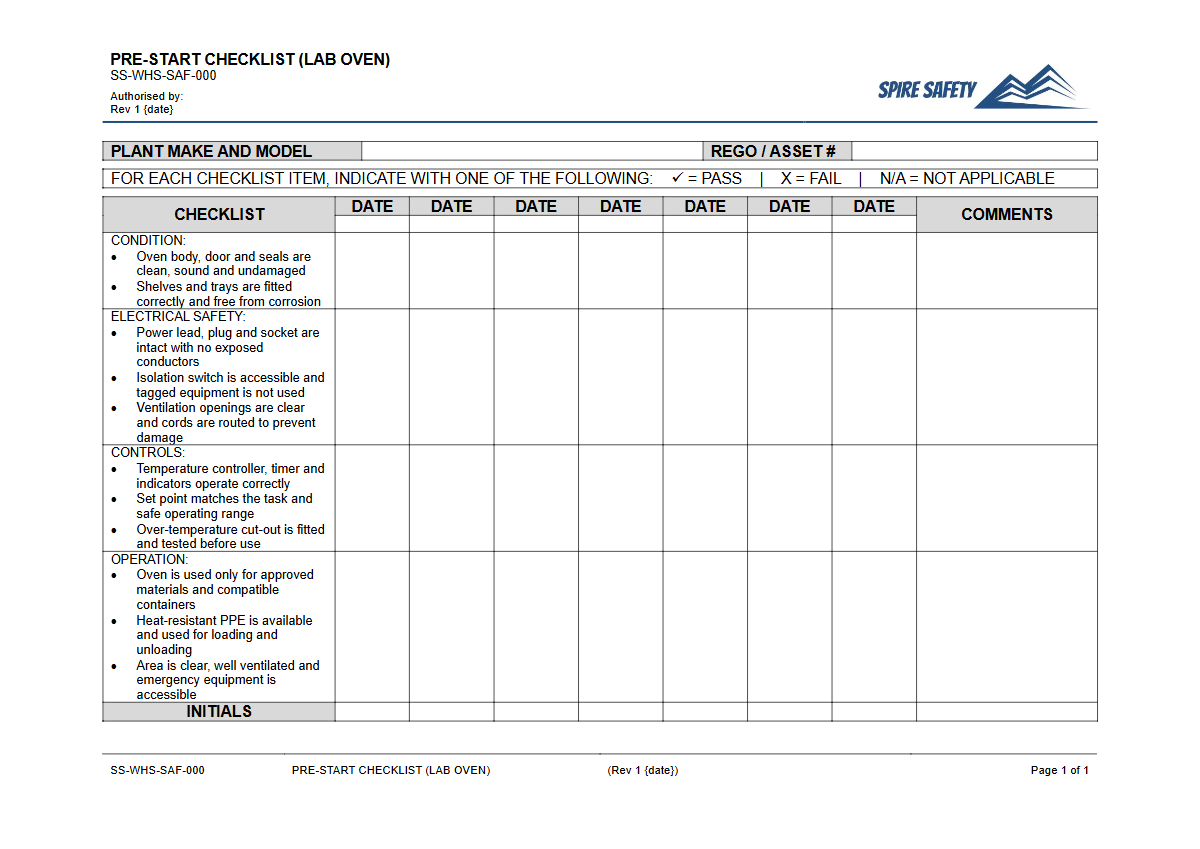
This Free Pre-Start Checklist (Lab Oven) Template provides a structured starting point for organisations to formalise their equipment inspection processes. Regular pre-start checks are a fundamental safety practice, helping to identify potential faults, damage, or operational issues before the equipment is used.
By systematically inspecting a lab oven, operators can proactively address hazards such as faulty temperature controls, damaged seals, or electrical issues, significantly reducing the risk of fire, burns, or damage to samples and the surrounding workplace. It serves as a practical tool for due diligence, demonstrating a commitment to a safe working environment.
Integrating this type of checklist into daily operations is a key component of effective WHS management systems. It creates a documented record that the equipment was in safe working order at the beginning of each shift or use. This record-keeping is invaluable for incident investigations, maintenance scheduling, and demonstrating procedural adherence.
It helps standardise safety expectations across all laboratory personnel, ensuring that every user performs the same critical checks.
Video walkthrough
How to use the Free Pre-Start Checklist (Lab Oven) Template
To effectively use this Free Pre-Start Checklist (Lab Oven) Template, download the DOCX or PDF file and begin by customising it to your specific workplace. This is a critical step, as no two laboratory environments or oven models are identical.
The provided template offers a solid foundation based on common safety considerations, but it must be adapted to reflect the unique features, risks, and operating procedures of your equipment and facility.
The customisation process should involve:
- Reviewing Manufacturer's Instructions: Cross-reference the checklist items with the safety and maintenance sections of your lab oven's user manual.
- Conducting a Risk Assessment: Identify specific hazards associated with your lab oven's location, use, and the materials being heated. Add checklist items that address these specific risks.
- Consulting with Workers: Involve the laboratory technicians and operators who use the oven daily. Their hands-on experience is vital for identifying practical inspection points and ensuring the checklist is user-friendly.
Once customised, the checklist should be made readily available near the equipment. To reinforce its importance, consider discussing its use during routine safety meetings, perhaps using a Pre-Start Checks and Plant Maintenance Toolbox Talk. Operators should be trained on how to complete each check correctly and what actions to take if a fault is identified, such as tagging the equipment out of service and reporting the issue to a supervisor.
A Note on Customisation
This document is a template and not a complete, out-of-the-box solution. It is essential that you customise this checklist to suit the specific make and model of your lab oven, your operational procedures, and the specific hazards present in your workplace.
We cannot provide advice on what specific items should be on your checklist; this must be determined through your own risk assessment process.
When to use it
A pre-start checklist for a lab oven should be completed before the first use of the equipment on any given day or shift. This ensures that its condition is verified before it is energised and brought to temperature.
For ovens used infrequently, the check should be performed before each use. Integrating this check into the daily workflow, perhaps as part of the opening procedures discussed in a morning briefing covered by a Pre-Start Meeting Template, helps embed it as a non-negotiable safety habit.
The checklist should also be used after any maintenance, repairs, or if the equipment has been moved. This confirms that the oven has been returned to a safe operational state and that no new hazards have been introduced during the work.
This disciplined approach is much safer than relying on memory or informal visual checks, as it provides a consistent and documented process. The use of specific checklists for different equipment is common practice; for instance, a workshop might use this template for an oven and a separate Free Pre-Start Checklist for a CNC Router for their machinery.
Who should use it
The pre-start checklist should be completed by the person operating the lab oven. This responsibility empowers the user and ensures the person most directly exposed to any potential risk is the one verifying the equipment's safety.
Assigning this task to the operator reinforces personal accountability and leverages their familiarity with the equipment's normal state. Supervisors and laboratory managers are responsible for ensuring these checks are being completed correctly and for taking appropriate action when faults are reported.
All personnel tasked with completing the checklist must be trained and competent. This includes not only understanding what each item on the checklist means but also knowing how to perform the inspection safely and recognise a potential defect.
Competency should also extend to the procedure for reporting faults. For complex equipment, verifying worker skills with a formal process, similar in principle to using a Verification of Competency for a Pipe Threader, can be a valuable part of your safety framework.
Ultimately, a robust safety culture is one where every team member understands their role in maintaining a safe work environment.
Regular reviews of completed checklists help management identify recurring issues, training gaps, or a need for more frequent maintenance. These documented checks are a key data source for continuous improvement and can be a focal point during WHS compliance auditing activities. For more templates and safety tools, browse our complete free WHS resources library.
Common mistakes
Common mistakes to avoid
- Using a generic checklist that doesn't match the specific oven model.
- "Pencil-whipping" the form without physically performing each check.
- Failing to remove the equipment from service when a serious fault is found.
- Not training operators on how to properly conduct the checks or recognise defects.
Legal references
Legal considerations
The following legal requirements may be relevant to this type of work.
- Work Health and Safety Act (Harmonised) — Provides the primary duties for protecting workers and other people from work health and safety risks.
- Work Health and Safety Regulations (Harmonised) — Sets out requirements supporting the management of workplace hazards and risks.
The following codes may be relevant to this type of work.
- Managing WHS Risks Code of Practice — Provides practical guidance on identifying hazards, assessing risks and applying effective controls.
- Work Health and Safety Consultation, Cooperation and Coordination Code of Practice — Provides practical guidance on consulting workers and coordinating with other duty holders.
- Managing the Work Environment and Facilities Code of Practice — Provides practical guidance on safe work environments, workplace facilities and related controls.
Did you know
Thermal Runaway
Malfunctioning lab ovens can lead to 'thermal runaway,' where increasing temperature causes a reaction that further increases the temperature, potentially leading to fires or explosions.
Record Keeping
Consistently completed pre-start checklists are valuable records for maintenance planning, demonstrating due diligence, and providing data for incident investigations.
FAQ
Frequently asked questions
01What should be included in a lab oven pre-start check?
02Why is a daily pre-start check necessary for a laboratory oven?
03Who is responsible for completing the lab oven pre-start checklist?
04How does a pre-start checklist help with WHS compliance for lab equipment?
Share this resource
Free Pre-Start Checklist (Lab Oven) Template
Browse Categories
How To Use It
- 1Download and open in Word or PDF.
- 2Replace the placeholders with your business details.
- 3Get it reviewed by a WHS specialist before rollout.
Need it customised?
Our WHS consultants can adapt this template to your site, run a gap analysis, or audit what you already have in place.
Book a Free Consultation WHS consulting servicesor call 1300 156 382