
Free Pre-Start Checklist (Laser Cutter) Template
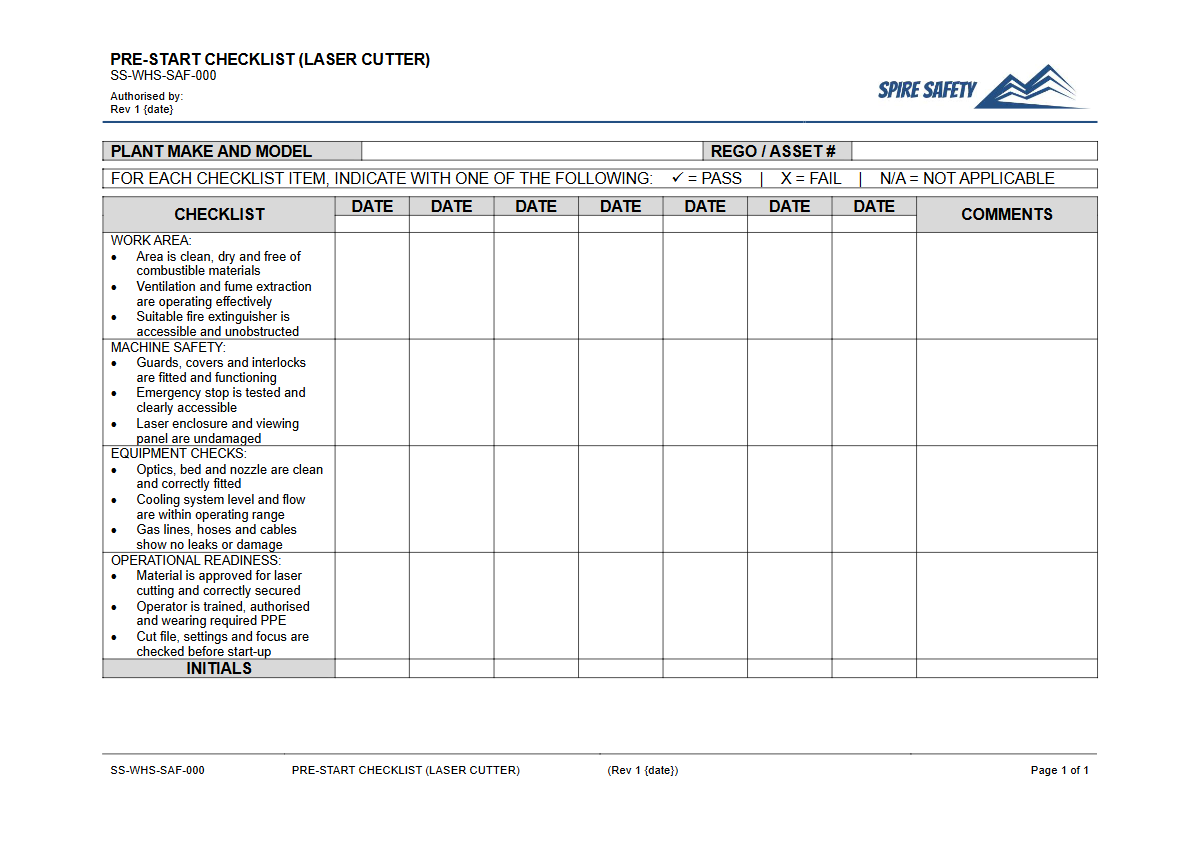
Download our Free Pre-Start Checklist (Laser Cutter) Template. This structured Word & PDF document helps formalise equipment safety inspections before use.
Free Pre-Start Checklist (Laser Cutter) Template
DOCX • 125 KB + PDF
Updated Oct 2026
No signup required
Purpose of the Free Pre-Start Checklist (Laser Cutter) Template
Using a laser cutter involves significant risks, including high-energy beams, hazardous fumes, and potential fire hazards. A documented pre-start inspection is a critical control measure to ensure the equipment is safe to operate.
This Free Pre-Start Checklist (Laser Cutter) Template provides a structured framework for operators to verify that safety controls are in place and functioning correctly before commencing work. Regular use helps identify potential faults, prevent incidents, and demonstrates a commitment to workplace health and safety. The checklist forms one part of a comprehensive safe system of work, which should also be documented in a free Laser Cutter SOP (Safe Operating Procedure) template.
Video walkthrough
How to Use the Free Pre-Start Checklist (Laser Cutter) Template
Our template is provided in both DOCX and PDF formats for your convenience. To use it effectively, download the file and adapt it to the specific make and model of laser cutter in your workplace.
Key steps include reviewing the manufacturer's operating manual, conducting a risk assessment, and adding or removing checklist items to reflect your unique operational environment and the materials being processed. Once customised, the checklist should be integrated into your daily operational procedures.
Effective document control is a core component of implementing a WHS management system that supports consistent and safe work practices.
A Note on Customisation
IMPORTANT: This document is a template and serves as a starting point. We have developed it based on common industry practice, but it must be customised to suit the specific equipment, processes, and risks present in your workplace.
A generic checklist cannot account for all variables, and failure to tailor it may result in an incomplete or ineffective safety check.
When to Use a Laser Cutter Pre-Start Checklist
A pre-start checklist for a laser cutter should be completed before the first use on any given day or shift. For equipment that is used intermittently, the check should be performed before each use.
The goal is to confirm the machine's safety status immediately prior to operation. This routine is a fundamental aspect of proactive equipment safety, reinforcing operator responsibility and preventing the use of unsafe plant. You can reinforce these principles with your team by using a Pre-Start Checks and Plant Maintenance Toolbox Talk.
Who Should Use This Checklist
This Pre-Start Checklist should be completed by the person operating the laser cutter. The operator must be trained, competent, and authorised to use the specific model of equipment.
Supervisors or safety personnel may also use the checklist to conduct periodic verifications or safety observations. It is the responsibility of the Person Conducting a Business or Undertaking (PCBU) to ensure that workers have the necessary training and resources to perform these checks correctly.
Key Inspection Areas in the Template
This template prompts operators to inspect critical safety components and environmental conditions. Key sections include:
- Safety Interlocks and Guards: Verifying that all access panels are secure and that safety interlocks function correctly, stopping the laser if a door is opened during operation.
- Fume and Particle Extraction: Ensuring the extraction system is turned on and operating effectively to remove hazardous fumes and dust from the work area.
- Laser Optics and Nozzle: Checking that the lens and mirrors are clean and free from damage, which is crucial for cut quality and fire prevention.
- Work Area and Housekeeping: Confirming the area is free of flammable materials and unnecessary clutter.
- Emergency Stop: Testing the function of the emergency stop button.
The principles of checking interlocks, guards, and emergency systems are common across many types of automated equipment, as seen in our Free Pre-Start Checklist (CNC Router) Template.
Integrating the Pre-Start Checklist into Your WHS System
Simply having a checklist is not enough; it must be used consistently and its findings acted upon. Completed checklists should be retained as a record of your organisation's safety diligence.
Any faults or issues identified must be reported immediately, and the equipment should be tagged out of service until it is repaired by a qualified person. These records can be invaluable during incident investigations or WHS compliance audits, providing clear evidence of your safety processes.
Explore our entire free WHS resources library to find other documents that can help strengthen your safety management system.
Common mistakes
Common mistakes to avoid
- Treating the checklist as a 'tick-and-flick' exercise without physically verifying each item.
- Neglecting to check the fume extraction system is on and drawing air effectively.
- Failing to customise the generic template for the specific make and model of the laser cutter.
- Ignoring small cracks or dirt on the lens, which can lead to poor performance, beam reflection, and fire.
Legal references
Legal considerations
The following legal requirements may be relevant to this type of work.
- Work Health and Safety Act (Harmonised) — Provides the primary duties for protecting workers and other people from work health and safety risks.
- Work Health and Safety Regulations (Harmonised) — Sets out requirements supporting the management of workplace hazards and risks.
The following codes may be relevant to this type of work.
- Managing WHS Risks Code of Practice — Provides practical guidance on identifying hazards, assessing risks and applying effective controls.
- Work Health and Safety Consultation, Cooperation and Coordination Code of Practice — Provides practical guidance on consulting workers and coordinating with other duty holders.
- Managing the Work Environment and Facilities Code of Practice — Provides practical guidance on safe work environments, workplace facilities and related controls.
Did you know
Invisible Danger
The beam from a CO2 laser is in the infrared spectrum, making it completely invisible to the human eye. This is why functioning safety interlocks that prevent the laser from firing when the lid is open are non-negotiable safety features.
Forbidden Materials
Never cut materials containing chlorine, such as PVC (polyvinyl chloride). When heated by a laser, PVC releases highly corrosive and toxic hydrogen chloride gas, which can cause severe respiratory damage and permanently destroy the machine's optics and mechanics.
FAQ
Frequently asked questions
01What is a laser cutter pre-start checklist?
02Why is a fume extraction check so important for laser cutters?
03How often should a laser cutter be inspected?
04Can I use this template for any type of laser cutter (CO2, fiber, etc.)?
Share this resource
Free Pre-Start Checklist (Laser Cutter) Template
Browse Categories
How To Use It
- 1Download and open in Word or PDF.
- 2Replace the placeholders with your business details.
- 3Get it reviewed by a WHS specialist before rollout.
Need it customised?
Our WHS consultants can adapt this template to your site, run a gap analysis, or audit what you already have in place.
Book a Free Consultation WHS consulting servicesor call 1300 156 382