
Free Pre-Start Checklist (Lathe) Template
Download our free Pre-Start Checklist (Lathe) Template. This structured DOCX & PDF resource helps formalise safety checks and manage WHS risks.
Free Pre-Start Checklist (Lathe) Template
DOCX • 125 KB + PDF
Updated Oct 2026
No signup required
Purpose of the Free Pre-Start Checklist (Lathe) Template
Operating a metalworking or woodworking lathe involves significant risks, including entanglement, impact from projectiles, and electrical hazards. This Free Pre-Start Checklist (Lathe) Template provides a structured framework for operators to conduct thorough, documented safety inspections before each use.
Implementing a consistent pre-start process is a critical step in proactively identifying and controlling hazards, preventing equipment failure, and reducing the likelihood of workplace incidents. It helps a Person Conducting a Business or Undertaking (PCBU) fulfil their primary duty of care under Australian WHS legislation.
Using a documented checklist ensures that inspections are systematic and that nothing is overlooked. It creates a formal record that checks have been completed, which is an essential component of any robust safety system.
This practice supports the ongoing maintenance of plant and demonstrates due diligence in managing workplace risks. Integrating such checklists is a foundational element of effective WHS management systems, helping to build a culture of safety and accountability.
Video walkthrough
How to use the Free Pre-Start Checklist (Lathe) Template
This template is designed for simplicity and practical use in a workshop environment. First, download the document in your preferred format (DOCX for easy editing or PDF for direct printing).
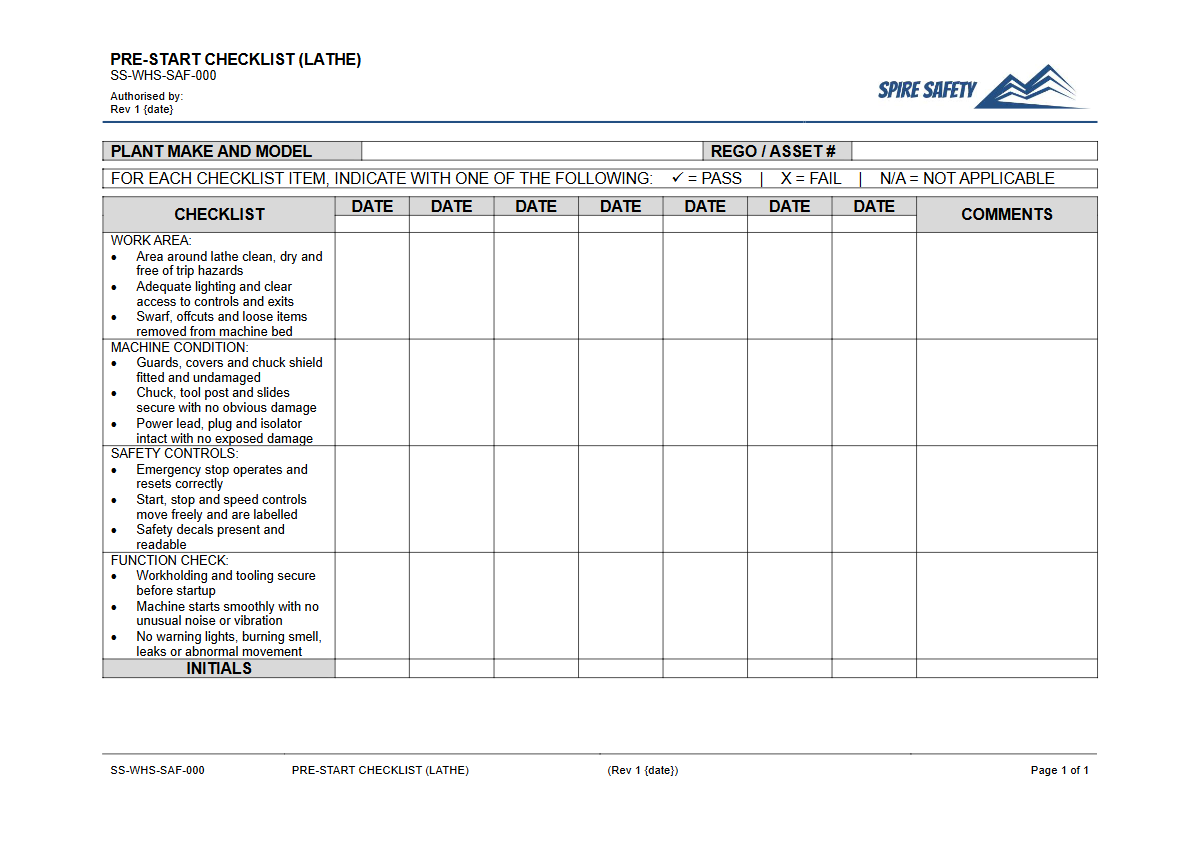
The checklist guides the operator through a series of critical inspection points, covering mechanical, electrical, and operational safety features. These include checking that guards are in place and secure, emergency stops are functional, the chuck key has been removed, and the work area is clear of trip hazards and clutter.
The operator ticks off each item, notes any defects, and signs the form.
Important: This is a general template designed as a starting point. We recommend that a competent person customises this document to suit the specific make, model, and configuration of the lathes used in your workplace.
Different machines have unique features and risks that must be addressed. A properly customised checklist, similar in principle to our free Pre-Start Checklist for Bench Grinders, ensures your safety checks are relevant and effective.
When to use it
A pre-start check should be conducted before the lathe is used for the first time each day or at the beginning of every shift. This routine ensures the machine is in a safe condition before any work commences.
Additionally, a check is recommended if a new operator takes over mid-shift, or after any maintenance, cleaning, or adjustment has been performed. Regular checks help catch developing issues, like loose components or worn parts, before they escalate into major failures or safety incidents.
Documenting these checks provides a valuable historical record of the equipment's condition. This log can be useful for maintenance planning and for identifying recurring faults that may indicate a deeper problem.
Consistently applying checks to all workshop machinery, including items covered by our Pre-Start Checklist (Floor Saw) Template, reinforces a comprehensive approach to plant safety.
Who should use it
The pre-start checklist should be completed by the person operating the lathe. This individual must be trained, competent, and authorised to use the specific machine.
They are in the best position to assess its immediate condition. If the operator identifies any faults, damage, or concerns during the check, they must not use the equipment.
The lathe should be immediately isolated and tagged out of service, and the issue must be reported to a supervisor or manager for corrective action.
Supervisors and managers have a responsibility to ensure these checks are being completed correctly and that any reported issues are addressed promptly. They should periodically review the completed checklists to verify compliance and monitor the condition of the equipment.
These records are vital evidence of safety procedures during any formal WHS compliance auditing process, demonstrating that the organisation has active controls in place to manage plant-related risks. You can find more templates for different equipment types in our free WHS resources library to build out your safety program.
Common mistakes
Common mistakes to avoid
- "Ticking and flicking" the checklist without physically performing the inspections.
- Failing to immediately tag out and report faulty or damaged equipment.
- Using a generic checklist that hasn't been customised for the specific lathe model and its risks.
- Operators not being adequately trained on how to conduct a thorough check and what to look for.
Legal references
Legal considerations
The following legal requirements may be relevant to this type of work.
- Work Health and Safety Act (Harmonised) — Provides the primary duties for protecting workers and other people from work health and safety risks.
- Work Health and Safety Regulations (Harmonised) — Sets out requirements supporting the management of workplace hazards and risks.
The following codes may be relevant to this type of work.
- Managing WHS Risks Code of Practice — Provides practical guidance on identifying hazards, assessing risks and applying effective controls.
- Work Health and Safety Consultation, Cooperation and Coordination Code of Practice — Provides practical guidance on consulting workers and coordinating with other duty holders.
- Managing the Work Environment and Facilities Code of Practice — Provides practical guidance on safe work environments, workplace facilities and related controls.
Did you know
Entanglement Risk
The most common cause of serious injury from lathes is entanglement. Loose clothing, long hair, gloves, and rags can be caught by the rotating workpiece or chuck, pulling the operator into the machine in an instant.
Chuck Key Danger
Forgetting to remove the chuck key before starting the lathe is a classic, high-risk error. The key can be ejected at high speed as the machine spins up, becoming a dangerous projectile with enough force to cause severe injury.
FAQ
Frequently asked questions
01What should be checked on a lathe before use?
02Is a lathe pre-start checklist a legal requirement in Australia?
03What happens if a fault is found during a pre-start check?
04How often should a lathe undergo formal maintenance?
Share this resource
Free Pre-Start Checklist (Lathe) Template
Browse Categories
How To Use It
- 1Download and open in Word or PDF.
- 2Replace the placeholders with your business details.
- 3Get it reviewed by a WHS specialist before rollout.
Need it customised?
Our WHS consultants can adapt this template to your site, run a gap analysis, or audit what you already have in place.
Book a Free Consultation WHS consulting servicesor call 1300 156 382