
Free Pre-Start Checklist (Bench Grinder) Template
Download our free Pre-Start Checklist (Bench Grinder) Template.
Free Pre-Start Checklist (Bench Grinder) Template
DOCX • 125 KB + PDF
Updated Oct 2026
No signup required
Purpose of the Free Pre-Start Checklist (Bench Grinder) Template
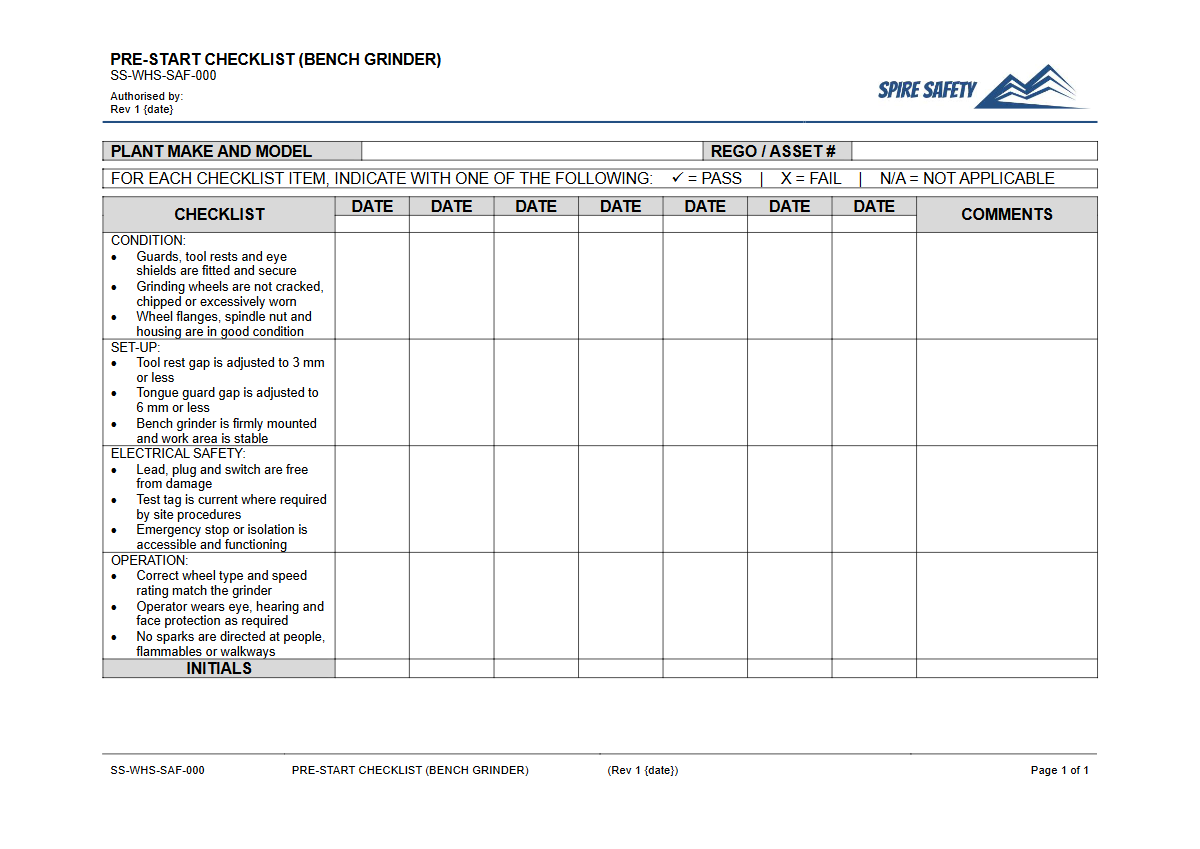
A bench grinder is a powerful tool found in many workshops, but its high-speed rotating abrasive wheels present significant risks, including wheel shatter, entanglement, and eye injuries from sparks and debris. This Free Pre-Start Checklist (Bench Grinder) Template provides a structured framework for operators to conduct consistent and thorough pre-operational inspections.
Formalising these checks helps identify potential hazards like cracked wheels, missing guards, or incorrectly adjusted tool rests before the equipment is used, preventing incidents and promoting a safer work environment. Using a checklist helps your organisation demonstrate a systematic approach to managing plant safety, aligning with the principles of Australian WHS legislation.
Integrating this checklist into your daily routine is a key part of equipment maintenance and operator responsibility. To further support this process, you can facilitate discussions with your team using our Pre-Start Checks and Plant Maintenance Toolbox Talk Template, reinforcing the importance of these inspections.
Video walkthrough
How to use the Free Pre-Start Checklist (Bench Grinder) Template
This document is a starting point designed for easy adoption. First, download the template in your preferred format (DOCX or PDF).
Next, and most importantly, you must review and customise the checklist to suit your specific operational context. This involves adding details specific to the make and model of your bench grinders, the types of materials being ground, and any unique environmental factors in your workshop.
The checklist should be a practical tool that reflects your actual risks.
Important: You must customise this template to your workplace. We cannot know the unique models of grinders you use, the materials being worked on, or the specific environmental risks of your site.
This document must be adapted to reflect those factors. Once customised, train all operators on how to properly complete the checklist and what actions to take if a fault is identified (e.g., tag out the equipment and notify a supervisor).
A pre-start checklist is just one part of a safe system of work. For high-risk tasks involving similar equipment, a more detailed risk assessment is often required.
You can use our Free Angle Grinder SWMS as a reference for developing comprehensive work method statements.
Key Inspection Points for a Bench Grinder Pre-Start Checklist
While your customised checklist will be specific, it should cover several critical areas to be effective. A thorough Pre-Start Checklist should prompt the operator to inspect the following components:
- Guarding: Check that the main wheel guards, adjustable tongue guards, and eye shields are in place, secure, and undamaged. The gap for the tongue guard should typically be no more than 6mm from the wheel.
- Tool Rests: Ensure tool rests are secure and adjusted correctly. The gap between the rest and the grinding wheel should be kept as small as possible, generally no more than 3mm, to prevent the workpiece from being jammed.
- Grinding Wheels: Visually inspect the abrasive wheels for any cracks, chips, or signs of damage. A 'ring test' should be performed on any new wheel before it is mounted to check for internal cracks that may not be visible.
- Mounting: Confirm the grinder is securely bolted to the bench or stand and does not vibrate excessively during operation.
- Controls: Test that the on/off switch and any emergency stop functions are working correctly and are easily accessible.
Regularly discussing these inspection points and other common hazards is crucial for maintaining safety awareness. Our Angle Grinder Safety Toolbox Talk provides a useful framework for these conversations, covering many principles applicable to bench grinders.
When to use this Pre-Start Checklist
The Pre-Start Checklist should be completed before the bench grinder is used for the first time each day or at the beginning of each shift. This routine ensures that the equipment's condition is verified before any work commences.
Additionally, a check should be performed after a grinding wheel has been replaced, following any maintenance or repair work, or if an operator suspects a fault may have developed during use. Consistent use demonstrates due diligence and helps create a culture where safety checks are a non-negotiable part of the job.
The principles of pre-start checks apply to a wide range of workshop equipment. Verifying worker skill is also critical, which can be formalised using tools like our Verification of Competency (Die Grinder) Template for similar high-speed tools.
Who should use it
The primary person responsible for completing the Pre-Start Checklist is the authorised operator of the bench grinder. This empowers workers to take ownership of their safety and the condition of their tools.
Supervisors and managers should periodically review the completed checklists to ensure they are being filled out correctly and to identify any recurring faults or maintenance trends that require attention. This data can provide valuable insights into equipment health and help inform purchasing decisions or adjustments to your maintenance schedule.
Ensuring operators are not only trained but also competent is a core WHS duty. For related equipment, you can formalise this with a document like our free Angle Grinder VOC template to verify a worker's skills and knowledge.
Ultimately, these checklists and procedures form part of your overall safety framework. Implementing and maintaining these documents are key components of effective WHS management systems, helping to systematically reduce risk across all operations.
Fulfilling the duty of care as a Person Conducting a Business or Undertaking (PCBU) can be complex. If you need assistance developing or reviewing your safety procedures for plant and equipment, consider engaging professional WHS consulting to ensure your systems are robust and practical for your business.
Common mistakes
Common mistakes to avoid
- Using the grinder without the tongue guard or eye shields in place.
- Allowing the gap between the tool rest and the wheel to become too large (over 3mm).
- Applying pressure to the side of a standard grinding wheel, which it is not designed for and can cause it to break.
- Failing to perform a 'ring test' on a new wheel before mounting it, thereby missing potential internal cracks.
Legal references
Legal considerations
The following legal requirements may be relevant to this type of work.
- Work Health and Safety Act (Harmonised) — Provides the primary duties for protecting workers and other people from work health and safety risks.
- Work Health and Safety Regulations (Harmonised) — Sets out requirements supporting the management of workplace hazards and risks.
The following codes may be relevant to this type of work.
- Managing WHS Risks Code of Practice — Provides practical guidance on identifying hazards, assessing risks and applying effective controls.
- Work Health and Safety Consultation, Cooperation and Coordination Code of Practice — Provides practical guidance on consulting workers and coordinating with other duty holders.
- Managing the Work Environment and Facilities Code of Practice — Provides practical guidance on safe work environments, workplace facilities and related controls.
Did you know
Speed Kills Wheels
One of the most dangerous mistakes is mounting a grinding wheel on a machine with a higher RPM than the wheel's maximum speed rating. This can cause the wheel to shatter violently during operation.
Gap Management
The small gap between the tool rest and the grinding wheel is a critical safety feature. If the gap is too wide, the workpiece can be pulled into the gap and jam, potentially shattering the wheel or causing a serious hand injury.
FAQ
Frequently asked questions
01What should be checked on a bench grinder before use?
02How often should a bench grinder pre-start check be done?
03Is a pre-start checklist a legal requirement for bench grinders in Australia?
04What is a 'ring test' for a grinding wheel?
Share this resource
Free Pre-Start Checklist (Bench Grinder) Template
Browse Categories
How To Use It
- 1Download and open in Word or PDF.
- 2Replace the placeholders with your business details.
- 3Get it reviewed by a WHS specialist before rollout.
Need it customised?
Our WHS consultants can adapt this template to your site, run a gap analysis, or audit what you already have in place.
Book a Free Consultation WHS consulting servicesor call 1300 156 382