
Free Pre-Start Checklist (Bio Cabinet) Template
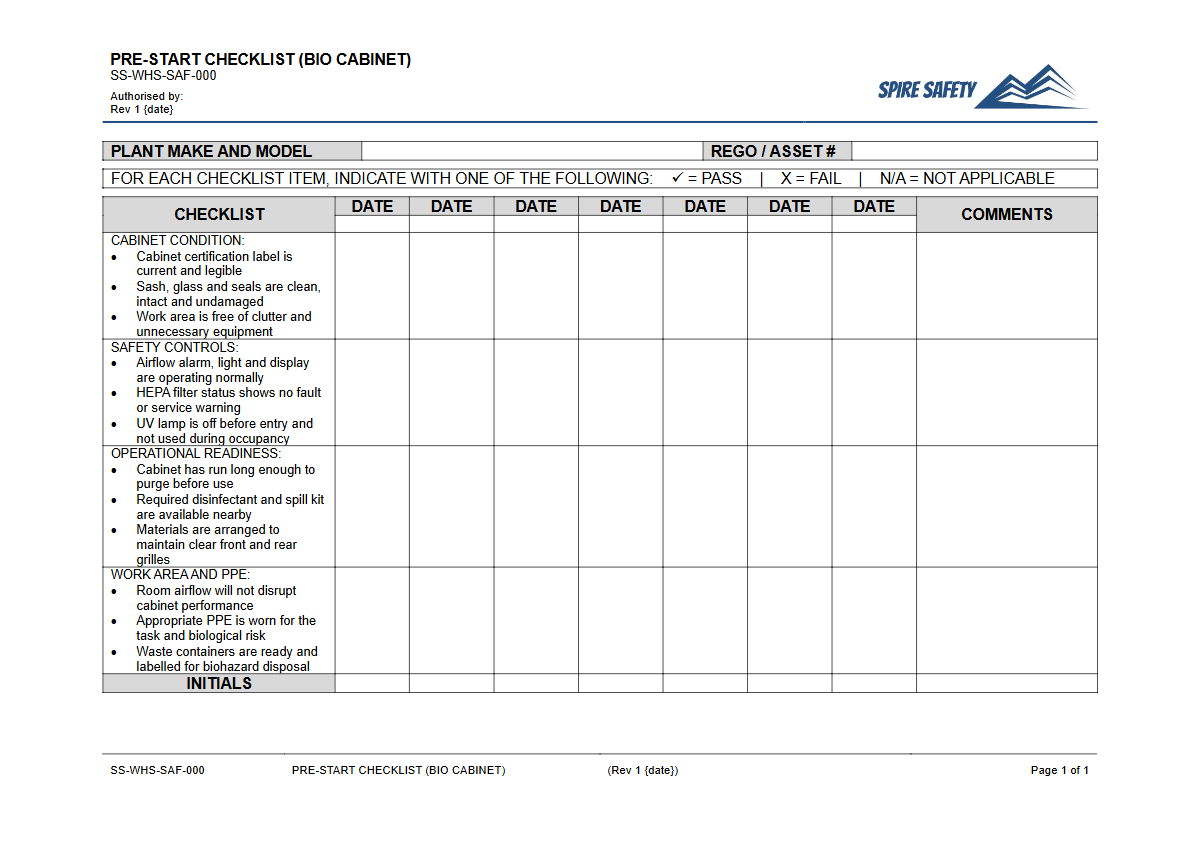
Download our free Pre-Start Checklist (Bio Cabinet) Template. This structured Word & PDF resource helps formalise safety checks for Australian labs.
Free Pre-Start Checklist (Bio Cabinet) Template
DOCX • 125 KB + PDF
Updated Oct 2026
No signup required
Purpose of the Free Pre-Start Checklist (Bio Cabinet) Template
A biological safety cabinet (BSC) is a critical piece of equipment for protecting personnel, the work product, and the environment from biohazardous materials. This Free Pre-Start Checklist (Bio Cabinet) Template provides a structured framework for operators to verify the cabinet is functioning correctly and safely before commencing any work.
Systematically performing these checks helps minimise exposure risks, prevent sample contamination, and ensure the equipment operates according to its design specifications.
Using a documented checklist formalises a crucial safety step, turning an assumed task into a verifiable action. It helps embed a consistent safety-first approach within your laboratory's daily operations and forms a key part of a facility's overall biosafety program.
Consistent checks can also aid in early detection of maintenance issues, preventing costly downtime and ensuring the longevity of the equipment.
Video walkthrough
How to use the Free Pre-Start Checklist (Bio Cabinet) Template
This template is designed as a starting point to be adapted to your specific operational needs. Download the DOCX or PDF file and begin by reviewing the listed checks against your specific biological safety cabinet's make and model.
You should add, remove, or modify checks to align with the manufacturer's operating manual and your site-specific risk assessments.
Integrate the customised checklist into your standard operating procedures (SOPs). Train all relevant personnel, including laboratory technicians and researchers, on its correct use.
The checklist should be completed before each use or at the beginning of each shift where the cabinet will be used. Completed checklists should be stored as a record of due diligence, which can be invaluable during safety reviews and regular WHS compliance audits.
Important: This document is a template only. We have provided a structured starting point, but you must customise this Pre-Start Checklist to suit the specific models of biological safety cabinets, laboratory protocols, and risk profile of your workplace.
It is not a substitute for manufacturer's instructions, formal training, or a comprehensive risk assessment.
When to use a Biological Safety Cabinet Pre-Start Checklist
A pre-start check should be conducted at the beginning of any work session involving a biological safety cabinet. This means completing the checklist before introducing any samples, materials, or equipment into the work area.
This ensures that any potential issues, such as incorrect airflow, alarms, or physical damage, are identified before they can compromise the safety of the operator or the integrity of the experiment. Making this a non-negotiable first step is fundamental to safe laboratory practice.
This routine is a core component of many robust WHS management systems, ensuring safety protocols are actively followed rather than passively assumed. Regular reinforcement of these checks helps build a proactive safety culture within the team.
Who should use this checklist
This Pre-Start Checklist should be used by any individual trained and authorised to operate a biological safety cabinet. This primarily includes laboratory technicians, research scientists, microbiologists, and clinical diagnosticians.
Supervisors and lab managers are responsible for ensuring these checks are consistently performed and for reviewing the completed records periodically. WHS personnel can also use the checklist as a tool for auditing compliance with established safety procedures.
The principles of verifying equipment before use are universal in workplace safety. We provide a Pre-Start Checks and Plant Maintenance Toolbox Talk that can help reinforce these concepts across your entire organisation, not just in the laboratory.
While this document focuses on laboratory equipment, the discipline of pre-start checks applies to a vast range of machinery. The same core principles of checking guards, controls, and operational readiness are found in checklists for completely different environments, such as our Pre-Start Checklist (Agitator) Template for industrial mixers.
This document is just one example of the many practical tools available in our free WHS resources library, designed to help Australian businesses improve their safety management systems.
Common mistakes
Common mistakes to avoid
- Working with the sash at the incorrect height, which disrupts the protective air curtain.
- Overloading the cabinet with equipment, which blocks airflow and creates turbulence.
- Failing to allow sufficient 'purge' time for the cabinet to clear contaminants before and after use.
- Making rapid movements in and out of the cabinet, which can compromise the air barrier.
Legal references
Legal considerations
The following legal requirements may be relevant to this type of work.
- Work Health and Safety Act (Harmonised) — Provides the primary duties for protecting workers and other people from work health and safety risks.
- Work Health and Safety Regulations (Harmonised) — Sets out requirements supporting the management of workplace hazards and risks.
The following codes may be relevant to this type of work.
- Managing WHS Risks Code of Practice — Provides practical guidance on identifying hazards, assessing risks and applying effective controls.
- Work Health and Safety Consultation, Cooperation and Coordination Code of Practice — Provides practical guidance on consulting workers and coordinating with other duty holders.
- Managing the Work Environment and Facilities Code of Practice — Provides practical guidance on safe work environments, workplace facilities and related controls.
Did you know
HEPA Filter Efficiency
The HEPA filters used in biological safety cabinets are incredibly efficient, capturing at least 99.97% of airborne particles 0.3 micrometres in diameter. This high level of filtration is what provides protection against microbiological agents.
Invisible Barrier
The primary form of operator protection in a Class II BSC is not a physical shield, but a precisely controlled curtain of air at the front opening. This air barrier prevents contaminated air from inside the cabinet from escaping into the lab.
FAQ
Frequently asked questions
01What is the difference between a Class I, II, and III biological safety cabinet?
02How often does a biological safety cabinet need to be certified?
03Why is the sash height critical on a biological safety cabinet?
04Can I use this template for a fume hood or laminar flow cabinet?
Share this resource
Free Pre-Start Checklist (Bio Cabinet) Template
Browse Categories
How To Use It
- 1Download and open in Word or PDF.
- 2Replace the placeholders with your business details.
- 3Get it reviewed by a WHS specialist before rollout.
Need it customised?
Our WHS consultants can adapt this template to your site, run a gap analysis, or audit what you already have in place.
Book a Free Consultation WHS consulting servicesor call 1300 156 382