
Free Pre-Start Checklist (Blender) Template
Download our free Pre-Start Checklist (Blender) Template. A structured DOCX & PDF to formalise daily safety inspections in Australian kitchens and labs.
Free Pre-Start Checklist (Blender) Template
DOCX • 125 KB + PDF
Updated Oct 2026
No signup required
Purpose of the Free Pre-Start Checklist (Blender) Template
Commercial blenders, whether used in kitchens, laboratories, or manufacturing, possess significant hazards including high-speed rotating blades, powerful motors, and electrical components. A failure in any of these areas can lead to serious injuries such as lacerations, amputations, or electric shock.
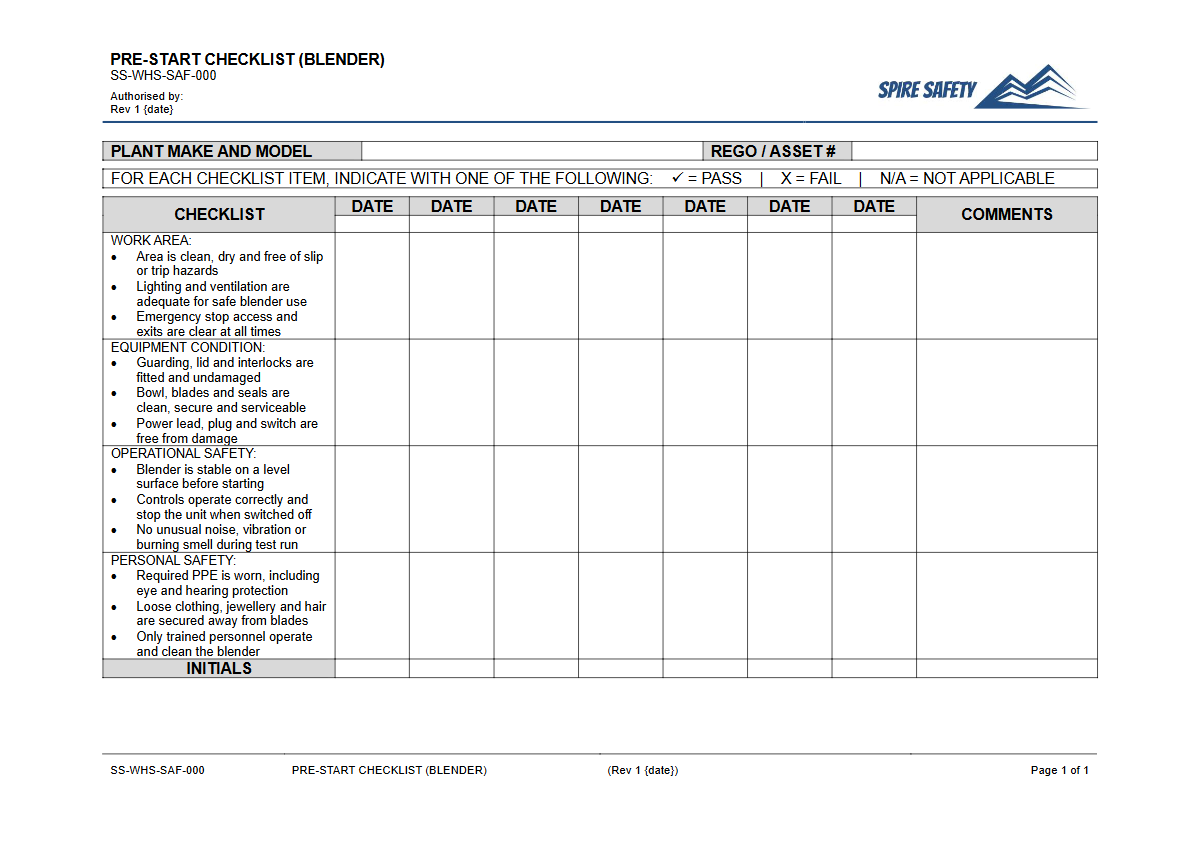
This Free Pre-Start Checklist (Blender) Template provides a structured method for operators to systematically inspect the equipment for potential faults and damage before they begin work. By formalising this process, you create a consistent safety habit and a verifiable record of due diligence.
The checklist prompts the user to examine critical safety components, including the integrity of the jug, the sharpness and security of the blades, the condition of electrical cords and plugs, the functionality of safety interlocks, and overall cleanliness. Integrating this check helps prevent accidents caused by equipment malfunction and promotes a proactive safety culture within the organisation. The principles of proactive inspection are vital for all equipment, a topic covered in our Pre-Start Checks and Plant Maintenance Toolbox Talk.
Video walkthrough
How to use the Free Pre-Start Checklist (Blender) Template
This downloadable document serves as a comprehensive starting point aligned with Australian WHS standards. It is available in DOCX format for easy editing and as a PDF for immediate printing and use.
Note: This template must be customised to your workplace. We are not familiar with your specific blender models, operational procedures, or unique environmental risks. It is your responsibility to adapt this document by adding, removing, or modifying checklist items to ensure it is fully relevant to your site.
A generic checklist that doesn't match your equipment is ineffective and may create a false sense of security.
Steps for effective implementation:
- Download the DOCX version of the template.
- Consult with the workers who operate the blenders to get their input on common issues and practical checks.
- Review the manufacturer's operating manual for your specific blender model(s) and incorporate any recommended safety and maintenance checks.
- Modify the checklist to reflect your equipment and the environment it's used in (e.g., wet areas, food preparation zones).
- Train all operators on how to use the finalised checklist correctly and what to do if they identify a fault (e.g., stop work, tag out the equipment, report to a supervisor).
Formalising procedures like this is a cornerstone of effective safety management. These documents form an important part of broader WHS management systems, helping to standardise safe work practices across your team.
When to use it
The pre-start checklist should be completed by the operator before the first use of the blender on any given shift. For equipment that is used intermittently throughout the day, a single check at the start of the shift is generally sufficient, unless the blender has been moved, cleaned, or serviced.
It should also be used after any maintenance or repair work to verify it has been returned to a safe operational state. This quick but critical process is similar to the checks required for other industrial mixing equipment, as detailed in resources like our Free Pre-Start Checklist (Agitator) Template.
Who should use it
This checklist is designed for direct use by trained and competent personnel who operate commercial blenders as part of their duties. This may include chefs, kitchen hands, bartenders, laboratory technicians, or food production workers.
It is crucial that these individuals are not only given the checklist but are also trained on its importance and how to conduct each check properly.
Supervisors and managers should periodically review completed checklists to ensure they are being filled out correctly and to identify recurring equipment faults that may signal a need for replacement or enhanced maintenance. These records can be valuable evidence during a WHS compliance audit to demonstrate that safety procedures are being consistently implemented.
Beyond the direct operation of the plant, workplaces must consider related hazards. For instance, lifting heavy blender bases or large, full jugs introduces manual handling risks.
The principles of safe lifting are universal, and while our Aged Care Manual Handling Toolbox Talk is industry-specific, the core concepts of assessing loads and using safe techniques apply in any setting. For a wider range of safety documents, you can browse our complete free WHS resources library.
Common mistakes
Common mistakes to avoid
- Using the generic template without customising it for the specific blender model in use.
- Operators 'pencil-whipping' the form without physically performing each check.
- Failing to implement a clear 'tag out' and reporting procedure for faulty equipment.
- Neglecting to train staff on how to use the checklist and why it is important.
Legal references
Legal considerations
The following legal requirements may be relevant to this type of work.
- Work Health and Safety Act (Harmonised) — Provides the primary duties for protecting workers and other people from work health and safety risks.
- Work Health and Safety Regulations (Harmonised) — Sets out requirements supporting the management of workplace hazards and risks.
The following codes may be relevant to this type of work.
- Managing WHS Risks Code of Practice — Provides practical guidance on identifying hazards, assessing risks and applying effective controls.
- Work Health and Safety Consultation, Cooperation and Coordination Code of Practice — Provides practical guidance on consulting workers and coordinating with other duty holders.
- Managing the Work Environment and Facilities Code of Practice — Provides practical guidance on safe work environments, workplace facilities and related controls.
Did you know
Cleaning Hazards
A significant portion of injuries involving blenders occur not during operation, but during cleaning, when operators may come into direct contact with blades while the unit is not properly de-energised.
Interlock Systems
Many commercial blenders feature safety interlocks that prevent the motor from running if the lid or jug is not properly in place. Regularly checking these interlocks is one of the most critical steps in a pre-start inspection.
FAQ
Frequently asked questions
01What is the difference between a pre-start checklist and a Safe Work Method Statement (SWMS)?
02Does this checklist cover all types of commercial blenders?
03How often should a blender pre-start check be conducted?
04Who is responsible for ensuring pre-start checks are completed?
Share this resource
Free Pre-Start Checklist (Blender) Template
Browse Categories
How To Use It
- 1Download and open in Word or PDF.
- 2Replace the placeholders with your business details.
- 3Get it reviewed by a WHS specialist before rollout.
Need it customised?
Our WHS consultants can adapt this template to your site, run a gap analysis, or audit what you already have in place.
Book a Free Consultation WHS consulting servicesor call 1300 156 382