
Free Pre-Start Checklist (Boiler) Template
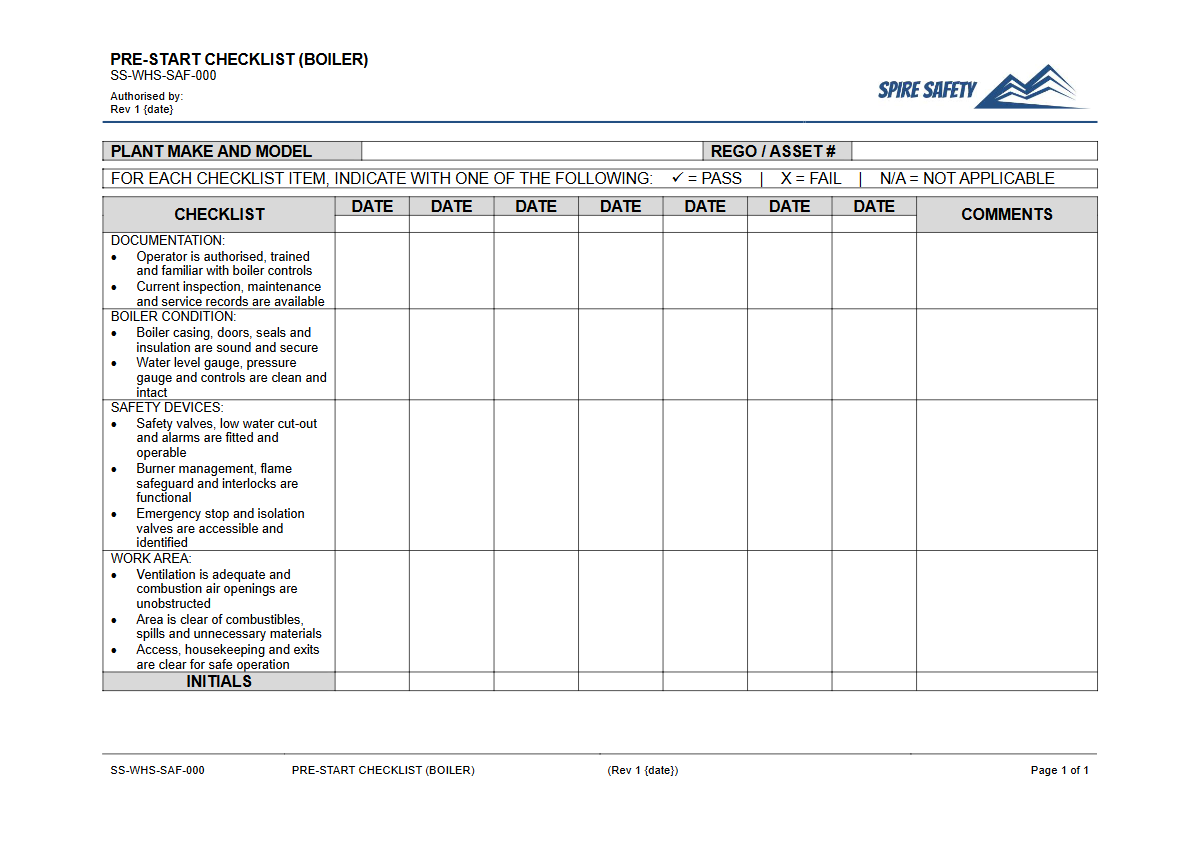
Download our free Pre-Start Checklist (Boiler) Template (DOCX & PDF). This structured starting point helps formalise daily safety checks. Download now.
Free Pre-Start Checklist (Boiler) Template
DOCX • 125 KB + PDF
Updated Oct 2026
No signup required
Purpose of the Free Pre-Start Checklist (Boiler) Template
Operating a boiler involves managing significant risks, including extreme pressure, high temperatures, and the potential for scalding or explosion. A systematic pre-start inspection is a fundamental safety control measure.
This Free Pre-Start Checklist (Boiler) Template provides a structured format for operators to verify that the equipment is safe to use before every shift. It formalises the process of checking critical components like pressure gauges, water levels, safety valves, and control systems, helping to identify potential faults before they escalate into dangerous situations.
Regular use promotes a consistent safety routine, reduces the risk of equipment failure, and helps your organisation meet its duty of care under Australian WHS laws.
Video walkthrough
How to use the Free Pre-Start Checklist (Boiler) Template
This template is designed as a comprehensive starting point. To implement it effectively, follow these steps:
- Download: Save the template in your preferred format (DOCX for easy editing or PDF).
- Customise: This is the most critical step. You must adapt the checklist to the specific make, model, and configuration of the boiler(s) in your workplace. Review the manufacturer’s operating manual and incorporate all specified daily checks. Add or remove items to ensure the checklist is relevant and thorough for your operational context.
- Train: Ensure all licensed operators are trained on how to use the customised checklist correctly. They must understand what each check involves and the required actions if a fault is found.
- Implement: Integrate the checklist into your daily start-up procedures. Make it a non-negotiable step before any boiler is fired up.
Important Note: We have developed this template as a guide based on common WHS practice. It is not a complete, out-of-the-box solution.
You must customise this document to address the specific hazards and control measures relevant to your equipment and workplace. Proper implementation of this checklist should be part of your broader WHS management systems.
When to use it
The boiler pre-start checklist should be completed before the boiler is operated at the beginning of each shift or after any period of shutdown. If operation is continuous, checks should still occur at scheduled intervals (e.g., every 24 hours) as defined by your internal procedures.
Consistency is key to identifying changes in equipment condition over time.
Who should use it
This checklist should be used by personnel who are trained, competent, and hold the appropriate High Risk Work Licence for the class of boiler they are operating. This typically includes:
- Licensed Boiler Operators: The primary users responsible for the safe start-up and operation of the boiler.
- Maintenance Personnel: May use the checklist as part of diagnostic or post-maintenance verification procedures.
- Supervisors: Responsible for ensuring operators are completing checks correctly and for reviewing completed checklists to identify recurring issues.
Verifying competency is crucial not just for boiler operation but for associated tasks. For example, a Verification of Competency (Pipe Threader) Template can be used to formalise assessments for maintenance staff working on connected pipe systems.
Reinforcing Safety Behaviours
A checklist is only effective if the operator is engaged and understands its importance. Regular training and safety discussions can reinforce the life-saving purpose behind each check.
An effective Pre-Start Checks and Plant Maintenance Toolbox Talk can be a great way to reinforce these procedures and discuss any recent findings or concerns with the team.
Auditing and Review
Completed checklists form a valuable record of your plant's condition and your organisation's safety diligence. These records should be periodically reviewed by supervisors or safety managers to spot trends, such as frequently recurring minor faults that may indicate a larger underlying problem.
Incorporating a review of these documents into your regular WHS compliance auditing helps verify that safety procedures are being followed correctly in practice.
Integrating with Other Plant Safety Procedures
The safety principles for pre-start inspections are universal across most types of workplace plant and equipment. The process of identifying hazards, checking controls, and documenting findings is a cornerstone of modern safety management. The structured approach used for boilers can be adapted for other machinery, and similar principles apply to other equipment, such as what's covered in our Free Pre-Start Checklist (Agitator) Template.
Common mistakes
Common mistakes to avoid
- Using a generic checklist that doesn't match the specific boiler model and its unique risks.
- Operators completing the checklist from memory without physically verifying each item.
- Failing to immediately report, document, and rectify identified faults before starting the boiler.
- Treating the checklist as a paperwork exercise rather than a critical safety function.
Legal references
Legal considerations
The following legal requirements may be relevant to this type of work.
- Work Health and Safety Act (Harmonised) — Provides the primary duties for protecting workers and other people from work health and safety risks.
- Work Health and Safety Regulations (Harmonised) — Sets out requirements supporting the management of workplace hazards and risks.
The following codes may be relevant to this type of work.
- Managing WHS Risks Code of Practice — Provides practical guidance on identifying hazards, assessing risks and applying effective controls.
- Work Health and Safety Consultation, Cooperation and Coordination Code of Practice — Provides practical guidance on consulting workers and coordinating with other duty holders.
- Managing the Work Environment and Facilities Code of Practice — Provides practical guidance on safe work environments, workplace facilities and related controls.
Did you know
Water Expansion
When water turns to steam at atmospheric pressure, it expands to over 1,600 times its original volume. This incredible expansion is what makes boilers powerful but also extremely hazardous if that pressure is not properly controlled.
Stored Energy
A medium-sized industrial boiler can contain the same amount of stored energy as several kilograms of TNT. A catastrophic failure can have devastating consequences for people and property.
FAQ
Frequently asked questions
01What is the main purpose of a boiler pre-start checklist?
02Who is qualified to operate a boiler in Australia?
03How often should a boiler be inspected?
04Can this template be used for any type of boiler?
Share this resource
Free Pre-Start Checklist (Boiler) Template
Browse Categories
How To Use It
- 1Download and open in Word or PDF.
- 2Replace the placeholders with your business details.
- 3Get it reviewed by a WHS specialist before rollout.
Need it customised?
Our WHS consultants can adapt this template to your site, run a gap analysis, or audit what you already have in place.
Book a Free Consultation WHS consulting servicesor call 1300 156 382