
Free Pre-Start Checklist (Boom Gate) Template
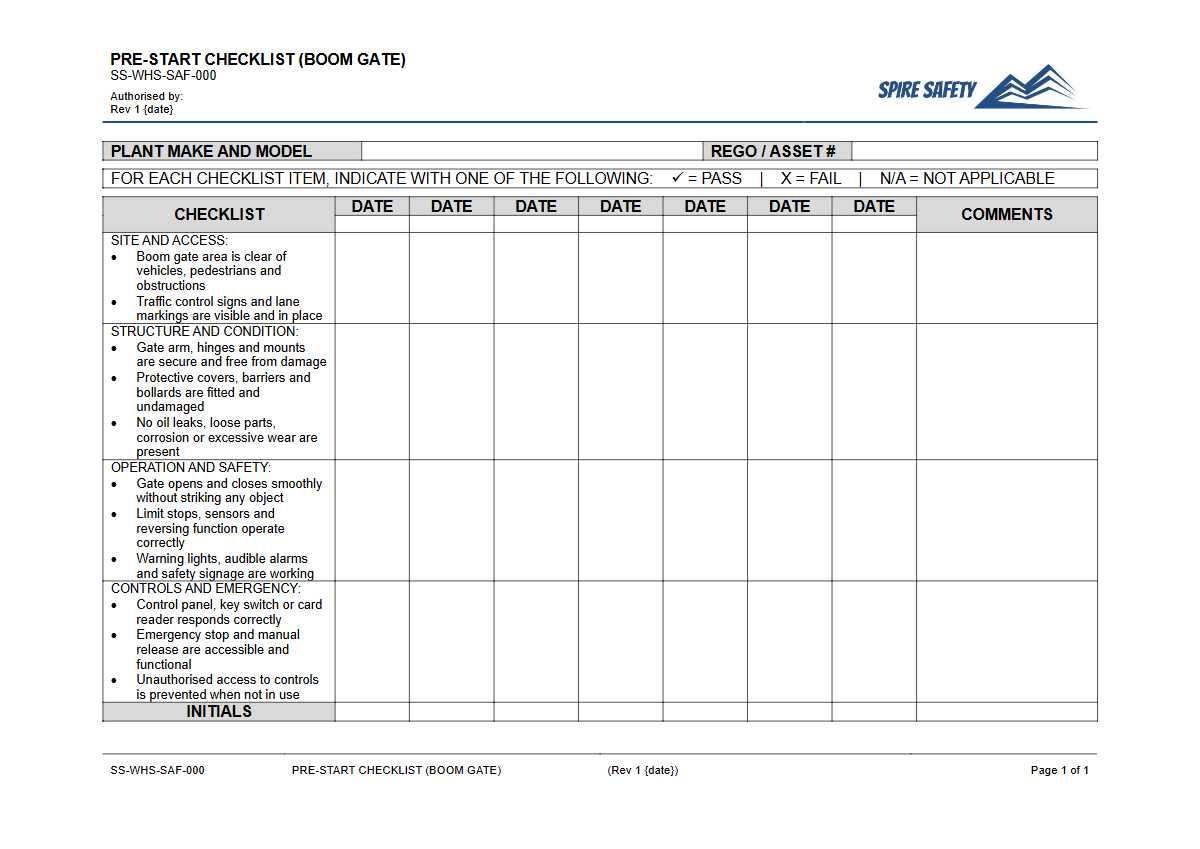
Download our free Pre-Start Checklist (Boom Gate) Template to help formalise daily safety inspections. This DOCX & PDF resource offers a solid starting point.
Free Pre-Start Checklist (Boom Gate) Template
DOCX • 125 KB + PDF
Updated Oct 2026
No signup required
Purpose of the Free Pre-Start Checklist (Boom Gate) Template
Boom gates are a critical component of traffic management and site security, controlling vehicle access to car parks, industrial sites, and restricted areas. Their reliable operation is essential for safety and efficiency.
A failure can lead to vehicle collisions, pedestrian injuries, property damage, or significant operational delays. This Free Pre-Start Checklist (Boom Gate) Template provides a structured format to guide operators through daily inspections, ensuring the equipment is safe and functional before it's used.
Implementing a routine check helps identify and address potential faults early, preventing them from escalating into serious incidents. It forms a key part of a proactive safety culture by formalising the inspection process, creating a verifiable record of due diligence, and reinforcing safe work habits. To further embed these practices, consider discussing equipment safety in your team meetings using a Pre-Start Checks and Plant Maintenance Toolbox Talk.
Video walkthrough
How to use the Free Pre-Start Checklist (Boom Gate) Template
This checklist is designed for simplicity and practical use on-site. Start by downloading the template in your preferred format, either DOCX for easy customisation or PDF for straightforward printing.
The next step is crucial for effective implementation.
IMPORTANT: This template provides a solid foundation, but it is not a complete, out-of-the-box solution. We have developed it as a starting point that you must adapt to the specific make, model, and operating environment of your boom gate(s), as well as your organisation's unique risk profile and procedures.
You should add or remove checks based on the manufacturer's recommendations and a site-specific risk assessment.
Once customised, integrate the checklist into your daily operational procedures. Ensure all relevant personnel are trained on how to use it correctly and understand the importance of each check.
This process should be a component of your broader WHS management systems, linking daily actions to overall safety objectives.
When to use a Boom Gate Pre-Start Checklist
A Pre-Start Checklist should be completed before the first operation of each shift or at the beginning of each workday. This frequency ensures that the gate's condition is verified before it is relied upon to manage vehicle and pedestrian traffic.
Additionally, a check should be performed after any maintenance work, repairs, or if a malfunction has been reported or suspected. This confirms that the equipment has been returned to a safe operational state. Defining this schedule is a key part of a safe system of work, similar to the procedures outlined in our Boom Pump SOP (Safe Operating Procedure) template.
Who should use it
The Pre-Start Checklist should be completed by personnel who are authorised and competent to operate the boom gate. This typically includes site security staff, facility managers, or designated equipment operators.
The person performing the check must be trained to recognise potential hazards, understand the gate's normal operating characteristics, and know the procedure for reporting faults or taking the equipment out of service. Supervisors should periodically review completed checklists to ensure they are being filled out correctly and that any reported issues are being addressed.
This oversight is often a focus of formal WHS compliance auditing to verify that safety procedures are being followed.
What to Inspect on a Boom Gate
While your specific checklist will vary, a comprehensive pre-start inspection generally covers several key areas. These checks ensure the mechanical, electrical, and safety systems are all functioning as intended. Key inspection points include:
- Physical Structure: Check the boom arm, housing, and foundation for any signs of damage, corrosion, or loose fittings.
- Signage and Lighting: Ensure all warning signs are legible and that any integrated lights (e.g., stop/go lights, flashing beacons) are working correctly.
- Safety Sensors: Test photocells, safety loops, or other presence-detection devices to confirm they stop or reverse the gate's motion when an obstruction is detected.
- Actuator and Motor: Listen for any unusual noises from the motor during operation and check for any fluid leaks from hydraulic systems.
- Manual Override: Verify that the manual release mechanism functions correctly, allowing the gate to be opened or closed during a power outage or emergency.
- Access Control System: Test the primary method of operation (e.g., card reader, remote control, keypad) to ensure it responds correctly.
For more templates and tools to support your safety processes, explore our complete free WHS resources library.
Common mistakes
Common mistakes to avoid
- "Pencil-whipping" the checklist without physically performing the inspections.
- Failing to customise the generic template for the specific boom gate model, features, and location.
- Ignoring or failing to report minor issues like slow operation or unusual noises, which can precede a major failure.
- Not training operators on how to properly conduct the checks and what to do if a fault is found.
Legal references
Legal considerations
The following legal requirements may be relevant to this type of work.
- Work Health and Safety Act (Harmonised) — Provides the primary duties for protecting workers and other people from work health and safety risks.
- Work Health and Safety Regulations (Harmonised) — Sets out requirements supporting the management of workplace hazards and risks.
The following codes may be relevant to this type of work.
- Managing WHS Risks Code of Practice — Provides practical guidance on identifying hazards, assessing risks and applying effective controls.
- Work Health and Safety Consultation, Cooperation and Coordination Code of Practice — Provides practical guidance on consulting workers and coordinating with other duty holders.
- Managing the Work Environment and Facilities Code of Practice — Provides practical guidance on safe work environments, workplace facilities and related controls.
Did you know
Fail-Safe vs. Fail-Secure
Many modern boom gates are designed with 'fail-safe' or 'fail-secure' mechanisms. A fail-safe gate will automatically open during a power failure to allow exit, while a fail-secure gate remains locked to maintain security.
Induction Loops
Many boom gate systems use in-ground induction loops as a primary safety and operational feature. These loops of wire detect the metal mass of a vehicle, preventing the gate from closing on it and enabling free-exit functions.
FAQ
Frequently asked questions
01Why is a documented pre-start check for a boom gate important?
02How often should our boom gate pre-start checklist be reviewed and updated?
03What is the difference between a pre-start check and regular maintenance?
04Can this template be used for all types of automated gates?
Share this resource
Free Pre-Start Checklist (Boom Gate) Template
Browse Categories
How To Use It
- 1Download and open in Word or PDF.
- 2Replace the placeholders with your business details.
- 3Get it reviewed by a WHS specialist before rollout.
Need it customised?
Our WHS consultants can adapt this template to your site, run a gap analysis, or audit what you already have in place.
Book a Free Consultation WHS consulting servicesor call 1300 156 382