
Free Pre-Start Checklist (Boom Lift) Template
Formalise your daily equipment inspections with our Free Pre-Start Checklist (Boom Lift) Template. This structured starting point helps manage WHS risks.
Free Pre-Start Checklist (Boom Lift) Template
DOCX • 125 KB + PDF
Updated Oct 2026
No signup required
Purpose of the Free Pre-Start Checklist (Boom Lift) Template
Operating a boom lift, a type of mobile elevating work platform (EWP), involves significant safety risks if the equipment is faulty or improperly used. This Free Pre-Start Checklist (Boom Lift) Template provides a structured framework for operators to conduct thorough, consistent inspections before each use.
Implementing a pre-start check helps identify potential defects, mechanical issues, or damage that could lead to equipment failure, property damage, or serious injury. By formalising this process, you create a verifiable record of due diligence, demonstrating a commitment to proactive risk management and meeting your duties under Australian WHS laws.
A pre-start check is a fundamental control measure for ensuring the safe operation of high-risk plant.
Regular inspections are a cornerstone of workplace safety for all types of heavy equipment. For example, similar rigorous checks are needed for forestry equipment, as detailed in our forwarder pre-start checklist. The goal is to catch small problems before they become catastrophic failures, protecting both the operator and others in the vicinity.
This checklist serves as an essential tool to guide that inspection process effectively.
Video walkthrough
How to use the Free Pre-Start Checklist (Boom Lift) Template
This template is designed as a robust starting point. First, download the document in your preferred format (DOCX for easy editing or PDF).
The next critical step is customisation. Different boom lift models have unique features, controls, and potential failure points.
You must adapt the checklist to reflect the specific make and model used in your workplace, as well as the unique environmental conditions and tasks it will be used for. We recommend reviewing the manufacturer's operating manual to ensure all key inspection points are included.
Once customised, integrate the checklist into your daily operational procedures. Train all authorised operators on how to use the checklist correctly, emphasising that it is not a tick-and-flick exercise.
Each item requires a physical and visual check. Completed checklists should be reviewed by a supervisor and filed as part of your safety documentation.
This process should be a formal component of your organisation's overarching WHS management system to ensure consistency and accountability.
Essential Checks Covered in the Template
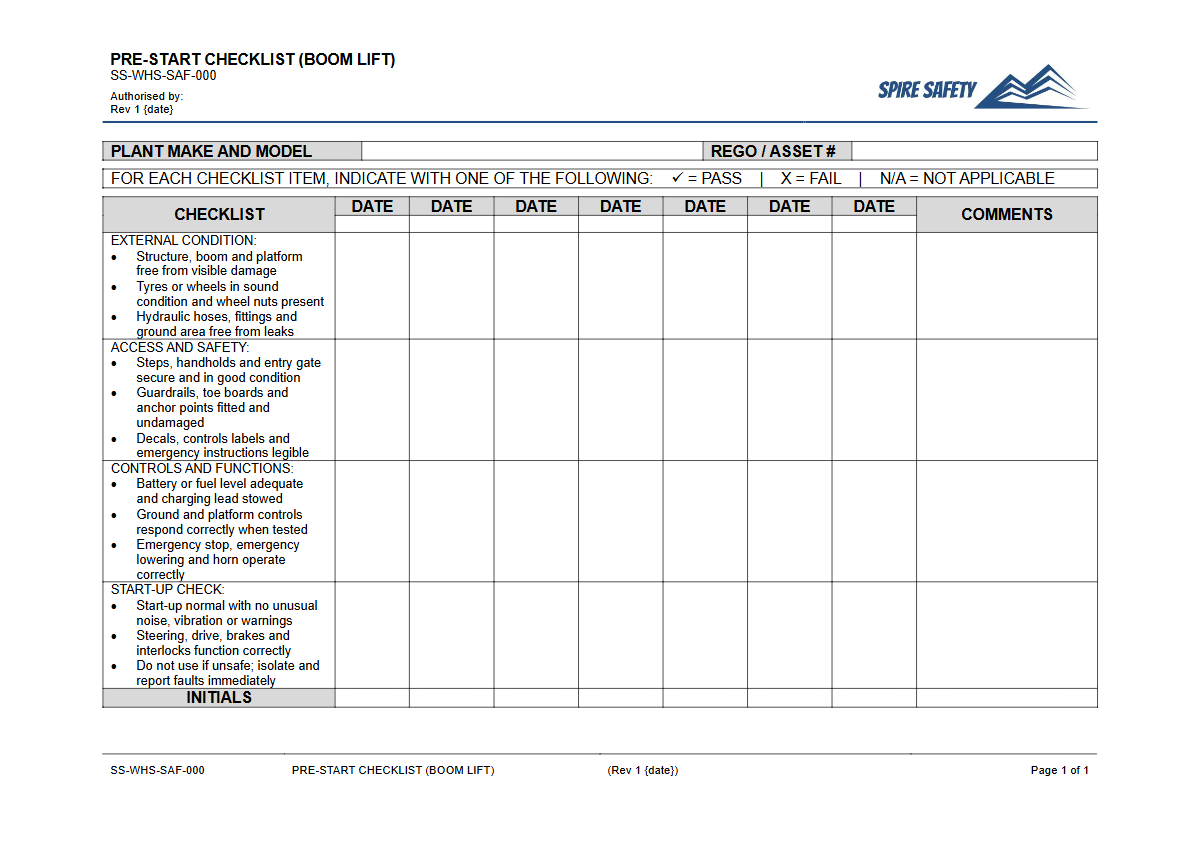
Our boom lift pre-start checklist is organised to cover all critical areas of the machine before operation. It prompts the user to inspect several key domains:
- Structural Components: Checking for cracks, dents, rust, or damage to the chassis, boom sections, basket, and welds.
- Fluid Levels: Ensuring engine oil, hydraulic fluid, fuel, and coolant are at their recommended levels.
- Tyres and Wheels: Inspecting for correct inflation, excessive wear, cuts, and security of wheel nuts.
- Operator Controls: Testing both ground and platform controls for proper function, including steering, driving, and boom movement.
- Safety Devices: Verifying that emergency stops, alarms, lights, horns, and harnesses/lanyards are present and functional.
- Work Area Assessment: Checking for ground stability, overhead obstructions like power lines, and general site hazards before commencing work.
These records are vital for demonstrating procedural safety, especially if their effectiveness is ever reviewed during a WHS compliance audit.
When to use it
The pre-start checklist for a boom lift must be completed before the start of every work shift or before the equipment is used for the first time on any given day. If multiple operators use the same machine during a single shift, a handover process should include a review of the initial checklist and a supplementary inspection to ensure its condition has not changed.
The checklist should also be used after any incident, repair, or if there is reason to believe the equipment's condition may have been compromised.
The principle of pre-use inspection is universal across various industries and equipment types. For example, the checks for a patient hoist in a healthcare setting are equally critical, albeit for a different set of risks and components.
Consistency is the key to an effective inspection program.
Who should use it
This pre-start checklist should be completed by a person who is competent to operate the boom lift. This means they must have received the necessary training, instruction, and information, and hold the relevant high-risk work licence (WP class) if required.
Supervisors and safety managers are responsible for ensuring these checks are being performed correctly and consistently. They should periodically review completed checklists to identify recurring faults or patterns of operator behaviour that may require intervention.
The responsibility for safety is shared across a worksite, and formal checks help standardise procedures for everyone. This applies to all equipment, including other tools on a construction site, which is why a specific floor saw pre-start checklist is also beneficial.
By empowering operators with the right tools, you foster a stronger safety culture. For more templates and safety guides, you can explore our complete free WHS resources library.
Common mistakes
Common mistakes to avoid
- Using a generic checklist without customising it for the specific boom lift model.
- "Pencil-whipping" the checklist without physically inspecting each item.
- Failing to immediately tag out and report faulty or damaged equipment.
- Neglecting to check the surrounding work area for ground stability and overhead hazards like power lines.
Legal references
Legal considerations
The following legal requirements may be relevant to this type of work.
- Work Health and Safety Act (Harmonised) — Provides the primary duties for protecting workers and other people from work health and safety risks.
- Work Health and Safety Regulations (Harmonised) — Sets out requirements supporting the management of workplace hazards and risks.
The following codes may be relevant to this type of work.
- Managing WHS Risks Code of Practice — Provides practical guidance on identifying hazards, assessing risks and applying effective controls.
- Work Health and Safety Consultation, Cooperation and Coordination Code of Practice — Provides practical guidance on consulting workers and coordinating with other duty holders.
- Managing the Work Environment and Facilities Code of Practice — Provides practical guidance on safe work environments, workplace facilities and related controls.
Did you know
EWP Incidents
A significant portion of incidents involving Elevating Work Platforms (EWPs) are attributed to mechanical failure or lack of maintenance — issues often detectable during a thorough pre-start inspection.
High-Risk Work Licence
In Australia, operating a boom lift with a boom length of 11 metres or more requires the operator to hold a specific high-risk work licence (class WP).
FAQ
Frequently asked questions
01What should happen if a fault is found during a boom lift pre-start check?
02How often should a boom lift pre-start checklist be completed?
03Is a generic checklist enough for a boom lift?
04Who is responsible for ensuring boom lift pre-start checks are done?
Share this resource
Free Pre-Start Checklist (Boom Lift) Template
Browse Categories
How To Use It
- 1Download and open in Word or PDF.
- 2Replace the placeholders with your business details.
- 3Get it reviewed by a WHS specialist before rollout.
Need it customised?
Our WHS consultants can adapt this template to your site, run a gap analysis, or audit what you already have in place.
Book a Free Consultation WHS consulting servicesor call 1300 156 382