
Free Pre-Start Checklist (Box Trailer) Template
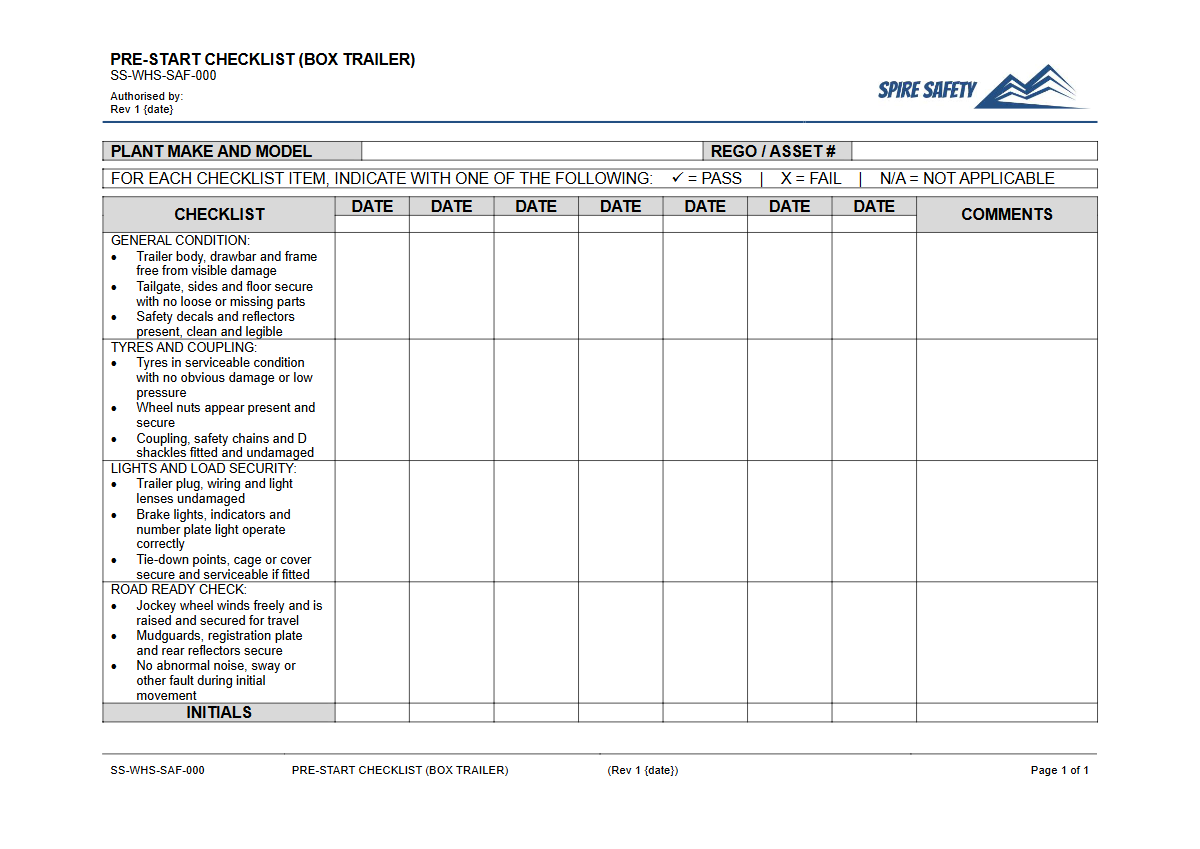
Download our free Pre-Start Checklist (Box Trailer) Template. This structured DOCX & PDF document helps formalise daily equipment checks. Get yours now.
Free Pre-Start Checklist (Box Trailer) Template
DOCX • 125 KB + PDF
Updated Oct 2026
No signup required
Purpose of the Free Pre-Start Checklist (Box Trailer) Template
Using a simple box trailer carries significant safety responsibilities. Our Free Pre-Start Checklist (Box Trailer) Template provides a structured starting point for organisations to formalise their equipment inspection process.
Regular pre-start checks are a fundamental aspect of proactive risk management, helping to identify mechanical faults, structural damage, or other hazards before the trailer is used on public roads or at a worksite. By documenting checks on critical components like tyres, couplings, lights, brakes (if fitted), and the chassis, you create a verifiable record of due diligence.
Implementing this checklist helps a Person Conducting a Business or Undertaking (PCBU) meet their primary duty of care under Australian WHS laws. It ensures that equipment provided for work is inspected and maintained in safe working order.
This documented process forms a vital part of broader WHS management systems, demonstrating a clear commitment to worker safety and operational integrity.
Video walkthrough
How to use the Free Pre-Start Checklist (Box Trailer) Template
This resource is available for immediate download in both DOCX and PDF formats. The DOCX file is fully editable, allowing you to tailor it to your specific operational needs.
The PDF is ideal for printing and immediate use. It is crucial to adapt this template to cover the unique features and risks associated with the trailers in your fleet.
Please note: We've designed this template as a starting point. You must customise it to reflect the specific types of box trailers used in your workplace, your operational risks, and your internal procedures. For example, you may need to add items for trailers with hydraulic tipping functions, which would be covered in a document like our Free Pre-Start Checklist (Dump Trailer) Template.
Customisation Suggestions:
- Add your company logo and business details.
- Modify check items to suit specific trailer models (e.g., single axle vs. tandem axle, caged vs. open).
- Include fields for trailer registration or asset numbers for clear identification.
- Define the escalation procedure for reporting faults or 'Not Fit for Use' conditions.
When to use it
A pre-start checklist for a box trailer should be completed before its first use on any given day or at the beginning of each work shift. This frequency ensures that any damage or wear that occurred during its last use or while parked is identified before it becomes a hazard on the road.
It is particularly important for trailers used by multiple operators or as part of a hire fleet, where the condition can change rapidly.
Consistently completing and archiving these checklists creates a historical record of the trailer's condition over time. This audit trail is an invaluable source of information for maintenance planning, incident investigations, and demonstrating procedural compliance during WHS compliance audits.
Who should use it
The checklist should be completed by the competent person assigned to operate the vehicle and tow the trailer. This is typically the driver or plant operator.
They are in the best position to conduct a thorough physical and visual inspection before connecting the trailer and commencing work. It is essential that these workers receive adequate information, training, and instruction on how to correctly perform each check and what to do if they identify a defect.
Supervisors and managers also have a role to play. They are responsible for ensuring that the pre-start checks are being completed correctly and consistently as per the organisation's procedures.
Just as a worker in a workshop would use a pre-start checklist for a bench grinder before starting a job, a driver must treat a trailer inspection with the same level of importance.
Integrating Trailer Checks into Your Safety System
A pre-start checklist is an effective tool, but it works best when integrated into a comprehensive safety framework. The findings from a checklist should feed into other processes.
For instance, a reported fault should trigger a formal maintenance request and a 'do not use' tag being placed on the trailer. This ensures that hazards are not just identified, but effectively controlled.
This process should also be referenced in relevant documents like Safe Work Method Statements (SWMS) for tasks involving towing. Developing a cohesive system that links inspections, maintenance, training, and operational procedures ensures a robust approach to managing plant and equipment risks.
If your organisation requires assistance in building these integrated systems, Spire Safety's WHS consulting services can provide expert guidance.
This template is one of many tools designed to support your safety efforts. For more templates, guides, and checklists covering a wide range of equipment and WHS topics, browse our complete free WHS resources library.
Common mistakes
Common mistakes to avoid
- Forgetting to check tyre pressure; trailer tyres often require higher pressure than car tyres.
- Failing to physically test all lights, including brake lights and indicators, with the trailer connected to the vehicle.
- Overlooking the condition of the safety chains and D-shackles, ensuring they are correctly rated and attached.
- Neglecting to document and report minor faults, which can develop into major failures if not addressed.
Legal references
Legal considerations
The following legal requirements may be relevant to this type of work.
- Work Health and Safety Act (Harmonised) — Provides the primary duties for protecting workers and other people from work health and safety risks.
- Work Health and Safety Regulations (Harmonised) — Sets out requirements supporting the management of workplace hazards and risks.
The following codes may be relevant to this type of work.
- Managing WHS Risks Code of Practice — Provides practical guidance on identifying hazards, assessing risks and applying effective controls.
- Work Health and Safety Consultation, Cooperation and Coordination Code of Practice — Provides practical guidance on consulting workers and coordinating with other duty holders.
- Managing the Work Environment and Facilities Code of Practice — Provides practical guidance on safe work environments, workplace facilities and related controls.
Did you know
Unbalanced Loads
Incorrectly distributed loads are a leading cause of trailer sway and loss of control. Even on a small box trailer, placing too much weight behind the axle can cause the rear of the towing vehicle to lift, severely compromising steering and braking.
Tyre Age Matters
Trailer tyres can degrade from age and sun exposure, not just from use. Many experts recommend replacing trailer tyres every 5-7 years, regardless of tread depth, to prevent sudden tyre failure on the road.
FAQ
Frequently asked questions
01Why is a pre-start check for a box trailer important?
02What are the key items to inspect on a box trailer pre-start check?
03How often should a box trailer pre-start checklist be completed?
04Who is responsible for completing the box trailer pre-start check?
Share this resource
Free Pre-Start Checklist (Box Trailer) Template
Browse Categories
How To Use It
- 1Download and open in Word or PDF.
- 2Replace the placeholders with your business details.
- 3Get it reviewed by a WHS specialist before rollout.
Need it customised?
Our WHS consultants can adapt this template to your site, run a gap analysis, or audit what you already have in place.
Book a Free Consultation WHS consulting servicesor call 1300 156 382