
Free Pre-Start Checklist (Dump Trailer) Template
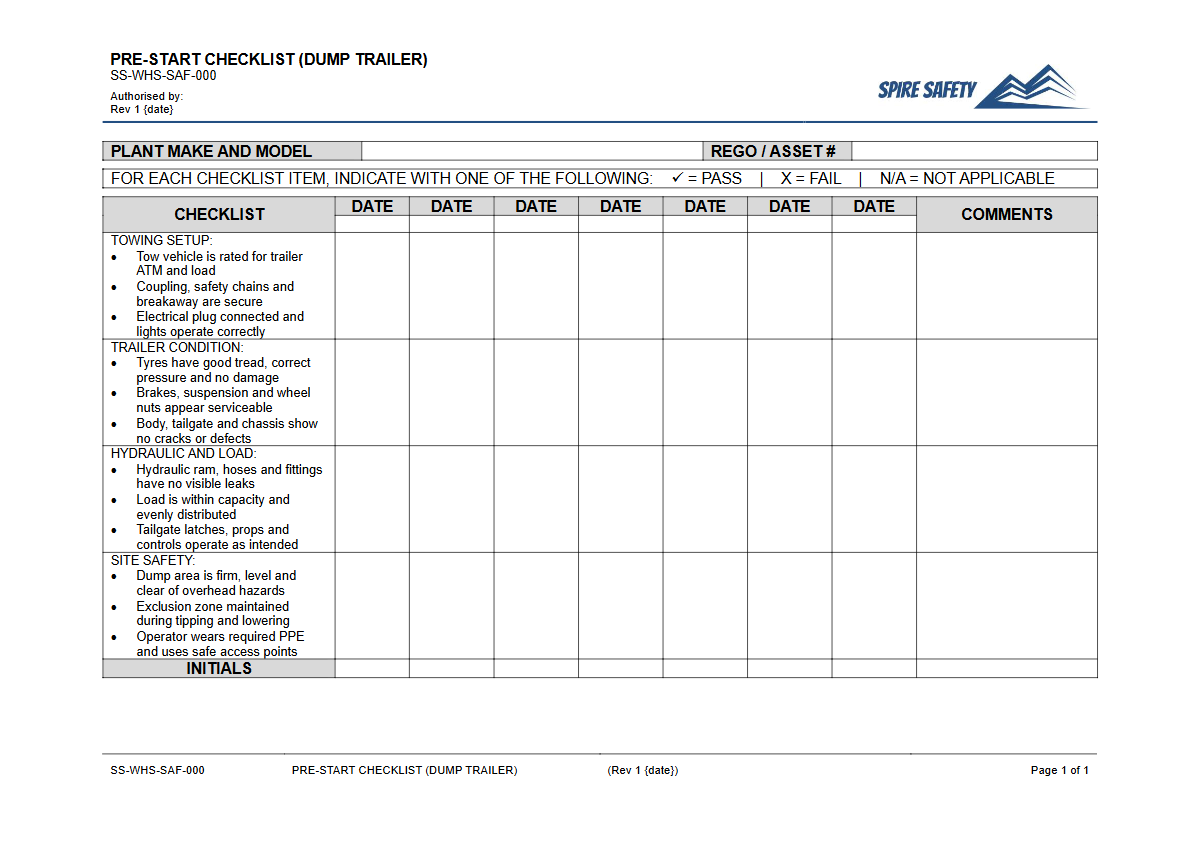
Download our free Pre-Start Checklist (Dump Trailer) Template (DOCX & PDF). A structured starting point to formalise equipment inspections in your workplace.
Free Pre-Start Checklist (Dump Trailer) Template
DOCX • 125 KB + PDF
Updated Oct 2026
No signup required
Purpose of the Free Pre-Start Checklist (Dump Trailer) Template
Operating a dump trailer, like any heavy vehicle combination, introduces significant risks to the workplace and public spaces. A systematic pre-start inspection is a fundamental safety practice that helps identify mechanical faults, fluid leaks, or other damage before the vehicle is used.
This free Pre-Start Checklist (Dump Trailer) Template provides a structured format for operators to conduct and record these critical daily checks.
Using a formal checklist helps ensure consistency, accountability, and due diligence. It prompts the operator to inspect key components such as tyres, brakes, lights, couplings, and the hydraulic tipping system.
Documenting these checks creates a record of the trailer's condition, which is vital for maintenance planning and incident investigations. The checklist is a key control measure that supports broader risk management activities, such as those documented in a Safe Work Method Statement (SWMS) for tip truck and trailer operations.
Regularly completing pre-start checks helps your organisation meet its primary duty of care under WHS legislation by ensuring, so far as is reasonably practicable, that plant and equipment is safe to use. These documented procedures form a critical part of larger comprehensive WHS management systems, demonstrating a proactive approach to safety.
Video walkthrough
How to use the Free Pre-Start Checklist (Dump Trailer) Template
This template is provided in both DOCX and PDF formats for your convenience. The DOCX file is fully editable, allowing you to tailor the checklist to the specific make, model, and configuration of the dump trailers used in your operations.
It serves as a solid foundation aligned with Australian WHS principles.
Important: This is a template only. We have provided a structured starting point, but you must customise this document to suit the unique requirements of your workplace, the specific equipment in use, and your operational risks.
Add or remove items to ensure the checklist is relevant and comprehensive for your trailers.
Once customised, the checklist should be integrated into your daily operating procedures. Operators should be trained on how to properly conduct each check and what to do if a fault is identified.
The process for reporting and rectifying defects must be clear, with procedures for tagging out and isolating unsafe equipment. You can reinforce this training with targeted safety communications, such as a Pre-Start Checks and Plant Maintenance Toolbox Talk.
When to use it
A pre-start inspection should be conducted at the beginning of each shift or day before the dump trailer is first used. It should also be completed if a new operator takes over the vehicle during a shift.
The goal is to catch potential issues before they can lead to an incident on the road or on a work site.
Beyond daily checks, this template can be adapted for post-operation or weekly inspections to ensure a more thorough examination of components that may not require daily scrutiny but are still critical for safe operation. For a more detailed analysis of equipment hazards, consider using a dedicated free Dump Truck Risk Assessment Template to inform your inspection criteria.
Who should use it
This checklist is designed to be used by competent and authorised operators of the dump trailer. The person using the equipment is best placed to identify any changes, damage, or unusual signs that may indicate a problem.
They must have the necessary training and experience to understand the function of each component they are inspecting.
Supervisors and managers also have a role to play. They are responsible for ensuring the pre-start check system is implemented correctly, that operators are completing the checks diligently, and that any reported faults are addressed in a timely manner. The effectiveness of these safety procedures can be verified through periodic WHS compliance auditing.
Finally, verifying that an operator can not only use the equipment but also correctly perform all associated safety checks is a key part of assessing competency. This can be formalised using documents like a Moxy VOC (Verification of Competency) Template, adapted for the specific vehicle combination.
Common mistakes
Common mistakes to avoid
- Using a generic checklist that doesn't match the specific trailer model.
- Operators 'pencil-whipping' the form without physically checking the items.
- Failing to establish a clear process for reporting and rectifying defects found during the check.
- Inadequate training for operators on how to properly inspect each component and recognise potential faults.
Legal references
Legal considerations
The following legal requirements may be relevant to this type of work.
- Work Health and Safety Act (Harmonised) — Provides the primary duties for protecting workers and other people from work health and safety risks.
- Work Health and Safety Regulations (Harmonised) — Sets out requirements supporting the management of workplace hazards and risks.
The following codes may be relevant to this type of work.
- Managing WHS Risks Code of Practice — Provides practical guidance on identifying hazards, assessing risks and applying effective controls.
- Work Health and Safety Consultation, Cooperation and Coordination Code of Practice — Provides practical guidance on consulting workers and coordinating with other duty holders.
- Managing the Work Environment and Facilities Code of Practice — Provides practical guidance on safe work environments, workplace facilities and related controls.
Did you know
Tipping Instability
One of the most significant risks associated with dump trailers is tipping instability. Tipping on uneven or soft ground, or having a poorly distributed load, can cause the entire vehicle combination to roll over.
Chain of Responsibility
Under the National Heavy Vehicle Law (NHVL), everyone in the supply chain, not just the driver or owner, has a responsibility to ensure the safety of transport activities. This 'Chain of Responsibility' includes ensuring equipment is properly maintained and safe for use.
FAQ
Frequently asked questions
01What key items should be on a dump trailer pre-start checklist?
02How often should a dump trailer pre-start check be completed?
03Who is responsible for ensuring pre-start checks are done?
04What happens if a fault is found during a pre-start check?
Share this resource
Free Pre-Start Checklist (Dump Trailer) Template
Browse Categories
How To Use It
- 1Download and open in Word or PDF.
- 2Replace the placeholders with your business details.
- 3Get it reviewed by a WHS specialist before rollout.
Need it customised?
Our WHS consultants can adapt this template to your site, run a gap analysis, or audit what you already have in place.
Book a Free Consultation WHS consulting servicesor call 1300 156 382