
Free Pre-Start Checklist (Edger) Template
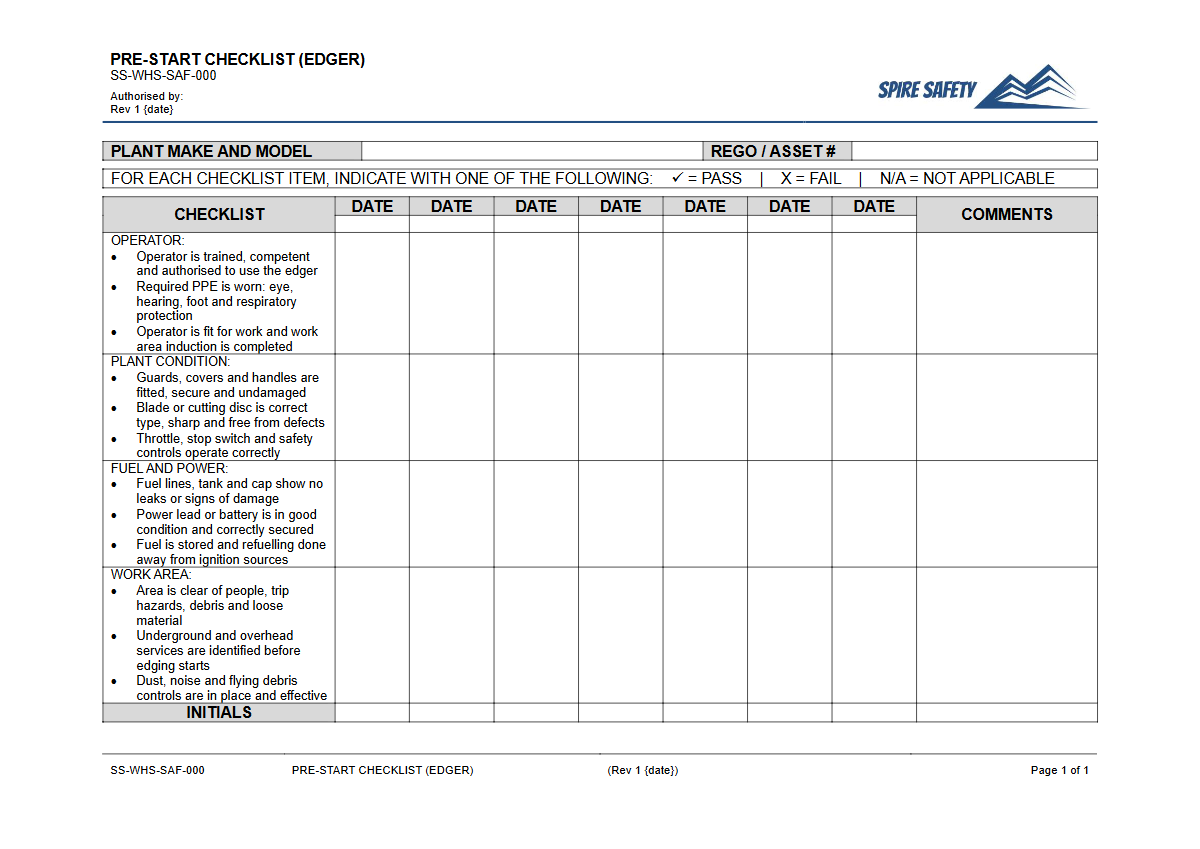
Formalise your equipment safety checks with our Free Pre-Start Checklist (Edger) Template. Download the DOCX & PDF to improve WHS management. Get yours now.
Free Pre-Start Checklist (Edger) Template
DOCX • 125 KB + PDF
Updated Oct 2026
No signup required
Purpose of the Free Pre-Start Checklist (Edger) Template
Using an edger without proper safety checks can lead to serious incidents, including cuts, debris projection, and mechanical failures. Our Free Pre-Start Checklist (Edger) Template provides a structured framework to guide operators through a systematic inspection before each use.
Implementing this process helps formalise your organisation's commitment to safety, ensuring that potential hazards like worn blades, damaged guards, fuel leaks, or faulty controls are identified and addressed before the equipment is operated. This proactive approach is a cornerstone of effective risk management, helping to prevent equipment damage, reduce downtime, and most importantly, protect workers from harm.
Regularly completing pre-start checks moves safety from an afterthought to a routine behaviour. It encourages operators to take ownership of their equipment's condition and provides a clear record of due diligence.
Integrating these checks can be reinforced through regular workplace discussions, and using a dedicated template can help structure these important safety conversations. For a structured way to present this information to your team, consider using a Pre-Start Checks and Plant Maintenance Toolbox Talk template to ensure the message is delivered consistently.
Video walkthrough
How to use the Free Pre-Start Checklist (Edger) Template
This resource is available as a fully editable Microsoft Word (DOCX) document and a print-ready PDF file. After downloading, you should add your company branding and review each checkpoint to ensure it aligns with the specific edger models used in your workplace.
This checklist should form part of a broader safe system of work, which is often documented in an Edger Safe Operating Procedure (SOP). The SOP outlines the step-by-step process for using the equipment safely, while the pre-start check confirms the equipment is safe to use in the first place.
Please note: this document is a template. We have designed it as a structured starting point, but you must customise it to reflect the specific hazards, risks, and control measures relevant to your unique workplace, equipment, and operational context.
A generic checklist that doesn't account for your specific edger's features or operating environment will not be effective.
When to use it
An edger pre-start checklist should be completed before the first use of the equipment on any given day or shift. Establishing this as a non-negotiable first step ensures that no operator ever begins work with potentially unsafe machinery.
The check should take only a few minutes but provides significant safety benefits. It is also good practice to conduct a brief post-use check to identify any damage that may have occurred during operation, allowing for timely repairs before the next use. This routine is also crucial for demonstrating operator competence, which can be formally assessed using an Edger Verification of Competency (VOC).
Who should use it
The primary user of this checklist is the equipment operator—the person who will be physically using the edger. They have the most immediate responsibility for ensuring the machine is safe to operate.
However, supervisors and managers also play a critical role. They are responsible for implementing the pre-start check system, training operators on its use, reviewing completed checklists periodically, and ensuring that any reported defects are actioned promptly.
This process of implementation, review, and continuous improvement is a key function of a robust WHS management system, creating a closed-loop system for managing plant safety.
A well-managed pre-start system also provides valuable data for the maintenance team. Consistent reports of minor issues can signal the need for preventative maintenance or indicate a recurring problem with a specific model.
Likewise, this documentation is essential during any internal or external safety review. The records created by using this template serve as evidence that the organisation is proactively managing equipment risks, which is a key area of focus during WHS compliance auditing.
This checklist is just one of many tools available to improve safety in landscaping and grounds maintenance. Your organisation may use a variety of equipment, each requiring its own specific checks.
For example, you might also need a Pre-Start Checklist for an Aerator to manage risks associated with that specific piece of plant. Building a library of customised, equipment-specific documents ensures comprehensive safety coverage across all your operations.
You can find more templates like this in our free WHS resources library to support your safety management efforts.
Common mistakes
Common mistakes to avoid
- Ticking boxes without physically inspecting the corresponding item ('pencil-whipping').
- Failing to remove a faulty edger from service after it fails a check.
- Not customising the checklist for the specific make and model of the edger being used.
- Ignoring small defects like a loose handle or cracked guard, which can lead to bigger failures.
Legal references
Legal considerations
The following legal requirements may be relevant to this type of work.
- Work Health and Safety Act (Harmonised) — Provides the primary duties for protecting workers and other people from work health and safety risks.
- Work Health and Safety Regulations (Harmonised) — Sets out requirements supporting the management of workplace hazards and risks.
The following codes may be relevant to this type of work.
- Managing WHS Risks Code of Practice — Provides practical guidance on identifying hazards, assessing risks and applying effective controls.
- Work Health and Safety Consultation, Cooperation and Coordination Code of Practice — Provides practical guidance on consulting workers and coordinating with other duty holders.
- Managing the Work Environment and Facilities Code of Practice — Provides practical guidance on safe work environments, workplace facilities and related controls.
Did you know
Flying Debris Hazard
The blade on a typical lawn edger can spin at over 3,000 RPM. This high speed can launch small rocks, metal, and other debris at over 160 km/h, making eye protection a critical piece of PPE.
FAQ
Frequently asked questions
01What is the difference between a Pre-Start Checklist and a Safe Work Method Statement (SWMS)?
02How often should a commercial lawn edger be professionally serviced?
03Who is responsible for ensuring edger pre-start checks are completed?
04Can I use this template for any brand or type of edger?
Share this resource
Free Pre-Start Checklist (Edger) Template
Browse Categories
How To Use It
- 1Download and open in Word or PDF.
- 2Replace the placeholders with your business details.
- 3Get it reviewed by a WHS specialist before rollout.
Need it customised?
Our WHS consultants can adapt this template to your site, run a gap analysis, or audit what you already have in place.
Book a Free Consultation WHS consulting servicesor call 1300 156 382