
Free Pre-Start Checklist (Egg Washer) Template
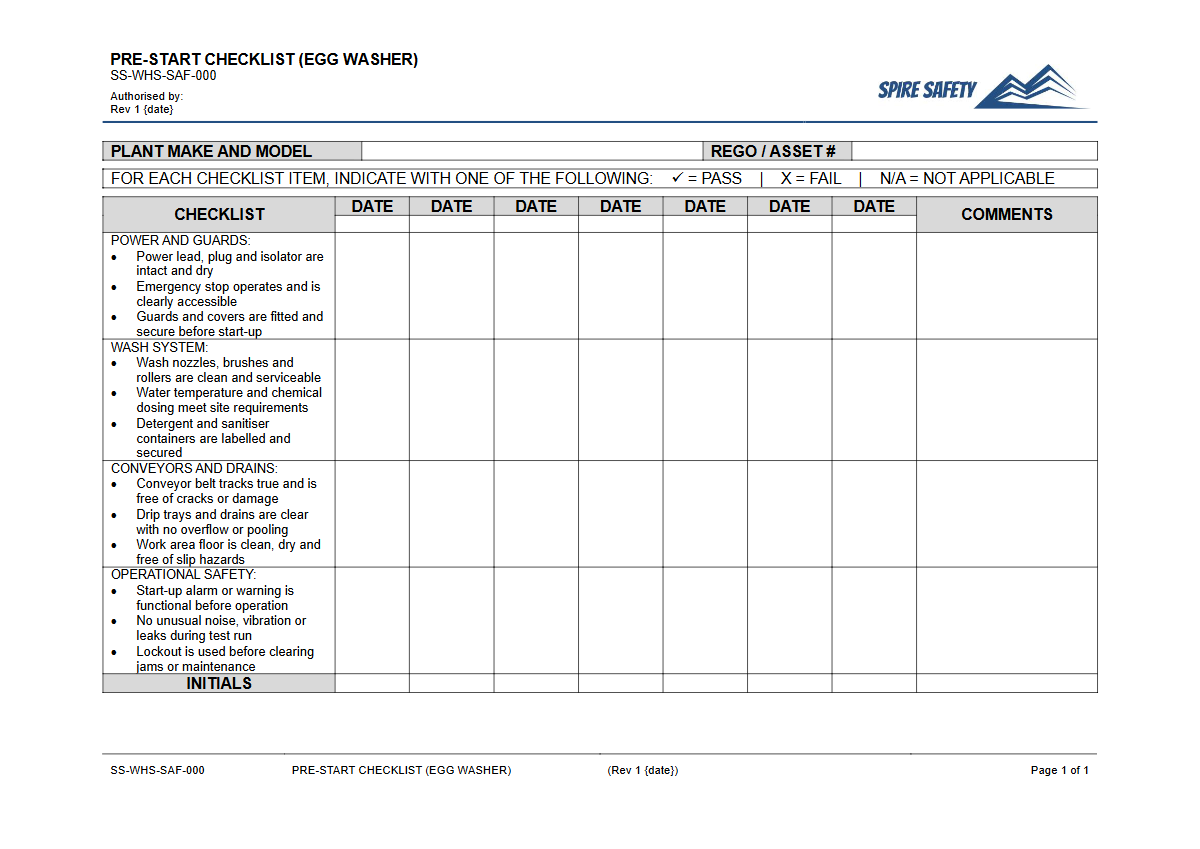
Download our Free Pre-Start Checklist (Egg Washer) Template. This structured DOCX & PDF resource helps formalise safety checks for food processing equipment.
Free Pre-Start Checklist (Egg Washer) Template
DOCX • 125 KB + PDF
Updated Oct 2026
No signup required
Purpose of the Free Pre-Start Checklist (Egg Washer) Template
Operating an egg washer involves specific risks related to water, electricity, mechanical moving parts, and cleaning chemicals. A systematic inspection before each use is a critical control measure to ensure the machine is safe to operate.
This Free Pre-Start Checklist (Egg Washer) Template provides a structured format for operators to verify the condition of the equipment, helping to identify potential faults or hazards before they cause injury, equipment damage, or product contamination. Using a formal checklist helps a Person Conducting a Business or Undertaking (PCBU) meet their primary duty of care under WHS law.
Regularly completing these checks promotes a proactive safety culture, reduces the likelihood of costly breakdowns, and ensures the machinery is operationally ready. It serves as a daily record of the equipment's condition, which is invaluable for maintenance scheduling and incident investigations.
Reinforcing these concepts is easy with resources like our Pre-Start Checks and Plant Maintenance Toolbox Talk, which helps communicate the importance of these inspections to your team.
Video walkthrough
How to use the Free Pre-Start Checklist (Egg Washer) Template
This document is a comprehensive starting point designed to be adapted for your specific workplace. To implement it effectively, follow these steps:
- Download: Select the DOCX file for easy editing or the PDF for immediate printing.
- Customise: Modify the checklist to include items specific to the make and model of your egg washer. Incorporate findings from your own WHS consulting and risk assessments, adding checks for unique site-specific hazards.
- Train: Ensure all operators are trained on how to properly conduct the inspection using the finalised checklist and what to do if they identify a fault.
- Implement: Integrate the checklist into your daily start-up procedures. Store completed checklists for record-keeping purposes as part of your broader safety framework.
Please note: This is a template we have developed as a starting point. It is essential that you customise it to reflect the specific make and model of your egg washer, your operational environment, and the outcomes of your risk assessments.
When to use the Pre-Start Checklist
The pre-start checklist should be completed before the egg washer is used for the first time each day or at the beginning of every shift in a multi-shift operation. This frequency ensures that any issues that may have developed overnight or between shifts—such as leaks, pest activity, or damage from cleaning or other activities—are identified before the machine is energised.
The cleaning function of an egg washer often involves high-pressure water, making procedures important. For guidance on a related task, you can refer to our FREE Pressure Washer SOP (Safe Operating Procedure) Template.
Consistent daily use turns the check into a routine behaviour, embedding safety as a non-negotiable part of the operation. This simple habit is one of the most effective ways to prevent incidents involving machinery. Similar principles apply to other food-grade equipment, as seen in our Free Pre-Start Checklist (Coffee Grinder) Template.
Who should use the Pre-Start Checklist
The primary user of this checklist is the trained and authorised operator of the egg washer. They are best placed to notice subtle changes in the machine's condition from one day to the next.
Supervisors or team leaders should also be familiar with the checklist content and are responsible for ensuring operators complete the checks correctly and consistently. They should periodically review the completed forms to identify recurring issues or patterns that may indicate a need for more significant maintenance or a review of procedures.
Completed checklists showing faults should be immediately escalated to a supervisor and maintenance personnel. The formal record created by the checklist provides clear, actionable information for the repair team and is a key input for effective WHS management systems. You can find many more helpful documents like this one in our extensive free WHS resources library to support your safety goals.
Common mistakes
Common mistakes to avoid
- Failing to customise the template for the specific egg washer make and model.
- Operators 'pencil-whipping' the form without physically checking the items.
- Not immediately tagging out and reporting faulty or unsafe equipment.
- Neglecting to check the concentration and levels of cleaning and sanitising chemicals.
Legal references
Legal considerations
The following legal requirements may be relevant to this type of work.
- Work Health and Safety Act (Harmonised) — Provides the primary duties for protecting workers and other people from work health and safety risks.
- Work Health and Safety Regulations (Harmonised) — Sets out requirements supporting the management of workplace hazards and risks.
The following codes may be relevant to this type of work.
- Managing WHS Risks Code of Practice — Provides practical guidance on identifying hazards, assessing risks and applying effective controls.
- Work Health and Safety Consultation, Cooperation and Coordination Code of Practice — Provides practical guidance on consulting workers and coordinating with other duty holders.
- Managing the Work Environment and Facilities Code of Practice — Provides practical guidance on safe work environments, workplace facilities and related controls.
Did you know
Temperature is Key
The water used to wash eggs must be carefully controlled. It should be at least 11°C warmer than the egg's internal temperature but not hot enough to damage the cuticle, a natural protective layer on the shell.
Cross-Contamination Risk
Improperly maintained egg washers can become a source of cross-contamination. Regular inspection and sanitation are not just for mechanical safety but are also critical food safety controls to prevent the spread of pathogens like Salmonella.
FAQ
Frequently asked questions
01What specific hazards should an egg washer pre-start checklist cover?
02How often should our egg washer pre-start checklist be reviewed and updated?
03What happens if an operator finds a fault during a pre-start check?
04Is a digital pre-start checklist better than a paper one?
Share this resource
Free Pre-Start Checklist (Egg Washer) Template
Browse Categories
How To Use It
- 1Download and open in Word or PDF.
- 2Replace the placeholders with your business details.
- 3Get it reviewed by a WHS specialist before rollout.
Need it customised?
Our WHS consultants can adapt this template to your site, run a gap analysis, or audit what you already have in place.
Book a Free Consultation WHS consulting servicesor call 1300 156 382