
Free Pre-Start Checklist (Emergency Generator) Template
Download our Free Pre-Start Checklist (Emergency Generator) Template to formalise your equipment safety inspections.
Free Pre-Start Checklist (Emergency Generator) Template
DOCX • 125 KB + PDF
Updated Oct 2026
No signup required
Purpose of the Free Pre-Start Checklist (Emergency Generator) Template
Emergency generators are critical assets, providing power continuity during outages to protect operations, data, and life-support systems. A failure to start during an emergency can have severe consequences.
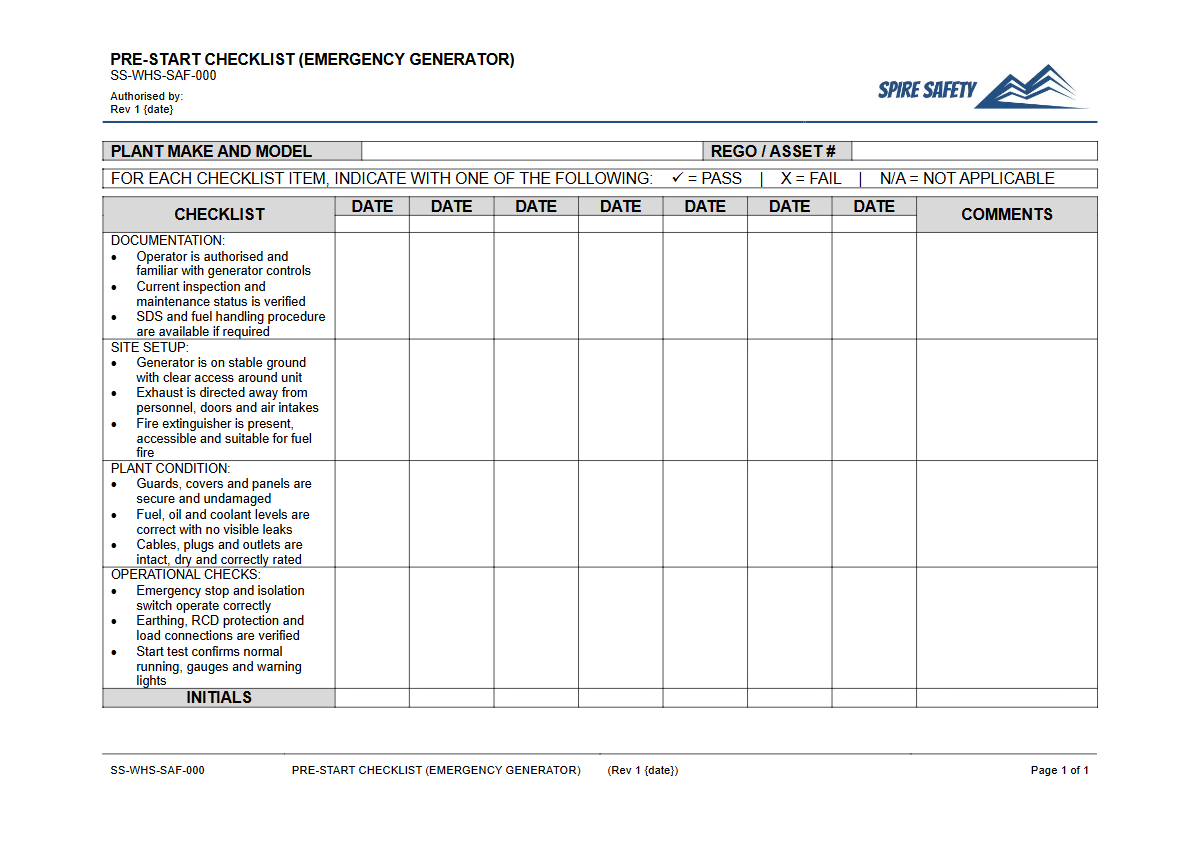
This Free Pre-Start Checklist (Emergency Generator) Template provides a structured framework for operators to conduct consistent, thorough inspections before use. Regular checks help identify potential faults, such as fuel leaks, low oil levels, or battery issues, before they cause a critical failure.
By formalising this process, your organisation can improve equipment reliability, ensure operator safety, and maintain a clear record of due diligence.
What this Pre-Start Checklist covers:
This template guides the user through key inspection areas, including:
- General area inspection (clearances, ventilation, housekeeping)
- Fluid levels (fuel, oil, coolant)
- Battery and electrical system checks
- Exhaust and fuel system integrity
- Gauges, indicators, and control panel functions
- A section for recording a brief test run
Using this checklist helps embed safety checks into your operational routine, forming a vital part of your plant and equipment management procedures. It also supports compliance with duties under WHS legislation to ensure, so far as is reasonably practicable, that plant is safe to use.
Video walkthrough
How to use the Free Pre-Start Checklist (Emergency Generator) Template
This resource is provided in both DOCX and PDF formats for your convenience. The DOCX file is fully editable, allowing you to tailor the checklist to the specific make, model, and operational context of the generators at your workplace. It's designed to be a starting point for developing robust internal safety documents that fit seamlessly into your existing WHS management systems.
Important: This is a template, not a finished document. To be effective, you must customise it to reflect the unique hazards and control measures relevant to your specific equipment and site.
We recommend consulting the manufacturer's operating manual and a competent person during this customisation process.
When to use it
A pre-start checklist for an emergency generator should be used consistently to maximise its effectiveness. Best practice involves conducting these checks:
- Before any planned test run (typically performed weekly or monthly).
- Immediately before a scheduled event where the generator is required for primary or backup power.
- After any maintenance, repair, or modification has been performed on the unit.
- As part of periodic safety inspections, even if the generator has not been run recently.
Consistent use creates a valuable log of the generator's condition over time, helping to identify developing faults and schedule preventative maintenance. Documenting these checks is a key part of demonstrating proactive safety management.
Who should use it
The checklist should be completed by a worker who is deemed competent to operate and inspect the emergency generator. This typically includes facilities managers, maintenance personnel, or specifically trained operators.
Competency means the person has the necessary knowledge, training, and experience to identify faults, understand the risks involved, and know when to escalate an issue or tag the equipment out of service. Verifying this competency is a crucial step for any Person Conducting a Business or Undertaking (PCBU). You can formalise this process using our free Verification of Competency (Diesel Generator) Template.
Key Inspection Points
While the template provides a comprehensive list, certain checks are fundamental to generator reliability. Operators should pay close attention to fuel quality and level, ensuring there is enough to sustain the required runtime.
The battery is another common point of failure; terminals should be clean, tight, and free of corrosion, and the charge level should be verified. Visually inspecting for any oil, coolant, or fuel leaks around the engine block, hoses, and connections can prevent both equipment failure and environmental incidents.
Integrating these checks with a comprehensive generator risk assessment ensures all potential hazards are systematically managed.
Beyond the Pre-Start Check
A completed checklist is just one part of a safe system of work. If a fault is identified, the worker must have clear instructions on the next steps.
This includes procedures for reporting the fault, applying a 'Do Not Operate' tag, and initiating maintenance. These procedures are excellent topics to reinforce with your team using tools like our Pre-Start Checks and Plant Maintenance Toolbox Talk.
Keeping completed checklists as a maintenance and safety record is also essential. These records can be invaluable during safety investigations or when demonstrating compliance.
Incorporating a review of these records into your regular WHS compliance auditing program helps verify that procedures are being followed correctly.
In the event of an incident where a generator fails to perform as expected, these records provide critical historical data. This information becomes a key input for a thorough root cause analysis, such as the ICAM incident investigation process, helping your organisation learn from the event and prevent recurrence.
Common mistakes
Common mistakes to avoid
- Completing the checklist from memory without physically inspecting each item ('pencil-whipping').
- Ignoring minor issues like small fluid weeps or slightly low levels, which can indicate a larger developing problem.
- Failing to test the generator under a sufficient load, which doesn't accurately assess its real-world performance.
- Not training workers on how to properly use the checklist and what to do if a fault is found.
Legal references
Legal considerations
The following legal requirements may be relevant to this type of work.
- Work Health and Safety Act (Harmonised) — Provides the primary duties for protecting workers and other people from work health and safety risks.
- Work Health and Safety Regulations (Harmonised) — Sets out requirements supporting the management of workplace hazards and risks.
The following codes may be relevant to this type of work.
- Managing WHS Risks Code of Practice — Provides practical guidance on identifying hazards, assessing risks and applying effective controls.
- Work Health and Safety Consultation, Cooperation and Coordination Code of Practice — Provides practical guidance on consulting workers and coordinating with other duty holders.
- Managing the Work Environment and Facilities Code of Practice — Provides practical guidance on safe work environments, workplace facilities and related controls.
Did you know
Wet Stacking
Regularly running a diesel generator on a light or no-load condition can cause 'wet stacking,' where unburnt fuel and carbon build up in the exhaust system. This reduces efficiency and can become a fire hazard.
Battery Failure
According to industry data, battery failure is one of the most common reasons an emergency generator fails to start. Regular inspection and maintenance of the battery system are critical for reliability.
FAQ
Frequently asked questions
01What is a pre-start checklist for an emergency generator?
02How often should you test an emergency generator?
03Who is a 'competent person' to inspect a generator?
04What are the risks of not using a generator pre-start checklist?
Share this resource
Free Pre-Start Checklist (Emergency Generator) Template
Browse Categories
How To Use It
- 1Download and open in Word or PDF.
- 2Replace the placeholders with your business details.
- 3Get it reviewed by a WHS specialist before rollout.
Need it customised?
Our WHS consultants can adapt this template to your site, run a gap analysis, or audit what you already have in place.
Book a Free Consultation WHS consulting servicesor call 1300 156 382