
Free Pre-Start Checklist (EV Charger) Template
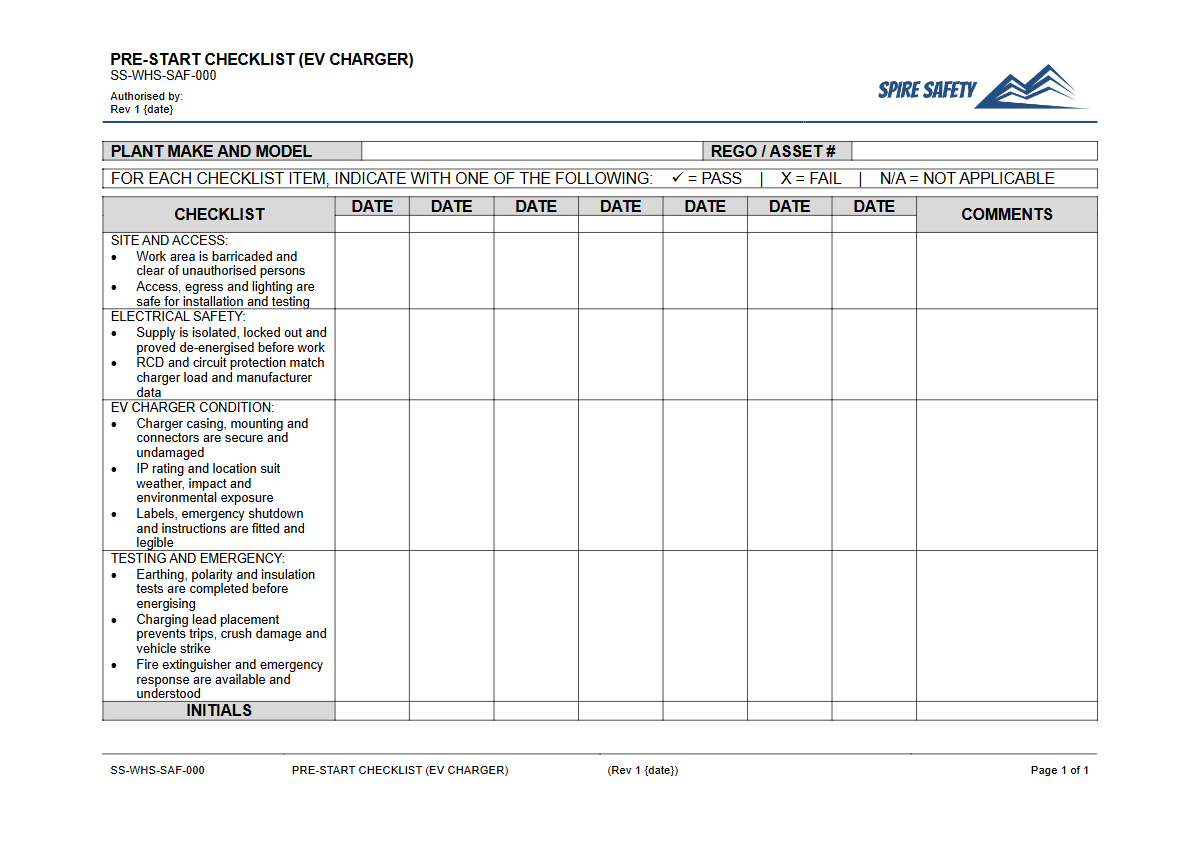
Download our free Pre-Start Checklist (EV Charger) Template in DOCX and PDF. This structured document helps formalise daily equipment safety inspections.
Free Pre-Start Checklist (EV Charger) Template
DOCX • 125 KB + PDF
Updated Oct 2026
No signup required
Purpose of the Free Pre-Start Checklist (EV Charger) Template
Operating any electrical equipment, including Electric Vehicle (EV) chargers, introduces significant workplace hazards if not properly managed. A pre-start check is a fundamental safety procedure used to identify potential faults or damage before the equipment is used.
This Free Pre-Start Checklist (EV Charger) Template provides a structured format for operators to conduct a systematic inspection, helping to prevent incidents such as electric shock, fire, equipment malfunction, or damage to vehicles.
Using this checklist helps a Person Conducting a Business or Undertaking (PCBU) meet their primary duty of care to ensure, so far as is reasonably practicable, that plant and structures are without risks to the health and safety of any person. It formalises the inspection process, creates a record of due diligence, and encourages a proactive safety culture where equipment condition is regularly monitored and maintained.
Video walkthrough
How to use the Free Pre-Start Checklist (EV Charger) Template
This resource is available as a DOCX file for easy customisation or a PDF for immediate use. To get the most value, download the Word document and adapt it to your specific operational needs.
This should include adding your company name and logo, and modifying the checklist items to match the exact make and model of the EV chargers used at your site, as well as any unique environmental or operational factors.
Integrating this checklist into your broader WHS management systems ensures that pre-start inspections are a consistent part of your daily operations, rather than an ad-hoc task. It provides a clear framework for recording inspections, reporting defects, and taking corrective actions.
Please note: This document is a template and must be customised to suit the specific equipment, environment, and operational procedures of your workplace. We are not responsible for any incidents that may occur from the use of this template.
What to Include in Your Custom EV Charger Pre-Start Checklist
While our template provides a solid foundation aligned with Australian WHS practice, your custom checklist should detail specific inspection points relevant to your equipment. Key areas to consider include:
Physical Condition
- Casing and Housing: Check for cracks, dents, or signs of impact that could compromise the internal components.
- Cables and Connectors: Inspect for fraying, cuts, exposed wires, or damage to the plug and connector head. Ensure cables are not a trip hazard.
- Mounting: Verify the charger is securely fixed to the wall or pedestal and has not become loose.
Operational Checks
- Indicator Lights: Ensure status lights (e.g., power, charging, fault) are functioning correctly as per the manufacturer's guide.
- Emergency Stop: If fitted, test the emergency stop button to confirm it de-energises the unit.
- User Interface: Check that the screen or interface is readable and responsive.
Surrounding Area
- Clearance: Confirm the area around the charger is free from obstruction, flammable materials, and water.
- Signage: Ensure all safety, operational, and warning signs are in place, legible, and undamaged.
For more complex machinery, a detailed checklist is equally critical. You can see another example with our Free Pre-Start Checklist (CNC Router) Template.
When to use a Pre-Start Checklist
An EV charger pre-start check should be completed before its first use each day or at the beginning of each shift in a commercial or fleet setting. For chargers in high-use public or workplace environments, a more frequent inspection schedule may be necessary as defined by a risk assessment.
The goal is to catch issues early before they can cause harm.
Consistent use of pre-start checks can be reinforced through regular training. Our Pre-Start Checks and Plant Maintenance Toolbox Talk is a useful resource for educating your team on the importance of these inspections.
Who should use it
The pre-start checklist should be completed by a person who is competent and has received adequate training on the specific EV charger model and the potential hazards involved. This could be a vehicle operator, a fleet manager, or a designated maintenance person.
The PCBU is responsible for ensuring that workers have the necessary training and resources to conduct these checks effectively and safely.
If you are unsure about assigning responsibilities or developing training for specific equipment, seeking professional advice is recommended. Spire Safety offers expert WHS consulting to help you establish safe systems of work for all plant and equipment.
Maintaining Records and Continuous Improvement
Completed checklists are valuable records. They should be stored and reviewed periodically to identify recurring faults or trends that may indicate a need for a different maintenance schedule or equipment replacement.
Any defects noted must have a clear follow-up action, such as 'tag out and report to maintenance', to ensure faults are not ignored. This process of review and action is a key part of continuous improvement in safety management.
Periodically verifying that procedures are being followed correctly is also essential. This can be achieved through internal reviews or external WHS compliance auditing to ensure your safety systems remain effective. For more templates and safety guides, explore our complete free WHS resources library.
Common mistakes
Common mistakes to avoid
- Using a generic checklist without customising it for the specific charger model and workplace environment.
- Failing to take immediate corrective action when a defect is found, such as tagging the unit out of service.
- Operators completing the checklist without physically performing the inspections ('pencil-whipping').
- Inadequate training for staff on how to properly and safely conduct the pre-start inspection.
Legal references
Legal considerations
The following legal requirements may be relevant to this type of work.
- Work Health and Safety Act (Harmonised) — Provides the primary duties for protecting workers and other people from work health and safety risks.
- Work Health and Safety Regulations (Harmonised) — Sets out requirements supporting the management of workplace hazards and risks.
The following codes may be relevant to this type of work.
- Managing WHS Risks Code of Practice — Provides practical guidance on identifying hazards, assessing risks and applying effective controls.
- Work Health and Safety Consultation, Cooperation and Coordination Code of Practice — Provides practical guidance on consulting workers and coordinating with other duty holders.
- Managing the Work Environment and Facilities Code of Practice — Provides practical guidance on safe work environments, workplace facilities and related controls.
Did you know
Australian Standards
The installation of EV chargers in Australia is governed by several standards, primarily AS/NZS 3000 (The Wiring Rules), which outlines the requirements for all electrical installations to ensure safety.
Not All Chargers Are Equal
EV chargers are categorised by levels (Level 1, 2, and 3 DC fast charging), each with different power outputs, charging speeds, and electrical requirements, necessitating tailored safety and maintenance procedures.
FAQ
Frequently asked questions
01Why is a pre-start check necessary for an EV charger?
02What are the key items to inspect on an EV charger before use?
03Who is responsible for completing the EV charger pre-start checklist?
04How often should an EV charger pre-start check be conducted?
Share this resource
Free Pre-Start Checklist (EV Charger) Template
Browse Categories
How To Use It
- 1Download and open in Word or PDF.
- 2Replace the placeholders with your business details.
- 3Get it reviewed by a WHS specialist before rollout.
Need it customised?
Our WHS consultants can adapt this template to your site, run a gap analysis, or audit what you already have in place.
Book a Free Consultation WHS consulting servicesor call 1300 156 382