
Free Pre-Start Checklist (Extruder) Template
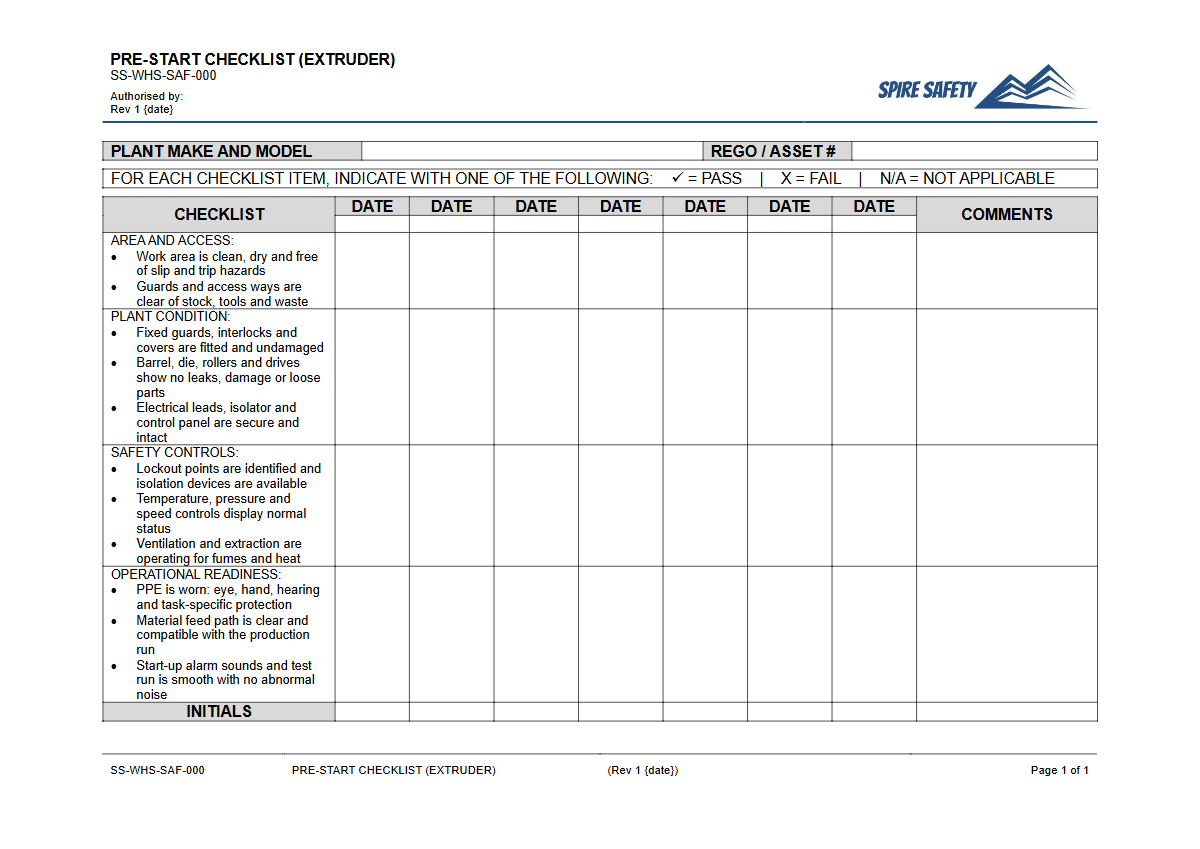
Download our Free Pre-Start Checklist (Extruder) Template (DOCX/PDF) to formalise daily equipment inspections and support WHS compliance. Get your template.
Free Pre-Start Checklist (Extruder) Template
DOCX • 125 KB + PDF
Updated Oct 2026
No signup required
Purpose of the Free Pre-Start Checklist (Extruder) Template
This Free Pre-Start Checklist (Extruder) Template provides a structured framework for operators to conduct consistent safety inspections on extrusion machinery before operation. Using a formal checklist helps formalise the process of identifying potential hazards, such as unguarded moving parts, damaged wiring, or failing temperature controls, before they cause injury or equipment damage.
By documenting these daily checks, organisations can demonstrate due diligence in managing plant risks and maintain a clear record of equipment condition over time. This proactive approach not only enhances operator safety but also helps minimise costly unplanned downtime.
Implementing routine inspections is a fundamental part of a proactive safety culture. It encourages operators to take ownership of their equipment and builds safety-conscious behaviour. To further embed these practices, you can reinforce key messages with a regular pre-start checks and plant maintenance toolbox talk.
Video walkthrough
How to use the Free Pre-Start Checklist (Extruder) Template
This resource is available for download as a fully editable Microsoft Word (DOCX) file and a print-ready PDF. The DOCX version allows you to add your company branding and customise the checklist items to suit your specific machinery and operational risks.
Extruders vary significantly in design, function, and associated hazards (e.g., thermal, mechanical, electrical), so customisation is essential.
Important: This document is a template and must be customised to your specific workplace. You need to conduct a risk assessment and edit the checklist to reflect the exact make, model, configuration, and operating environment of your extruder.
We are not responsible for your safety outcomes. Items to add include manufacturer-specific checks, site emergency procedures, and contact details for maintenance and supervision.
A pre-start checklist is just one component of a holistic safety framework. For the greatest effect, it should be integrated into your organisation's overall WHS management systems, linking pre-start results to your hazard reporting and maintenance scheduling processes. Just as this checklist is specific to extruders, other complex equipment requires its own tailored inspection process, such as our Free Pre-Start Checklist (CNC Router) Template.
When to use it
A pre-start checklist for an extruder should be completed before every shift or before the machine is used for the first time each day. It provides a final verification that the equipment is safe to operate following any period of inactivity.
The check should also be performed after any maintenance, repair, or adjustment has been carried out on the machine to ensure it has been returned to a safe operational state. If the extruder is moved or reconfigured, a thorough inspection using the checklist is necessary before resuming production.
The frequency and rigour of these checks should be determined by a risk assessment, considering the age and condition of the equipment, the intensity of its use, and the operating environment. This principle applies to all types of machinery, from extruders to mixers, as seen in our Free Pre-Start Checklist (Agitator) Template.
Who should use it
The primary user of this pre-start checklist is the trained and competent operator assigned to the extruder for the shift. They are best placed to identify any changes or abnormalities in the machine's condition.
It is critical that operators are not only trained in the extruder's operation but also in how to properly conduct the pre-start inspection and what to do if a fault is found.
Supervisors and line managers should periodically review completed checklists to verify that inspections are being carried out correctly and to identify any recurring issues that may indicate a need for more significant maintenance or a review of safe operating procedures. Where complex machinery or high-risk processes are involved, seeking external expertise through WHS consulting can provide valuable insight into best practices. Furthermore, alongside pre-start checks, it's vital to ensure operators are competent, a process you can formalise using tools like our Verification of Competency (Pipe Threader) Template.
Browse our complete free WHS resources library for more templates and guides to support your safety management system.
Common mistakes
Common mistakes to avoid
- Using a generic plant checklist that doesn't cover extruder-specific hazards like barrel heaters or screen changers.
- Operators 'pencil-whipping' the checklist without physically inspecting the items.
- Failing to immediately lock-out and tag-out a machine when a critical safety defect is found.
- Not retaining completed checklists for a sufficient period to assist in incident investigations or WHS audits.
Legal references
Legal considerations
The following legal requirements may be relevant to this type of work.
- Work Health and Safety Act (Harmonised) — Provides the primary duties for protecting workers and other people from work health and safety risks.
- Work Health and Safety Regulations (Harmonised) — Sets out requirements supporting the management of workplace hazards and risks.
The following codes may be relevant to this type of work.
- Managing WHS Risks Code of Practice — Provides practical guidance on identifying hazards, assessing risks and applying effective controls.
- Work Health and Safety Consultation, Cooperation and Coordination Code of Practice — Provides practical guidance on consulting workers and coordinating with other duty holders.
- Managing the Work Environment and Facilities Code of Practice — Provides practical guidance on safe work environments, workplace facilities and related controls.
Did you know
Molten Polymer Hazards
Extruders often operate at temperatures exceeding 200°C. Contact with molten polymer can cause severe thermal burns that continue to damage tissue even after initial contact, as the material adheres to the skin.
High-Pressure Risks
The pressure inside an extruder barrel can be immense, sometimes exceeding 10,000 psi. A catastrophic failure or a blockage can lead to the violent ejection of hot material and machine components.
FAQ
Frequently asked questions
01What are the most critical safety items on an extruder pre-start checklist?
02How often should an extruder pre-start check be performed?
03Who is responsible for signing off on an extruder pre-start checklist?
04Can we use a digital pre-start checklist for an extruder?
Share this resource
Free Pre-Start Checklist (Extruder) Template
Browse Categories
How To Use It
- 1Download and open in Word or PDF.
- 2Replace the placeholders with your business details.
- 3Get it reviewed by a WHS specialist before rollout.
Need it customised?
Our WHS consultants can adapt this template to your site, run a gap analysis, or audit what you already have in place.
Book a Free Consultation WHS consulting servicesor call 1300 156 382