
Free Pre-Start Checklist (Feed Hopper) Template
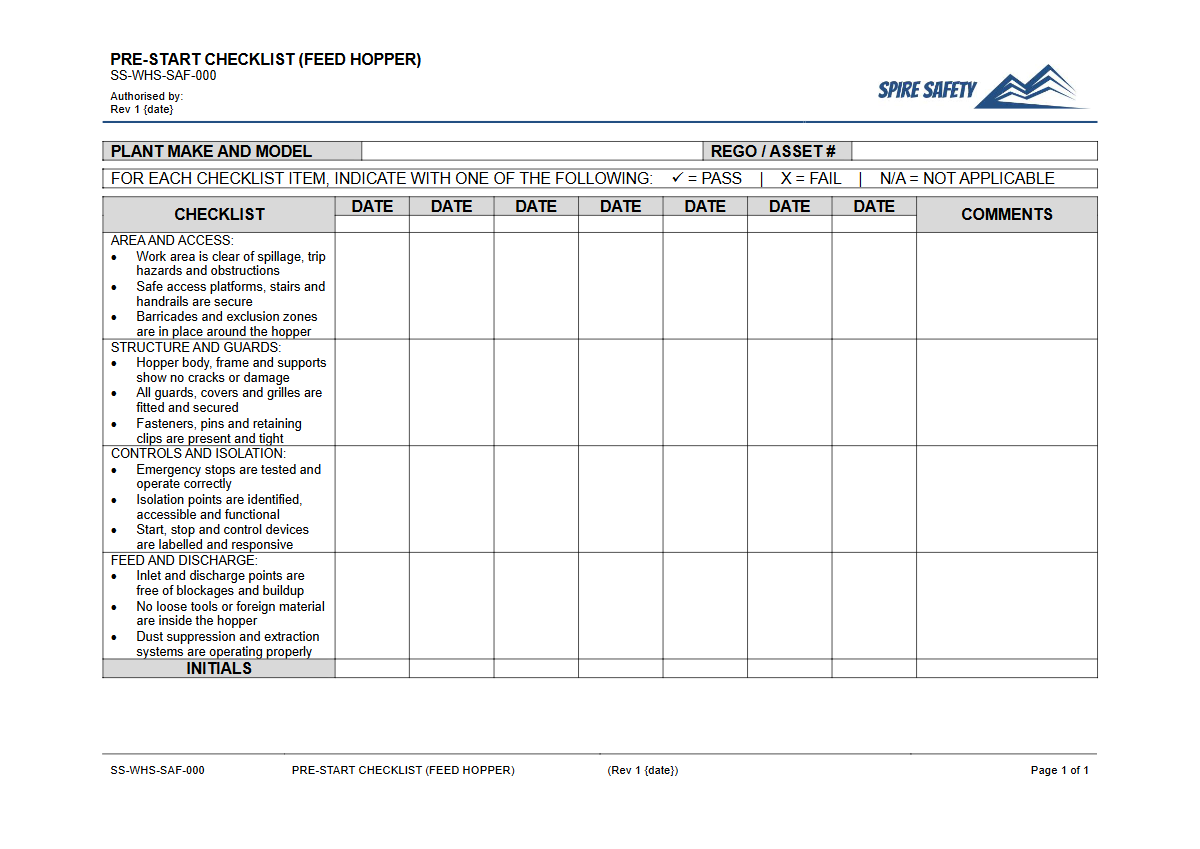
Download our Free Pre-Start Checklist (Feed Hopper) Template in DOCX and PDF. This structured document helps formalise daily safety checks. Get started today.
Free Pre-Start Checklist (Feed Hopper) Template
DOCX • 125 KB + PDF
Updated Oct 2026
No signup required
Purpose of the Free Pre-Start Checklist (Feed Hopper) Template
Feed hoppers are essential in many industries, from agriculture and manufacturing to construction and mining. However, their moving parts, such as augers, conveyors, and gates, present significant risks of entanglement, crushing, and other serious injuries.
A systematic inspection before each use is a critical control measure. This Free Pre-Start Checklist (Feed Hopper) Template provides a structured starting point for organisations to formalise their daily equipment inspections.
Using a checklist helps operators methodically verify that safety features are in place and the equipment is in good working order before it is energised. It creates a documented record of due diligence, assists in early fault detection, and reinforces safe work practices. Regularly completing these checks is a key part of any effective plant and equipment safety program, which can be reinforced with tools like a Pre-Start Checks and Plant Maintenance Toolbox Talk.
Video walkthrough
How to use the Free Pre-Start Checklist (Feed Hopper) Template
This template is provided in both DOCX and PDF formats to suit your operational needs. The DOCX file is fully editable, allowing for complete customisation.
To effectively implement the checklist:
- Download: Select your preferred format (DOCX or PDF).
- Customise: Modify the DOCX file to match the specific make, model, and configuration of your feed hopper(s). Add your company branding, site-specific hazards, and relevant operational details.
- Integrate: Incorporate the finalised checklist into your daily operational procedures. Ensure it is part of your comprehensive WHS management systems.
- Train: Instruct all authorised operators on how to properly complete the checklist, what each item means, and the procedure to follow if a fault is found.
- Implement: Make the checklist readily available at the point of use and ensure supervisors are monitoring its correct completion.
Note: This document is a template only. We are not familiar with your specific machinery, operational context, or unique workplace risks.
You must customise this checklist to ensure it is suitable for your business needs and the specific plant being used.
When to use it
A pre-start check for a feed hopper should be completed by a competent operator before the start of each shift or before the first use of the day. It should also be conducted if the equipment has been idle for an extended period or after any maintenance or repair work has been performed.
The goal is to verify the hopper's safe condition before introducing energy and materials, as its status can change due to damage, tampering, or environmental factors.
Who should use it
This checklist should be used by personnel who are trained, competent, and authorised to operate the specific feed hopper. Competency includes not only knowing how to operate the machinery but also understanding its specific hazards and the function of its safety controls.
Supervisors and managers also have a responsibility to ensure these checks are being completed correctly and that any reported issues are addressed promptly. Verifying that procedures are being followed is a key outcome of regular WHS compliance auditing.
Key Areas for Inspection
While your customised checklist will be more detailed, a thorough feed hopper inspection should always cover several critical areas to manage risk effectively.
Guarding and Interlocks
Ensure all physical guards are secure, undamaged, and in their correct position. This is especially important for intake points, augers, conveyors, and drive mechanisms.
If the hopper is fitted with interlocked guards, test that they function correctly by confirming the machine cannot start or will stop if a guard is opened. The principles of guarding moving parts are similar across various types of plant, such as those covered in our Free Pre-Start Checklist (Agitator) Template.
Emergency Stops and Controls
Locate and test all emergency stop buttons, pull cords, and other safety cut-outs. They must be clearly visible, unobstructed, and functional.
Check that all operating controls are clearly labelled and move as expected without sticking or jamming.
Structural Integrity and Housekeeping
Inspect the frame, bin, legs, and welds for any signs of cracking, bending, corrosion, or other damage that could compromise stability. The area around the hopper should be clear of debris, spills, and trip hazards to ensure safe access and operation.
Associated Systems
Depending on its use, a hopper may be part of a larger system. For high-risk activities, broader safety documentation is often required, such as a Safe Work Method Statement (SWMS) for Concrete Truck Operations, which involves managing risks associated with chutes and discharge mechanisms.
Inspect any associated conveyors, chutes, and power systems for defects.
By standardising your equipment safety checks, you create a more proactive safety culture. Explore our free WHS resources library for more templates to support your safety management system.
Common mistakes
Common mistakes to avoid
- Using a generic checklist without customising it for the specific hopper model.
- Ticking boxes without physically verifying each safety item (pencil-whipping).
- Failing to immediately report, isolate, and tag-out faulty equipment.
- Not providing adequate training to operators on how to conduct the inspection properly.
Legal references
Legal considerations
The following legal requirements may be relevant to this type of work.
- Work Health and Safety Act (Harmonised) — Provides the primary duties for protecting workers and other people from work health and safety risks.
- Work Health and Safety Regulations (Harmonised) — Sets out requirements supporting the management of workplace hazards and risks.
The following codes may be relevant to this type of work.
- Managing WHS Risks Code of Practice — Provides practical guidance on identifying hazards, assessing risks and applying effective controls.
- Work Health and Safety Consultation, Cooperation and Coordination Code of Practice — Provides practical guidance on consulting workers and coordinating with other duty holders.
- Managing the Work Environment and Facilities Code of Practice — Provides practical guidance on safe work environments, workplace facilities and related controls.
Did you know
Entanglement Hazard
Contact with moving parts on machinery like feed hoppers is a leading cause of serious workplace injuries. Even a brief moment of contact with an unguarded auger or conveyor can result in amputation or fatality.
Duty of Care
Under Australian WHS law, providing and maintaining safe plant and structures is a primary duty of care for a PCBU. Documented pre-start checks are a practical way to help demonstrate this duty is being met.
FAQ
Frequently asked questions
01What is the difference between a pre-start checklist and a SWMS?
02How often should a feed hopper be inspected?
03Who is responsible for ensuring pre-start checks are done?
04Can I use this template for any type of feed hopper?
Share this resource
Free Pre-Start Checklist (Feed Hopper) Template
Browse Categories
How To Use It
- 1Download and open in Word or PDF.
- 2Replace the placeholders with your business details.
- 3Get it reviewed by a WHS specialist before rollout.
Need it customised?
Our WHS consultants can adapt this template to your site, run a gap analysis, or audit what you already have in place.
Book a Free Consultation WHS consulting servicesor call 1300 156 382