
Free Pre-Start Checklist (Exhaust Fan) Template
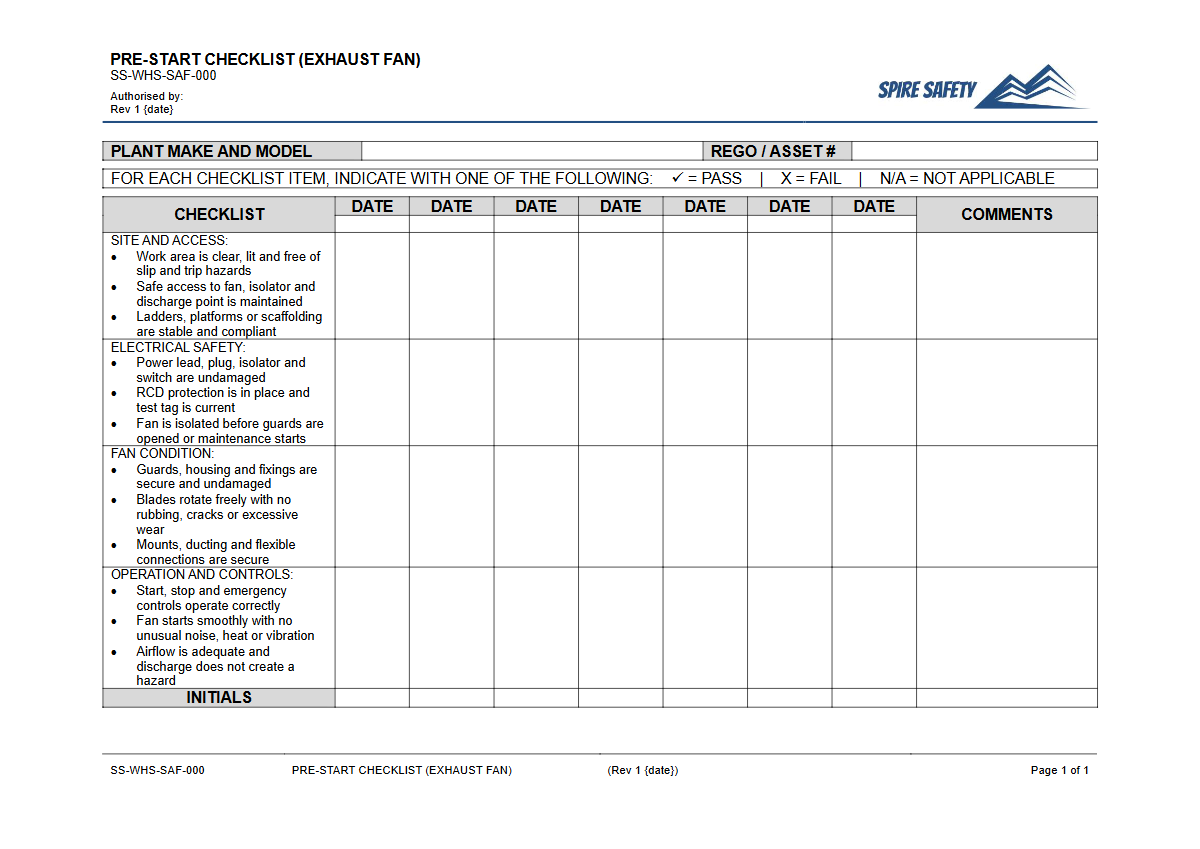
Download our free Pre-Start Checklist (Exhaust Fan) Template. This customisable DOCX & PDF helps formalise safety checks for workplace exhaust fans.
Free Pre-Start Checklist (Exhaust Fan) Template
DOCX • 125 KB + PDF
Updated Oct 2026
No signup required
Purpose of the Free Pre-Start Checklist (Exhaust Fan) Template
Ensuring workplace exhaust fans are in safe, operational condition is fundamental to managing airborne contaminants and maintaining a healthy work environment. This Free Pre-Start Checklist (Exhaust Fan) Template provides a structured starting point for formalising daily inspections.
Regularly using a pre-start checklist helps your organisation identify potential faults, prevent equipment failure, and protect workers from hazards like dust, fumes, vapours, and excessive heat. It serves as a practical tool to help meet your duties under Australian WHS laws by systematically checking for defects before the equipment is used.
Properly functioning exhaust fans are critical in many industries, from commercial kitchens and manufacturing facilities to workshops and laboratories. A simple fault can lead to poor air quality, increased fire risk from motor failure or duct blockages, or exposure to hazardous substances.
This template helps create a consistent inspection process, fostering a proactive safety culture and providing a clear record of due diligence.
Video walkthrough
How to use the Free Pre-Start Checklist (Exhaust Fan) Template
This resource is provided as a fully editable DOCX file, with a PDF version also included for convenience. The key to its effectiveness is customisation.
Download the file and adapt it to the specific exhaust fans and operational context of your workplace. Add your company branding, specific fan models, locations, and any unique inspection points relevant to your site.
For example, the checks for a fan extracting wood dust in a joinery will differ from one extracting chemical fumes in a laboratory.
It is critical that you customise this template for your specific needs. As a generic document, it cannot cover every possible hazard or control measure.
We are not in your workplace and cannot know what specific risks are present. Once customised, train your workers on how to conduct the checks properly and what to do if they identify a fault. This training can be supported by clear, concise instructions, which you can document in a Pre-Start Checks and Plant Maintenance Toolbox Talk.
When to use it
An exhaust fan Pre-Start Checklist should be completed by the operator or a designated person before each work shift begins or before the first use of the fan for the day. This frequency ensures that any issues that may have developed overnight or between shifts are caught before they can cause harm.
For fans that run continuously, checks should be integrated into a daily or shift-based inspection schedule.
These daily checks are a supplement to, not a replacement for, scheduled periodic maintenance and servicing by competent personnel. Daily pre-start inspections focus on easily observable issues, whereas comprehensive maintenance involves more technical assessments of motors, bearings, and electrical systems. Integrating both daily checks and long-term servicing is a core part of an effective WHS management system.
Who should use it
This Pre-Start Checklist is designed for several key personnel within an organisation:
- Operators and Workers: The primary users are the individuals who work in the area serviced by the exhaust fan. They are best placed to notice changes in performance or condition and should be empowered to conduct the checks.
- Supervisors and Team Leaders: Supervisors are responsible for ensuring that workers complete the pre-start checks correctly and consistently. They must also take immediate action when a fault is reported, such as isolating the equipment and arranging for repairs.
- Maintenance Personnel: While maintenance teams perform deeper servicing, they may use the completed checklists to identify recurring faults or trends that could indicate a more significant underlying problem with the equipment.
Ultimately, a robust pre-start inspection process relies on the collaboration of all parties. This is supported by ensuring everyone involved is competent for their role, a process that can be documented using frameworks like our Verification of Competency (Pipe Threader) Template as a structural guide for different equipment.
Integrating Checks into Your Safety Framework
Pre-start checks are a vital control measure, but they are most effective when they are part of a broader safety strategy. The data collected from these checklists can provide valuable insights for risk assessments and procedure reviews.
For instance, repeated faults on a specific fan might trigger a review of the current Safe Work Method Statement (SWMS) for the associated task or prompt a management of change process. While a pre-start is a simple check, some high-risk activities require a far more detailed document, such as a Safe Work Method Statement (Concrete Truck Operation) Template.
Regularly reviewing completed checklists helps management verify that safety procedures are being followed on the ground. This verification is a key activity in preparation for or as part of a formal WHS compliance audit, demonstrating a functional and documented system for managing plant safety.
You can find many other useful templates in our free WHS resources library to help build out your safety systems.
Common mistakes
Common mistakes to avoid
- Using a generic checklist without customising it for the specific fan model and workplace hazards.
- Ticking boxes without performing the actual physical and visual checks ('pencil-whipping').
- Failing to have a clear procedure for what to do when a defect or fault is found.
- Not retaining completed checklists as a record of inspection and maintenance history.
Legal references
Legal considerations
The following legal requirements may be relevant to this type of work.
- Work Health and Safety Act (Harmonised) — Provides the primary duties for protecting workers and other people from work health and safety risks.
- Work Health and Safety Regulations (Harmonised) — Sets out requirements supporting the management of workplace hazards and risks.
The following codes may be relevant to this type of work.
- Managing WHS Risks Code of Practice — Provides practical guidance on identifying hazards, assessing risks and applying effective controls.
- Work Health and Safety Consultation, Cooperation and Coordination Code of Practice — Provides practical guidance on consulting workers and coordinating with other duty holders.
- Managing the Work Environment and Facilities Code of Practice — Provides practical guidance on safe work environments, workplace facilities and related controls.
Did you know
Airborne Contaminants
According to Safe Work Australia, exposure to airborne contaminants at work is a leading cause of occupational diseases, contributing to thousands of new disease cases each year.
Efficiency Loss
A dirty or poorly maintained exhaust fan can lose over 50% of its air-moving capacity. This not only creates a safety hazard but also significantly increases energy consumption as the system struggles to perform.
FAQ
Frequently asked questions
01What is the difference between a pre-start check and regular maintenance for an exhaust fan?
02Are pre-start checklists a legal requirement in Australia?
03How often should an exhaust fan pre-start check be completed?
04Can I use this digital checklist template on a tablet or phone?
Share this resource
Free Pre-Start Checklist (Exhaust Fan) Template
Browse Categories
How To Use It
- 1Download and open in Word or PDF.
- 2Replace the placeholders with your business details.
- 3Get it reviewed by a WHS specialist before rollout.
Need it customised?
Our WHS consultants can adapt this template to your site, run a gap analysis, or audit what you already have in place.
Book a Free Consultation WHS consulting servicesor call 1300 156 382