
Free Pre-Start Checklist (EWP) Template
Formalise daily safety checks for elevating work platforms with our free Pre-Start Checklist (EWP) Template. Available in DOCX & PDF.
Free Pre-Start Checklist (EWP) Template
DOCX • 125 KB + PDF
Updated Oct 2026
No signup required
Purpose of the Free Pre-Start Checklist (EWP) Template
An Elevating Work Platform (EWP) presents significant risks if not properly maintained and operated. This Free Pre-Start Checklist (EWP) Template provides a structured framework for conducting essential safety inspections before each use.
Regularly completing these checks helps identify potential mechanical failures, hydraulic leaks, or structural damage before they lead to an incident. It's a fundamental tool for any person conducting a business or undertaking (PCBU) to demonstrate due diligence and maintain a safe working environment for operators and those nearby.
Implementing such procedures is a critical component of effective WHS management systems, ensuring safety is proactive rather than reactive.
Video walkthrough
How to use the Free Pre-Start Checklist (EWP) Template
This template is designed as a starting point. It covers common inspection points for various types of EWPs, including boom lifts, scissor lifts, and vertical lifts. To implement it effectively in your workplace, follow these steps:
- Download: Get the template in your preferred format (DOCX or PDF).
- Customise: This is the most critical step. You must adapt the checklist to the specific make, model, and configuration of your EWP. Add or remove items to reflect the manufacturer’s recommendations and the unique hazards of your worksite. We cannot guarantee this template will be suitable for your exact needs without customisation.
- Train: Ensure all operators are trained on how to properly conduct the inspection using the customised checklist and understand what to do if they find a fault.
- Implement: Integrate the checklist into your daily operational procedures. Make it a non-negotiable step before any EWP is operated.
Regular review of your safety documents is also crucial to ensure they remain current and effective. A periodic audit can identify gaps in your procedures and help maintain alignment with WHS regulations.
Engaging professionals for a WHS compliance audit can provide an external perspective on your system's health.
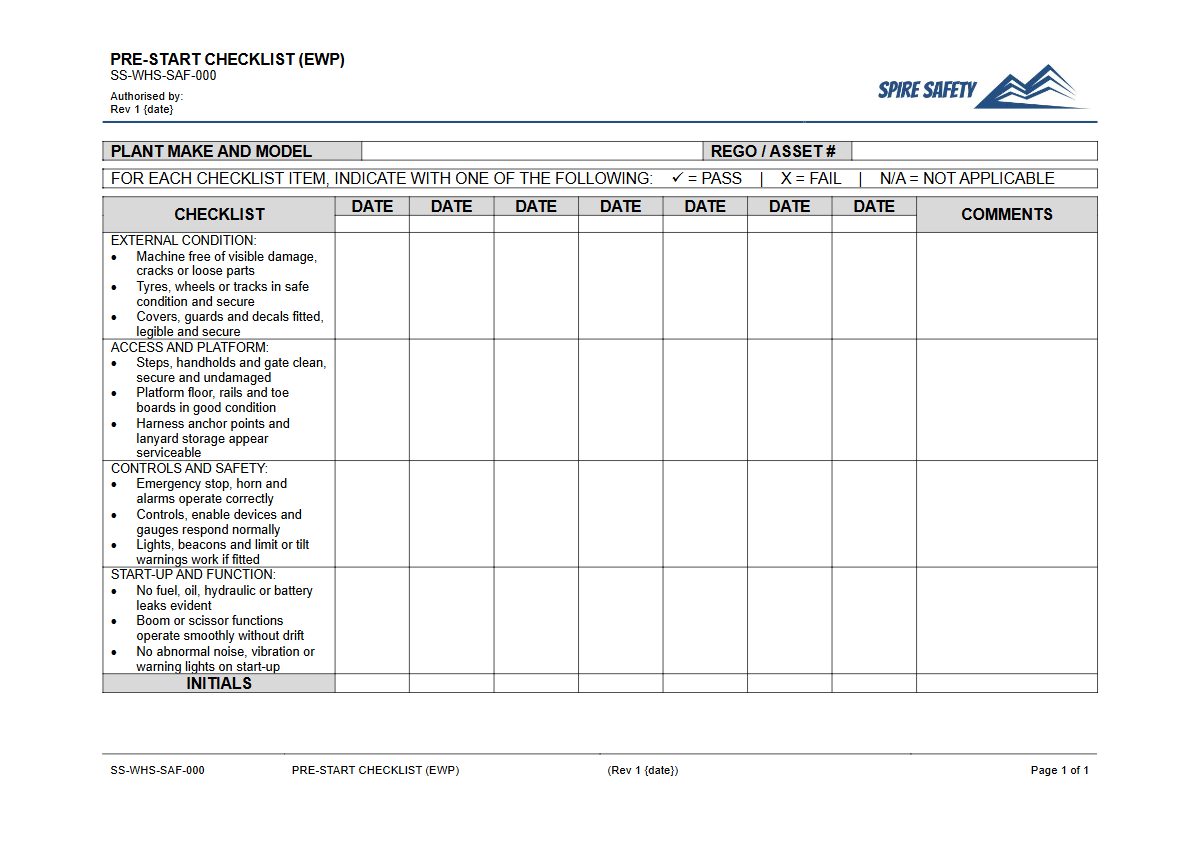
What's Included in an EWP Pre-Start Checklist?
A comprehensive EWP pre-start should cover all critical safety and operational components of the machine. While specifics vary between models, our template provides sections for:
Visual & Structural Checks
- Chassis, wheels, and tyres
- Platform, guardrails, and entry gate
- Structural components for cracks, rust, or damage
- Decals, placards, and control markings
Operational Checks
- Emergency stop controls (ground and platform)
- Operating controls for function, speed, and smoothness
- Emergency lowering system
- Lights, alarms, and horns
Systems & Fluids
- Hydraulic and fuel levels
- Evidence of fluid leaks
- Battery charge and connections
The logic of systematic pre-start checks applies to all high-risk plant, not just EWPs. For example, operators of other heavy machinery would follow a similar process using a specialised tool like our free Pre-Start Checklist (Forwarder) Template to ensure their equipment is safe for use in forestry operations.
When to Use the Pre-Start Checklist
The pre-start inspection must be completed at regular intervals to be effective. The checklist should be used:
- Before the start of each shift: This is the most common and essential use.
- Before first use on a new worksite: A new environment may introduce different risks or reveal issues caused during transport.
- After a long period of inactivity: Equipment that has been idle can develop issues like flat-spotted tyres or drained batteries.
- After any incident or near miss: A thorough inspection is required to ensure the machine was not damaged.
This routine is similar for other mechanical lifting aids, where daily checks are crucial for safety. For instance, in waste management environments, a routine using a document like our free Pre-Start Checklist (Bin Lifter) Template is vital to prevent equipment failure and injuries.
Who Should Use the EWP Pre-Start Checklist?
The primary user of the checklist is the EWP operator. They must be deemed competent and hold the relevant High Risk Work Licence (WP class for boom-type EWPs over 11 metres). The operator is responsible for performing the checks and verifying the machine is safe before they begin work.
Supervisors and managers also have a role. They are responsible for ensuring the pre-start system is being used correctly, reviewing completed checklists, and taking prompt action on any reported faults.
They must ensure that operators do not use equipment that has been tagged out as unsafe. For guidance on developing these broader responsibilities, consider engaging WHS consulting services.
Beyond the Checklist: Safe EWP Operation
A pre-start checklist is just one part of a comprehensive safe work procedure for EWPs. Other critical elements include:
- A Safe Work Method Statement (SWMS) for high-risk construction work.
- Verification of Competency (VOC) for all operators.
- Regularly scheduled maintenance by a qualified technician.
- Site-specific risk assessments to manage hazards like overhead power lines, unstable ground, and vehicle traffic.
Similarly, using other high-risk tools requires a holistic approach to safety. A pre-start inspection for a concrete saw, for instance, should be supported by a SWMS and operator training, similar to the process for using a free Pre-Start Checklist for Floor Saws.
By combining this EWP pre-start checklist with robust procedures and training, you can significantly reduce the risk of incidents. For more templates and safety documents covering a wide range of equipment and tasks, explore our complete free WHS resources library.
Common mistakes
Common mistakes to avoid
- "Pencil-whipping" the form without performing a genuine physical inspection.
- Using a generic checklist that is not customised for the specific make and model of the EWP.
- Failing to immediately tag out and report faulty equipment found during the check.
- Not retaining completed checklists as records for audits or incident investigations.
Legal references
Legal considerations
The following legal requirements may be relevant to this type of work.
- Work Health and Safety Act (Harmonised) — Provides the primary duties for protecting workers and other people from work health and safety risks.
- Work Health and Safety Regulations (Harmonised) — Sets out requirements supporting the management of workplace hazards and risks.
The following codes may be relevant to this type of work.
- Managing WHS Risks Code of Practice — Provides practical guidance on identifying hazards, assessing risks and applying effective controls.
- Work Health and Safety Consultation, Cooperation and Coordination Code of Practice — Provides practical guidance on consulting workers and coordinating with other duty holders.
- Managing the Work Environment and Facilities Code of Practice — Provides practical guidance on safe work environments, workplace facilities and related controls.
Did you know
Licensing Requirements
In Australia, a High Risk Work Licence (class WP) is required to operate a boom-type EWP with a boom length of 11 metres or more. This licence is not required for scissor lifts or vertical lifts.
Leading Cause of Fatalities
According to Safe Work Australia, the most common cause of fatalities involving EWPs is electrocution, followed by falls from the platform and being crushed by the machine.
FAQ
Frequently asked questions
01What is an EWP pre-start checklist?
02Is it a legal requirement to complete a pre-start checklist for an EWP in Australia?
03How often should an EWP pre-start check be performed?
04What happens if a fault is found during the EWP pre-start inspection?
Share this resource
Free Pre-Start Checklist (EWP) Template
Browse Categories
How To Use It
- 1Download and open in Word or PDF.
- 2Replace the placeholders with your business details.
- 3Get it reviewed by a WHS specialist before rollout.
Need it customised?
Our WHS consultants can adapt this template to your site, run a gap analysis, or audit what you already have in place.
Book a Free Consultation WHS consulting servicesor call 1300 156 382