
Free Pre-Start Checklist (Floor Saw) Template
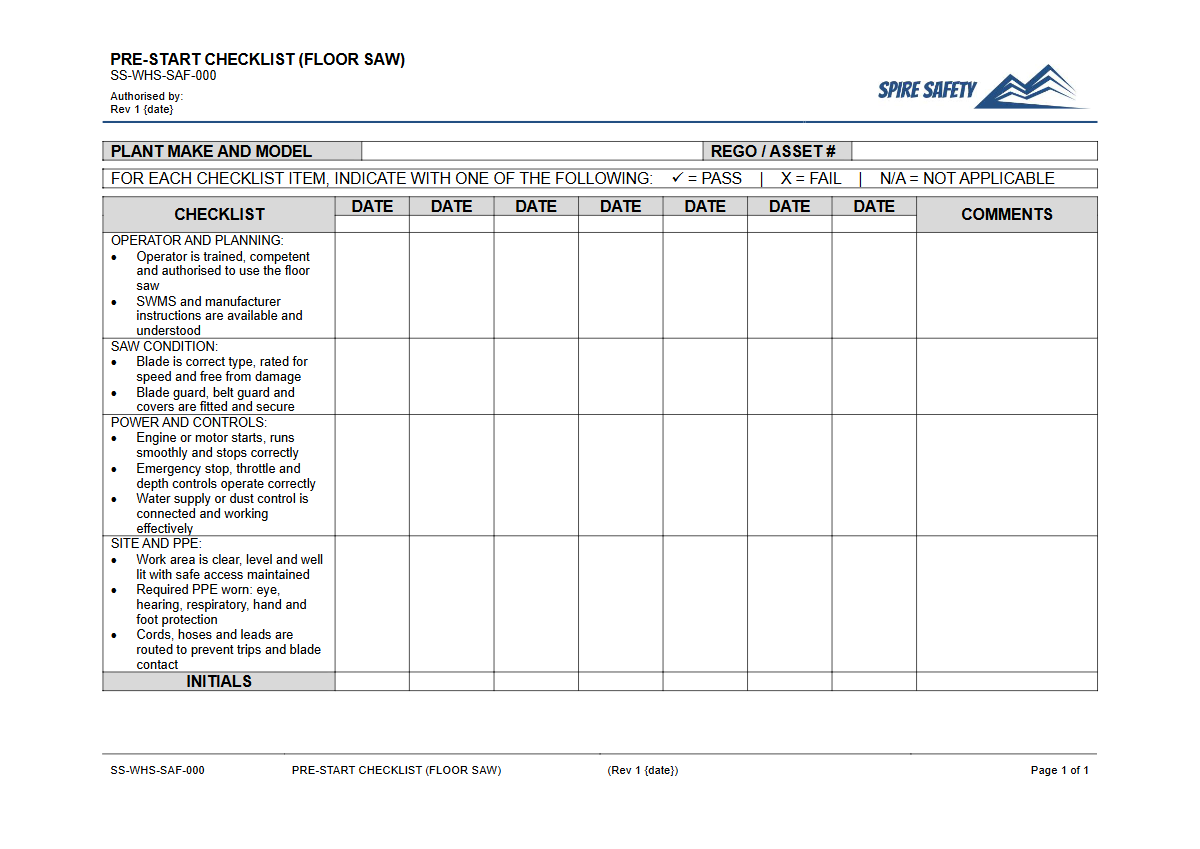
Download a free Pre-Start Checklist for Floor Saws. This structured template (DOCX/PDF) helps formalise equipment safety checks and manage WHS risks.
Free Pre-Start Checklist (Floor Saw) Template
DOCX • 125 KB + PDF
Updated Oct 2026
No signup required
Purpose of the Free Pre-Start Checklist (Floor Saw) Template
Using a floor saw, also known as a concrete saw or flat saw, involves significant risks. This free Pre-Start Checklist (Floor Saw) Template provides a structured method for operators to inspect the equipment before use, ensuring it is in safe working order.
Systematically checking key components like the blade, guards, engine, and safety features helps identify potential defects or damage that could lead to incidents, equipment failure, or operator injury. Regular use of this checklist creates a formal record of inspections, demonstrating due diligence and contributing to a proactive safety culture.
A consistent inspection process is a cornerstone of workplace safety. You can reinforce this principle across your teams by using a Pre-Start Checks and Plant Maintenance Toolbox Talk to discuss the importance of these daily routines.
Key Hazards Addressed
Floor saws present numerous hazards that a pre-start check helps to control, including:
- Mechanical Hazards: Inspecting the blade for cracks, missing teeth, or incorrect mounting, and ensuring guards are secure and functional.
- Noise: While a checklist can't reduce noise, it can confirm the muffler is intact, which is a contributing factor.
- Vibration: Checking for loose components or a poorly maintained engine can help mitigate excessive hand-arm vibration.
- Airborne Contaminants: Ensuring water-suppression systems for dust control are functional is a critical step in managing the risk of respirable crystalline silica.
- Fire/Explosion: Checking for fuel leaks, correct fuel caps, and the condition of electrical leads on electric models.
Video walkthrough
How to Use the Free Pre-Start Checklist (Floor Saw) Template
This Pre-Start Checklist (Floor Saw) Template is designed for immediate use and easy adaptation. After downloading the DOCX or PDF file, integrate it into your daily operational procedures by following these steps:
- Customise the Checklist: This template provides a solid foundation based on Australian WHS principles. However, to be effective, you must customise it. We have included common checkpoints, but you need to add, remove, or modify items to reflect the specific make and model of your floor saw, your site conditions, and your unique operational risks.
- Train Your Operators: Ensure every operator is trained on how to conduct the pre-start inspection thoroughly. They must understand what they are checking, why it's important, and the process for reporting any faults.
- Implement and Monitor: Make the pre-start check a non-negotiable step before every shift. Supervisors should periodically review completed checklists to verify they are being filled out correctly and to ensure any reported issues are actioned promptly.
- File and Retain: Keep completed checklists as part of your WHS records. They serve as evidence of your safety procedures and can be valuable during safety audits or incident investigations.
Integrating this process into your organisation's broader WHS management systems ensures it becomes a routine, tracked, and auditable part of your safety program.
When to Use It
A pre-start checklist for a floor saw should be completed before the equipment is used for the first time each day or at the beginning of every shift. This frequency ensures that any damage or defects that may have occurred overnight, during transport, or from previous use are identified before work commences.
It should also be completed after any significant break in operation or following maintenance or repairs to verify the equipment is safe to return to service.
Who Should Use It
The primary user of this checklist is the competent operator assigned to use the floor saw. This person is best placed to assess the equipment's condition immediately before use.
Supervisors and managers also have a responsibility to ensure the checks are being completed correctly and to review the findings. They are responsible for taking defective equipment out of service and arranging for necessary repairs or maintenance.
Competency is key. The operator must be skilled not only in performing the checks but also in operating the machinery safely.
You can formalise this assessment using our corresponding Verification of Competency (Concrete Saw or Floor Saw) Template to confirm and document their skills.
If you are unsure how to properly customise this template, train your staff, or integrate it into your existing safety framework, engaging professional WHS consulting services can provide expert guidance tailored to your business needs.
This document is just one of many resources designed to support your safety goals. You can explore our complete free WHS resources library for more templates, checklists, and toolbox talks to help you build a safer workplace.
Common mistakes
Common mistakes to avoid
- Ticking boxes without physically inspecting the corresponding item.
- Failing to report or immediately action identified defects.
- Using a generic checklist that doesn't match the specific floor saw model.
- Neglecting to train operators on how to properly conduct the inspection.
Legal references
Legal considerations
The following legal requirements may be relevant to this type of work.
- Work Health and Safety Act (Harmonised) — Provides the primary duties for protecting workers and other people from work health and safety risks.
- Work Health and Safety Regulations (Harmonised) — Sets out requirements supporting the management of workplace hazards and risks.
The following codes may be relevant to this type of work.
- Managing WHS Risks Code of Practice — Provides practical guidance on identifying hazards, assessing risks and applying effective controls.
- Work Health and Safety Consultation, Cooperation and Coordination Code of Practice — Provides practical guidance on consulting workers and coordinating with other duty holders.
- Managing the Work Environment and Facilities Code of Practice — Provides practical guidance on safe work environments, workplace facilities and related controls.
Did you know
Silica Dust Hazard
Cutting concrete with a floor saw generates high levels of respirable crystalline silica (RCS). Inhaling RCS can lead to serious diseases like silicosis, so dust suppression methods (like wet cutting) and appropriate respiratory protection are critical controls.
Hand-Arm Vibration
Prolonged use of floor saws can expose operators to significant Hand-Arm Vibration (HAV), which can cause permanent nerve, muscle, and joint damage. Regular maintenance and job rotation are key to managing this risk.
FAQ
Frequently asked questions
01What is the difference between a pre-start checklist and a SWMS?
02How often should a floor saw pre-start checklist be completed?
03Does using this floor saw checklist guarantee WHS compliance?
04Who is responsible for signing off on a pre-start checklist?
Share this resource
Free Pre-Start Checklist (Floor Saw) Template
Browse Categories
How To Use It
- 1Download and open in Word or PDF.
- 2Replace the placeholders with your business details.
- 3Get it reviewed by a WHS specialist before rollout.
Need it customised?
Our WHS consultants can adapt this template to your site, run a gap analysis, or audit what you already have in place.
Book a Free Consultation WHS consulting servicesor call 1300 156 382