
Free Pre-Start Checklist (Floor Sweeper) Template
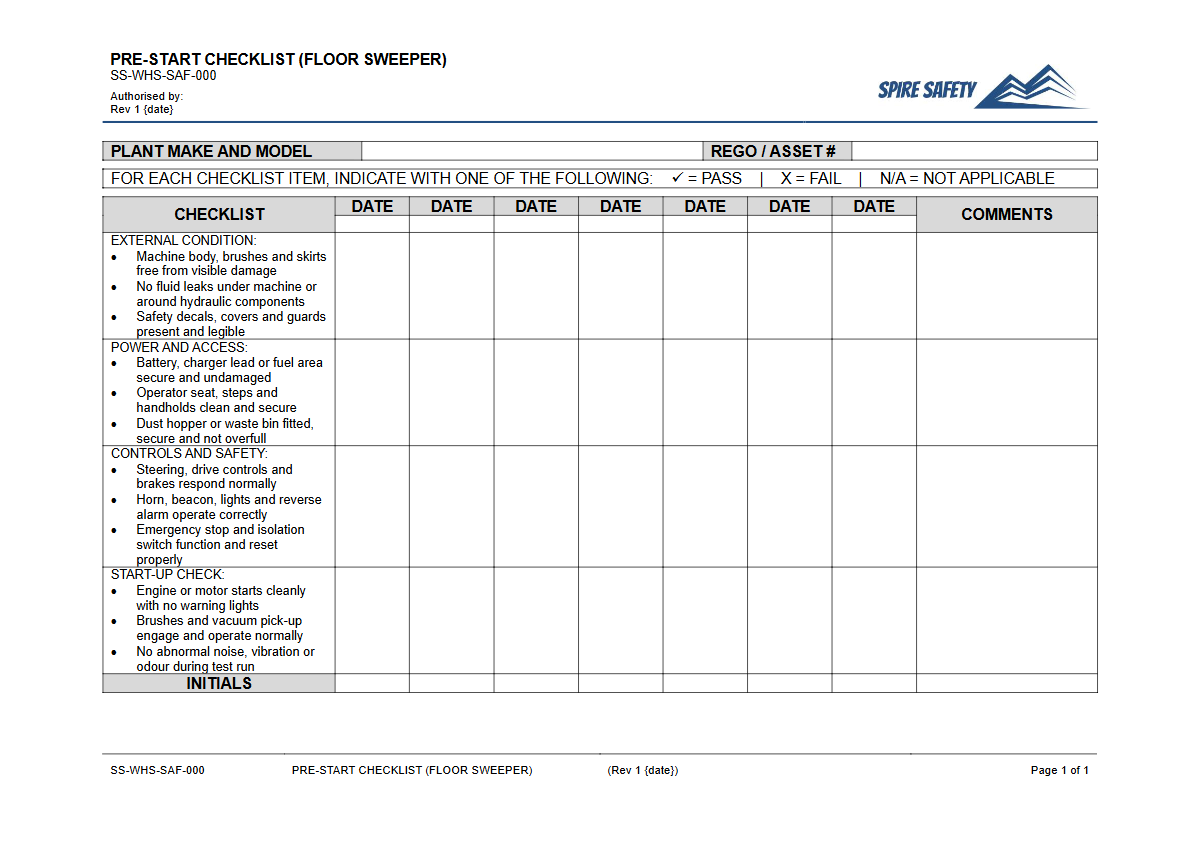
Download our free Pre-Start Checklist for Floor Sweepers. This structured template (DOCX/PDF) helps formalise daily safety inspections and manage WHS risks.
Free Pre-Start Checklist (Floor Sweeper) Template
DOCX • 125 KB + PDF
Updated Oct 2026
No signup required
Purpose of the Free Pre-Start Checklist (Floor Sweeper) Template
Operating a floor sweeper, like any piece of mobile plant, introduces risks into the workplace. A systematic inspection before each use is a critical control measure to ensure the equipment is safe to operate.
This free Pre-Start Checklist (Floor Sweeper) template provides a structured format for operators to verify the mechanical and safety integrity of the machine, helping to identify potential faults before they lead to incidents. Regular use helps prevent breakdowns, reduces the risk of collisions or operator injury, and controls hazards such as hydraulic fluid leaks or exposure to dust.
Integrating this checklist into your daily routine demonstrates a commitment to proactive safety management. It forms a key part of an organisation's duty of care to provide and maintain safe plant. Formalising these checks creates a documented record that can be used for maintenance scheduling, incident investigation, and performance review within your broader WHS management systems.
Video walkthrough
How to use the Free Pre-Start Checklist (Floor Sweeper) Template
Using this template effectively involves more than just downloading and printing. Follow these steps to integrate it properly into your safety procedures:
- Download: Choose between the DOCX format for easy customisation or the PDF for immediate use.
- Customise: Adapt the checklist to the specific make and model of your floor sweeper. Add or remove checks based on manufacturer recommendations and a site-specific risk assessment.
- Train: Ensure all operators are trained not only on how to operate the sweeper but also on the importance and correct procedure for completing the pre-start check.
- Implement: Make the checklist a mandatory step before any operator begins their shift. Establish a clear process for what to do if a fault is identified, including tagging the equipment out of service and reporting the issue to a supervisor.
- Review: Periodically review completed checklists to identify recurring faults or patterns of damage, which may indicate a need for further training or a review of operating procedures.
Please note: We have designed this template as a foundational guide. You must customise it to reflect the specific make, model, and configuration of your floor sweeper, as well as the unique environmental conditions and risks of your workplace.
A generic checklist cannot account for the unique features of every machine, much like how a Pre-Start Checklist for a Bench Grinder differs significantly from one for mobile plant.
When to use a Floor Sweeper Pre-Start Checklist
A pre-start check should be completed by the operator before the floor sweeper is used for the first time on any given day or at the beginning of each shift. This frequency ensures that any damage or faults that may have occurred since its last use—whether from the previous shift, during storage, or overnight—are identified before the machine is put into operation.
Consistency is key; making the check a non-negotiable part of the daily startup routine helps build a strong safety culture and prevents complacency.
What Should the Checklist Cover?
A comprehensive checklist should be grouped into logical sections for clarity. While your customised version will be specific to your equipment, key areas to inspect generally include:
- General Condition & Structure: Look for any signs of physical damage, loose parts, or fluid leaks (hydraulic, oil, coolant). Check the condition of the chassis, guards, and covers.
- Operator's Compartment: Ensure the seat, seatbelt, and access steps are secure and in good condition. Check for clear visibility through all windows and mirrors.
- Safety Features: Test the horn, lights, indicators, and reversing alarm. Verify that any emergency stop buttons function correctly and that all safety guards are in place and secure.
- Controls & Operation: Check steering and braking systems for correct operation. Test the function of the brushes, vacuum system, and water sprayers (if applicable).
- Power & Fluids: Verify fuel, hydraulic oil, and coolant levels. For electric models, check the battery charge level and the condition of charging cables and connections. Inspect tyres for correct pressure and any signs of wear or damage.
This process of systematically checking equipment is fundamental to workplace safety, whether you are preparing a floor sweeper or using a Free Pre-Start Checklist (Floor Saw) Template for concrete cutting tasks.
Who should use the Pre-Start Checklist
The primary person responsible for completing the pre-start checklist is the operator assigned to use the floor sweeper. As the individual directly interacting with the equipment, they are best placed to notice subtle changes or potential defects.
All operators must be deemed competent, having received adequate training and instruction on both the sweeper's operation and the pre-start inspection process.
Supervisors and managers also have a role. They are responsible for ensuring operators are completing the checks correctly and for taking prompt action when faults are reported.
This includes arranging for repairs and ensuring the equipment is not used until it is safe. The effectiveness of these procedures can be verified through processes like WHS compliance auditing. These audits help confirm that documented safety processes are being followed in practice throughout the organisation.
Ultimately, the Person Conducting a Business or Undertaking (PCBU) holds the primary duty of care to ensure the provision and maintenance of safe plant. Implementing mandatory pre-start inspections using a tool like this template is a practical way to help meet that obligation. For more templates and safety documents, browse our complete free WHS resources library.
Common mistakes
Common mistakes to avoid
- Pencil-whipping the checklist without physically inspecting the items.
- Using a generic checklist that doesn't match the specific floor sweeper model.
- Failing to report 'minor' issues like a worn tyre or a small leak, which can escalate into major failures.
- Continuing to operate the machine after identifying a fault, even for 'just a quick job'.
Legal references
Legal considerations
The following legal requirements may be relevant to this type of work.
- Work Health and Safety Act (Harmonised) — Provides the primary duties for protecting workers and other people from work health and safety risks.
- Work Health and Safety Regulations (Harmonised) — Sets out requirements supporting the management of workplace hazards and risks.
The following codes may be relevant to this type of work.
- Managing WHS Risks Code of Practice — Provides practical guidance on identifying hazards, assessing risks and applying effective controls.
- Work Health and Safety Consultation, Cooperation and Coordination Code of Practice — Provides practical guidance on consulting workers and coordinating with other duty holders.
- Managing the Work Environment and Facilities Code of Practice — Provides practical guidance on safe work environments, workplace facilities and related controls.
Did you know
Dust Control
Modern industrial floor sweepers are primarily designed for dust control, not just debris collection. Their integrated vacuum and filter systems are critical for preventing worker exposure to harmful airborne particulates like crystalline silica.
Battery Hazards
For electric floor sweepers, the battery packs can pose significant risks. They are heavy, can produce explosive hydrogen gas during charging, and contain corrosive acid, requiring specific safe handling and charging procedures.
FAQ
Frequently asked questions
01What are the main hazards of operating a floor sweeper?
02Is a pre-start check a legal requirement for floor sweepers in Australia?
03How long should a floor sweeper pre-start check take?
04What should happen if a fault is found during a pre-start check?
Share this resource
Free Pre-Start Checklist (Floor Sweeper) Template
Browse Categories
How To Use It
- 1Download and open in Word or PDF.
- 2Replace the placeholders with your business details.
- 3Get it reviewed by a WHS specialist before rollout.
Need it customised?
Our WHS consultants can adapt this template to your site, run a gap analysis, or audit what you already have in place.
Book a Free Consultation WHS consulting servicesor call 1300 156 382