
Free Pre-Start Checklist (Food Warmer) Template
Download our free Pre-Start Checklist for Food Warmers.
Free Pre-Start Checklist (Food Warmer) Template
DOCX • 125 KB + PDF
Updated Oct 2026
No signup required
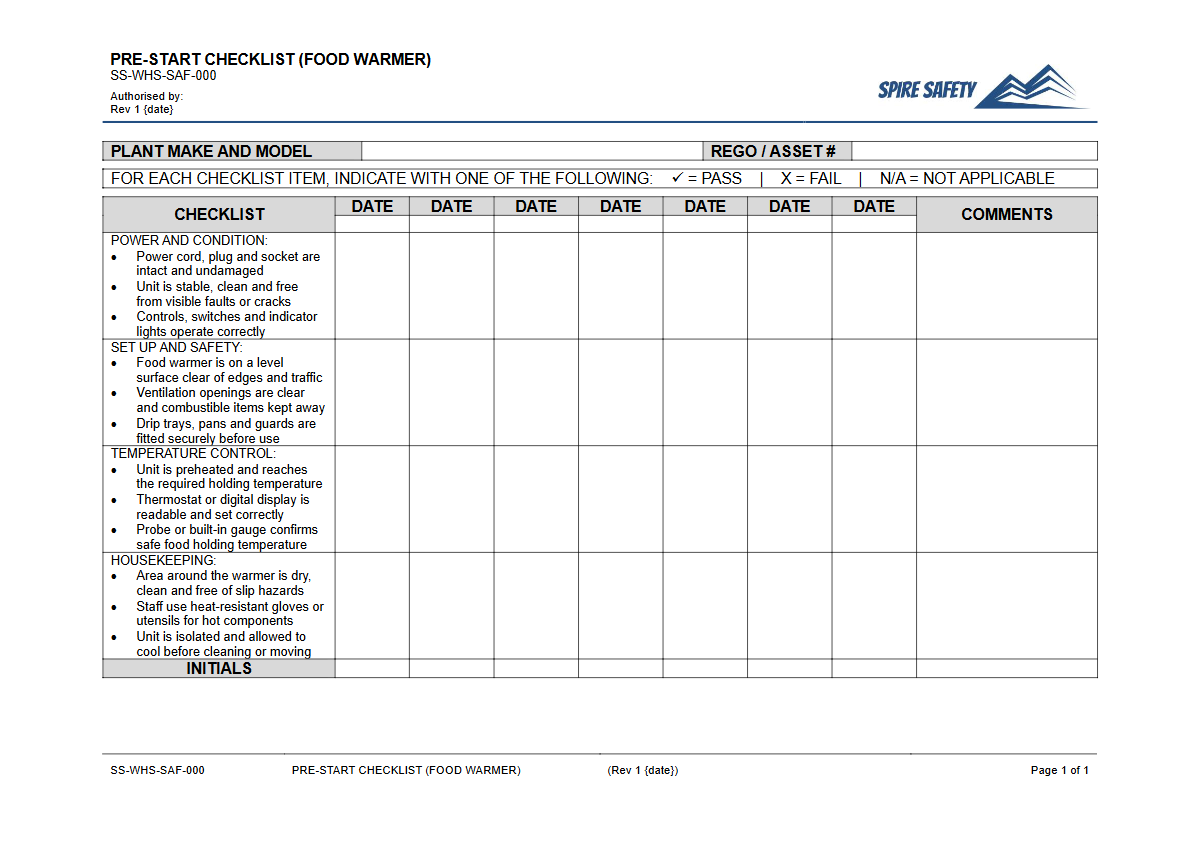
Purpose of the Free Pre-Start Checklist (Food Warmer) Template
Ensuring the safe and effective operation of commercial food warmers, such as bain-maries and hot holding cabinets, is critical in any food service environment. This Free Pre-Start Checklist (Food Warmer) Template provides a structured starting point for formalising daily equipment inspections.
Regular checks help identify potential hazards before they cause harm, such as electrical faults, overheating, or contamination risks. Using a checklist promotes a consistent inspection process, helping your organisation meet its duty of care to provide safe plant and equipment for workers.
The primary goals of this Pre-Start Checklist are to prevent injuries from burns or electrical shock, ensure the equipment can maintain safe food holding temperatures, and prolong the operational life of the asset. Integrating these checks into your broader WHS management system ensures they are performed consistently and that records are maintained, providing valuable data for maintenance schedules and risk assessments.
Video walkthrough
How to use the Free Pre-Start Checklist (Food Warmer) Template
This template is provided in both DOCX and PDF formats for your convenience. The DOCX file is fully editable, allowing you to tailor it to the specific food warmers used in your workplace.
Different models have unique features, controls, and potential failure points, so customisation is essential for the checklist to be effective.
Note: This document is a template only. You must customise it to suit the specific equipment, environment, and operational risks of your workplace.
We recommend consulting with the workers who operate the equipment, as well as supervisors and maintenance personnel, to ensure the checklist is practical and comprehensive. Your final document should accurately reflect all necessary safety and operational checks for your particular assets.
Regular reviews of your safety procedures, sometimes conducted as part of a formal WHS compliance auditing program, can identify gaps and opportunities for improvement in your pre-start process.
When to use it
A pre-start check should be completed before the food warmer is used for the first time each day or at the beginning of every shift. This frequency ensures that any damage or faults that may have occurred overnight or between shifts (e.g., from cleaning or movement) are identified before the unit is energised and filled with food.
Documenting each check creates a historical record that is useful for tracking equipment condition and demonstrating due diligence.
Regular equipment checks are a core part of any preventative maintenance program, a topic covered in our Pre-Start Checks and Plant Maintenance Toolbox Talk template. This proactive approach helps minimise downtime and prevent costly emergency repairs.
Who should use it
The pre-start checklist should be used by the person operating the equipment. This typically includes kitchen hands, chefs, cooks, and other food service staff.
It is the responsibility of supervisors and managers to ensure that workers are trained on how to conduct the checks properly and understand the importance of reporting any identified faults immediately.
A thorough understanding of equipment checks is also vital for maintaining food safety standards, which can be reinforced with a Food Safety Awareness Toolbox Talk. Similar principles of pre-operational inspection apply to other kitchen equipment, and you can find examples in resources like our Free Pre-Start Checklist (Coffee Grinder) Template.
By making these simple checks part of the daily routine, you empower workers to take an active role in workplace safety. For more downloadable templates, guides, and checklists to support your WHS program, browse our complete free WHS resources library.
Common mistakes
Common mistakes to avoid
- Forgetting to check the thermostat's accuracy, leading to food being held at unsafe temperatures.
- Ignoring frayed or damaged power cords, creating a significant electrical shock or fire hazard.
- Only performing a visual check without physically testing controls, dials, and safety features.
- Failing to document the check or report identified faults, meaning hazards are not rectified.
Legal references
Legal considerations
The following legal requirements may be relevant to this type of work.
- Work Health and Safety Act (Harmonised) — Provides the primary duties for protecting workers and other people from work health and safety risks.
- Work Health and Safety Regulations (Harmonised) — Sets out requirements supporting the management of workplace hazards and risks.
The following codes may be relevant to this type of work.
- Managing WHS Risks Code of Practice — Provides practical guidance on identifying hazards, assessing risks and applying effective controls.
- Work Health and Safety Consultation, Cooperation and Coordination Code of Practice — Provides practical guidance on consulting workers and coordinating with other duty holders.
- Managing the Work Environment and Facilities Code of Practice — Provides practical guidance on safe work environments, workplace facilities and related controls.
Did you know
Temperature Danger Zone
Food must be held at 60°C or hotter to stay out of the 'temperature danger zone' (5°C to 60°C), where bacteria can grow rapidly. Pre-start checks help verify your warmer can achieve and maintain this.
Electrical Safety
According to Safe Work Australia, contact with electricity is a significant cause of workplace injury. Checking cords and plugs on appliances like food warmers is a simple but critical step in preventing electrical incidents.
FAQ
Frequently asked questions
01Why are pre-start checks for food warmers important?
02What should be included in a food warmer pre-start checklist?
03How often should a food warmer pre-start check be done?
04Can this template be used for all types of food warmers?
Share this resource
Free Pre-Start Checklist (Food Warmer) Template
Browse Categories
How To Use It
- 1Download and open in Word or PDF.
- 2Replace the placeholders with your business details.
- 3Get it reviewed by a WHS specialist before rollout.
Need it customised?
Our WHS consultants can adapt this template to your site, run a gap analysis, or audit what you already have in place.
Book a Free Consultation WHS consulting servicesor call 1300 156 382