
Free Pre-Start Checklist (Forest Harv) Template
Download our free Pre-Start Checklist (Forest Harv) Template to improve safety and formalise equipment inspections.
Free Pre-Start Checklist (Forest Harv) Template
DOCX • 125 KB + PDF
Updated Oct 2026
No signup required
Purpose of the Free Pre-Start Checklist (Forest Harv) Template
Operating a forest harvester involves significant risks, from powerful cutting mechanisms to challenging and uneven terrain. A systematic pre-start inspection is a fundamental safety control for any person conducting a business or undertaking (PCBU).
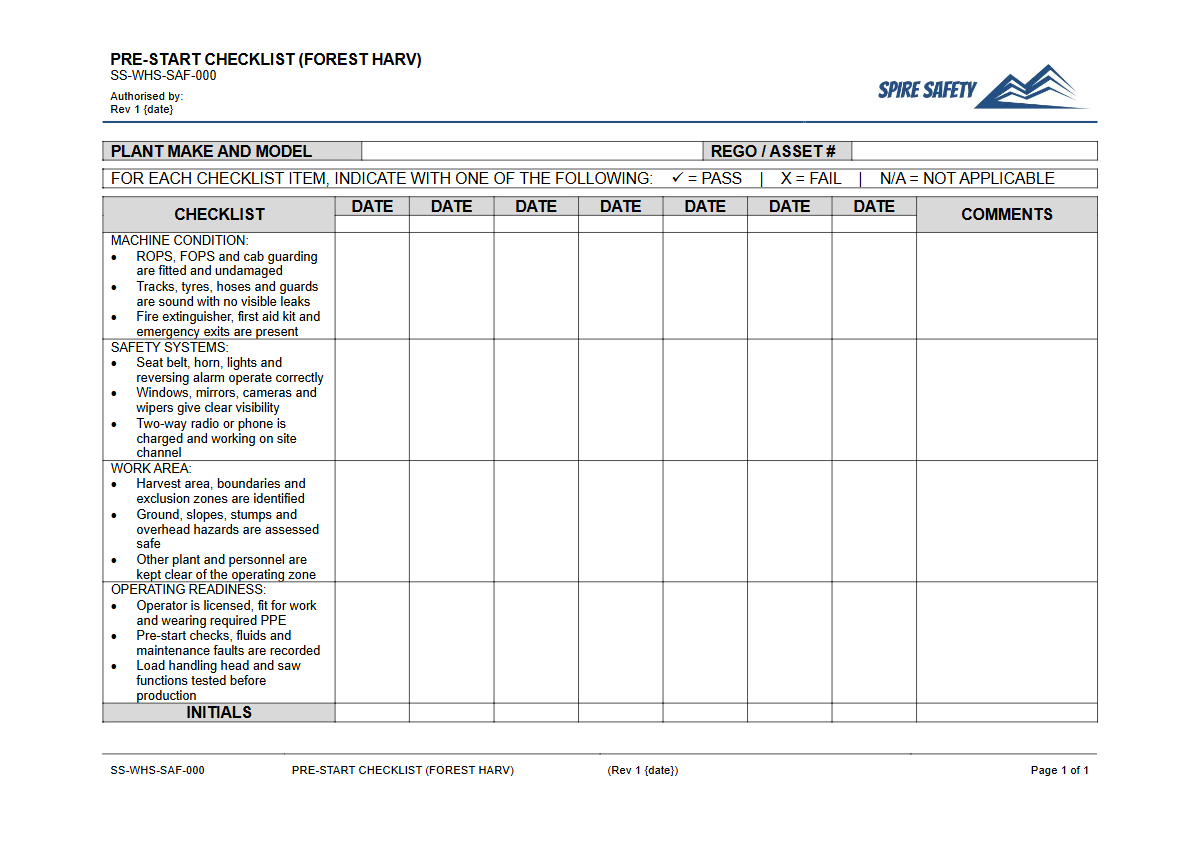
Our free Pre-Start Checklist (Forest Harv) Template provides a structured starting point to formalise daily equipment checks. Using this document helps operators methodically inspect critical components, identify potential faults before they lead to incidents or costly downtime, and demonstrate a commitment to workplace health and safety. Integrating such checks is a key component of effective WHS management systems.
The primary purpose of this Free Pre-Start Checklist (Forest Harv) Template is to provide a comprehensive guide for inspecting the unique components and risks associated with these powerful machines. Forestry operations present a high-risk environment, and equipment failure can have severe consequences.
This checklist prompts checks on vital safety and operational systems, including the cutting head, saw chains and bars, hydraulic lines and fluid levels, cabin protection structures (ROPS/FOPS), fire suppression systems, and communication equipment. By standardising this process, you create a consistent safety benchmark across all operators and machines.
Video walkthrough
How to use the Free Pre-Start Checklist (Forest Harv) Template
This template is designed as a foundation that you must build upon. To implement it effectively, download the DOCX file and adapt it to your specific operational context.
This involves adding or removing checks based on the exact make and model of your forest harvesters, any specific attachments used, and the unique environmental conditions of your worksite.
We must stress that this document is a template, not a finished, universal procedure. Your organisation is responsible for ensuring the final checklist is comprehensive and fit for purpose. Once customised, provide training to all operators so they understand not just how to fill out the form, but the reason and importance behind each checkpoint. These checks can also form the basis of safety discussions, such as a regular Pre-Start Checks and Plant Maintenance Toolbox Talk.
For complex machinery or high-risk environments, tailoring safety documents can be a challenging task. If you require assistance in adapting this template or developing other site-specific safety procedures, engaging expert advice through WHS consulting can ensure your documentation is robust and practical for your needs.
When to use it
A pre-start inspection should be a non-negotiable part of the daily routine. The checklist should be completed by a competent operator at the following times:
- Before the beginning of every work shift.
- Before the machine is used for the first time on any given day.
- Following a change of operator during a shift.
- After the machine has been idle for an extended period.
- After significant maintenance or repair work has been performed.
Who should use it
The primary user of this checklist is the forest harvester operator. They are in the best position to notice small changes or early signs of malfunction.
The person completing the check must be deemed competent to not only operate the machinery but also to understand the items they are inspecting. Supervisors and managers also play a crucial role in ensuring the pre-start checks are being completed correctly, reviewing the completed forms for any reported defects, and ensuring that any identified issues are rectified before the machine is used.
Completed checklists become important records for maintenance personnel to track equipment health and identify recurring faults.
Ensuring Records and Compliance
Simply ticking boxes is not enough to ensure safety. Completed pre-start checklists are important WHS records that demonstrate due diligence and provide valuable data for your maintenance program.
They should be stored systematically, either physically or digitally, and reviewed periodically to identify trends or recurring issues. This documentation forms a key part of your safety evidence and can be reviewed during an internal WHS compliance auditing process to verify that safety procedures are being followed effectively. For more templates and safety guides, feel free to browse our complete free WHS resources library.
Common mistakes
Common mistakes to avoid
- "Pencil-whipping" the checklist without physically inspecting each component.
- Failing to customise the generic template for specific machine attachments or models.
- Not having a clear, enforced procedure for reporting faults and taking faulty equipment out of service.
- Providing inadequate operator training on what each checkpoint actually entails and why it is important.
Legal references
Legal considerations
The following legal requirements may be relevant to this type of work.
- Work Health and Safety Act (Harmonised) — Provides the primary duties for protecting workers and other people from work health and safety risks.
- Work Health and Safety Regulations (Harmonised) — Sets out requirements supporting the management of workplace hazards and risks.
The following codes may be relevant to this type of work.
- Managing WHS Risks Code of Practice — Provides practical guidance on identifying hazards, assessing risks and applying effective controls.
- Work Health and Safety Consultation, Cooperation and Coordination Code of Practice — Provides practical guidance on consulting workers and coordinating with other duty holders.
- Managing the Work Environment and Facilities Code of Practice — Provides practical guidance on safe work environments, workplace facilities and related controls.
Did you know
Forestry Safety
The forestry and logging industry consistently ranks as one of the most hazardous in Australia, highlighting the critical importance of robust safety procedures like pre-start checks for high-risk machinery.
FAQ
Frequently asked questions
01What makes a forest harvester a high-risk piece of plant?
02How often should a pre-start check on a forest harvester be done?
03Is this template alone enough for WHS compliance?
04What happens if a fault is found during the pre-start check?
Share this resource
Free Pre-Start Checklist (Forest Harv) Template
Browse Categories
How To Use It
- 1Download and open in Word or PDF.
- 2Replace the placeholders with your business details.
- 3Get it reviewed by a WHS specialist before rollout.
Need it customised?
Our WHS consultants can adapt this template to your site, run a gap analysis, or audit what you already have in place.
Book a Free Consultation WHS consulting servicesor call 1300 156 382