
Free Pre-Start Checklist (Forklift) Template
Download our free Pre-Start Checklist (Forklift) Template.
Free Pre-Start Checklist (Forklift) Template
DOCX • 125 KB + PDF
Updated Oct 2026
No signup required
Purpose of the Free Pre-Start Checklist (Forklift) Template
Implementing a daily inspection using this Free Pre-Start Checklist (Forklift) Template is a critical step in maintaining a safe workplace. Its primary purpose is to provide a structured method for forklift operators to systematically check the equipment before use.
This process helps to identify any potential defects, damage, or maintenance issues that could compromise safety during operation. By documenting these checks, your organisation creates a formal record of due diligence, demonstrating a commitment to proactive risk management.
Regular, documented inspections are a fundamental component of effective WHS management systems, helping to prevent incidents, reduce downtime, and ensure the ongoing mechanical safety of your plant.
Video walkthrough
How to use the Free Pre-Start Checklist (Forklift) Template
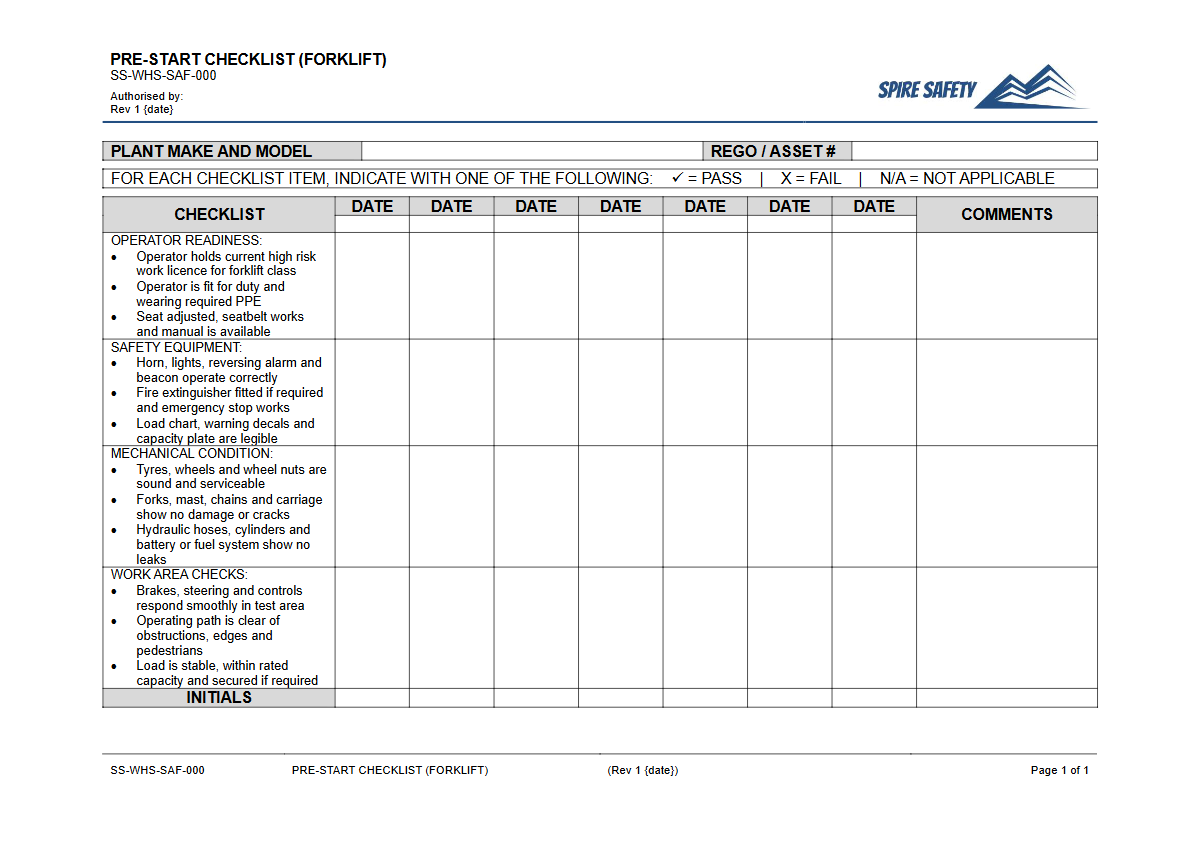
This Pre-Start Checklist is available for download as a DOCX file for easy customisation or a PDF for immediate printing. The checklist is divided into logical sections covering key components of a standard forklift, including visual checks, operational controls, and safety features.
To use it effectively, operators should complete the checklist at the beginning of their shift, methodically inspecting each item listed and ticking it off. The document includes space to record details of any faults found, the date, operator's name, and supervisor's sign-off.
Important: This document is a template and must be customised to your specific needs. We've created it as a general guide, but you should review and amend it to suit the particular make and model of your forklifts, your site-specific hazards, and any unique attachments used, such as those covered in our Forklift Jib SOP.
When to conduct a Forklift Pre-Start Checklist
A forklift pre-start inspection should be carried out before the forklift is used for the first time on any given day or at the beginning of every shift. If multiple operators use the same forklift throughout a 24-hour period, each operator should conduct their own pre-start check before they begin their work.
This ensures that any faults that may have developed during the previous shift are identified immediately. Making these inspections a non-negotiable daily routine reinforces safe work practices and can be supported with regular training, such as the topics covered in our Pre-Start Checks and Plant Maintenance Toolbox Talk Template.
Who should use it
The checklist is designed to be completed by a competent person—specifically, a licensed forklift operator who is familiar with the machine's functions and features. The operator holds the primary responsibility for ensuring the equipment is safe to use before they commence work.
Supervisors and managers also have a role in reviewing completed checklists, ensuring the checks are being performed correctly, and actioning any reported faults or defects in a timely manner. This process also helps verify an operator's knowledge and can complement formal assessments like those detailed in a Verification of Competency for a Rough Terrain Forklift.
What to Inspect on a Forklift
A thorough pre-start inspection covers three main areas: visual, operational, and safety features.
- Visual Checks: Examine the condition of the tyres (pressure and damage), forks (cracks or bends), mast assembly, chains, hydraulic hoses (leaks), fluid levels (oil, fuel, coolant), and the general structural integrity of the machine.
- Operational Checks: Test the brakes, steering, and hydraulic controls (lift, tilt, side-shift). Sound the horn and check all lights (headlights, brake lights, indicators) and warning devices like reversing beepers.
- Safety Features: Ensure the seatbelt is functional, overhead guards are secure, the load backrest is in place, and the data/capacity plate is legible and correct for the machine. These topics are essential for promoting a safety-first culture, which can be reinforced using resources like our Forklift Safety Toolbox Talk Template.
Managing Identified Faults
If an operator identifies a defect during the pre-start check that could affect the safe operation of the forklift, the machine must not be used. It should be immediately removed from service, with a 'Do Not Operate' or 'Out of Service' tag attached in a highly visible location, such as on the steering wheel.
The fault must be reported to a supervisor or the designated maintenance person according to your workplace's procedures. Using the forklift should only resume once the fault has been rectified by a qualified person and the machine is confirmed to be safe. This entire process should be outlined in your company's FREE Forklift SOP (Safe Operating Procedure) Template.
Common mistakes
Common mistakes to avoid
- "Pencil-whipping" the form without physically performing each inspection.
- Failing to immediately tag out and report faulty or damaged equipment.
- Using a generic checklist that doesn't cover the specific model, attachments, or hazards of the workplace.
- Not retaining completed checklists as a record of inspection and for maintenance planning.
Legal references
Legal considerations
The following legal requirements may be relevant to this type of work.
- Work Health and Safety Act (Harmonised) — Provides the primary duties for protecting workers and other people from work health and safety risks.
- Work Health and Safety Regulations (Harmonised) — Sets out requirements supporting the management of workplace hazards and risks.
The following codes may be relevant to this type of work.
- Managing WHS Risks Code of Practice — Provides practical guidance on identifying hazards, assessing risks and applying effective controls.
- Work Health and Safety Consultation, Cooperation and Coordination Code of Practice — Provides practical guidance on consulting workers and coordinating with other duty holders.
- Managing the Work Environment and Facilities Code of Practice — Provides practical guidance on safe work environments, workplace facilities and related controls.
Did you know
Forklift Stability
A forklift's stability depends on keeping the combined centre of gravity (of the truck and its load) within the 'stability triangle' formed between its front wheels and the rear axle's pivot point. Exceeding this can easily lead to a tip-over.
Licensing is Key
Operating a forklift in Australia requires a specific High Risk Work Licence (class LF for standard forklifts). This is a national requirement and is separate from a standard car driver's licence.
FAQ
Frequently asked questions
01Is a forklift pre-start checklist a legal requirement in Australia?
02How often should a forklift pre-start check be done?
03What happens if a fault is found during a pre-start check?
04Can this forklift checklist be used for any type of forklift?
Share this resource
Free Pre-Start Checklist (Forklift) Template
Browse Categories
How To Use It
- 1Download and open in Word or PDF.
- 2Replace the placeholders with your business details.
- 3Get it reviewed by a WHS specialist before rollout.
Need it customised?
Our WHS consultants can adapt this template to your site, run a gap analysis, or audit what you already have in place.
Book a Free Consultation WHS consulting servicesor call 1300 156 382