
Free Pre-Start Checklist (Front Loader) Template
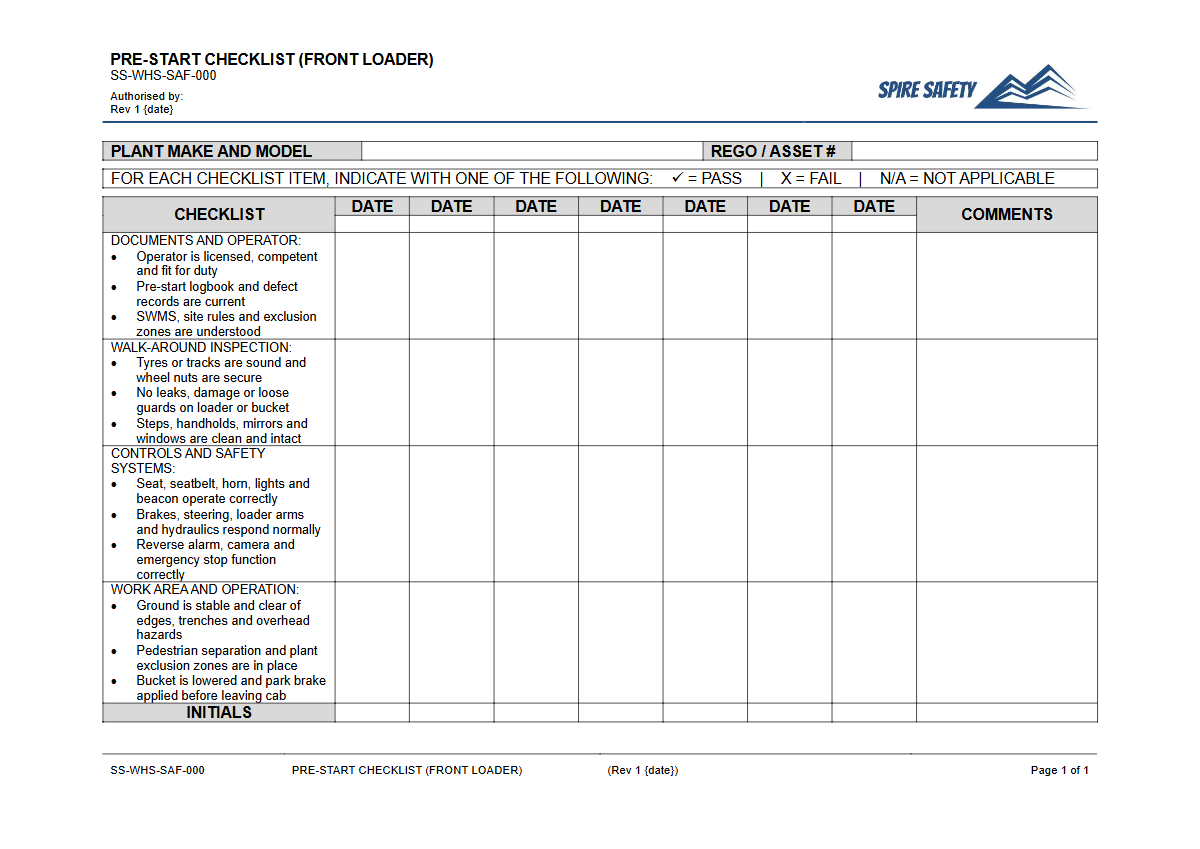
Download our Free Pre-Start Checklist (Front Loader) Template in an editable DOCX and PDF format. Formalise daily checks and improve equipment safety.
Free Pre-Start Checklist (Front Loader) Template
DOCX • 125 KB + PDF
Updated Oct 2026
No signup required
Purpose of the Free Pre-Start Checklist (Front Loader) Template
Operating a front loader involves significant risks, making daily equipment inspections non-negotiable. This Free Pre-Start Checklist (Front Loader) Template provides a structured format for operators to conduct thorough, consistent safety checks before each shift.
Regular use helps identify mechanical faults, hydraulic leaks, or structural damage before they lead to incidents, equipment failure, or costly downtime. Formalising this process ensures that critical safety components are inspected every time, creating a reliable record of the machine's condition and supporting a proactive safety culture. It's a foundational step in managing the specific hazards associated with this type of heavy mobile plant, which should be detailed in your Front End Loader Risk Assessment Template.
Video walkthrough
How to use the Free Pre-Start Checklist (Front Loader) Template
Download the template in your preferred format (DOCX for easy editing or PDF for straightforward printing). Before implementing it, your organisation must customise the contents to reflect the specific make, model, and configuration of your front loaders, as well as your site-specific operational risks and procedures.
This document is a starting point, not a finished product.
Important: We have provided this template as a guide aligned with Australian WHS principles. You must adapt it to suit the unique requirements of your workplace and equipment.
Consult the operator's manual and conduct a risk assessment to ensure all necessary inspection points are included. Integrating this checklist into your operational workflow is best done as part of a documented procedure, such as a Front End Loader SOP (Safe Operating Procedure).
Key Sections of the Checklist
A comprehensive pre-start checklist for a front loader typically covers several key areas to ensure its safe operation:
- General Visual Inspection: Checking for obvious signs of damage, leaks, loose parts, and the overall cleanliness of the machine, including the cab and windows.
- Fluid Levels: Verifying engine oil, hydraulic fluid, coolant, and fuel levels are within the manufacturer's specified operating range.
- Tyres and Wheels: Inspecting tyre pressure, condition (cuts, bulges), and ensuring wheel nuts are secure.
- Safety Features: Testing critical safety systems like the horn, lights, indicators, reversing alarm, seatbelt, mirrors, and fire extinguisher.
- Operator's Cabin: Ensuring controls are clearly labelled and functioning, the seat is secure, and there is no debris obstructing pedals or levers.
- Hydraulics and Attachments: Checking hoses for leaks or wear, and ensuring the bucket, forks, or other attachments are securely mounted and function correctly through their full range of motion.
When to use it
A pre-start check must be completed before the front loader is used for the first time on any shift or after a change of operator. This routine ensures the machine's condition is verified at the start of each work period.
If any defects or issues are identified, the machine should be tagged out of service and the fault reported immediately according to your organisation's maintenance procedures. Maintaining records of these completed checklists is crucial for demonstrating due diligence and tracking the equipment's service history.
These records complement other operator documents, such as a Front End Loader VOC (Verification of Competency), to form a complete picture of safe operation.
Who should use it
The pre-start checklist should be completed by the person operating the front loader. Operators have a direct responsibility to ensure the equipment they are using is safe.
They are the most familiar with the machine's day-to-day performance and are best placed to notice subtle changes or new faults. Supervisors or managers also have a role in ensuring these checks are being conducted correctly and consistently.
They should periodically review completed checklists and ensure that any reported defects are addressed in a timely manner. Reinforcing these responsibilities can be effectively done through regular training sessions, like a Pre-Start Checks and Plant Maintenance Toolbox Talk.
Integrating Pre-Starts into Your Safety System
Pre-start checklists are not a standalone activity; they are a vital component of your overall safety framework. To be effective, they must be integrated into your WHS management systems. This involves establishing clear procedures for reporting and rectifying defects, training workers on how to properly complete the checks, and periodically reviewing the process to ensure its effectiveness.
By embedding these checks into your daily routine, you move from a reactive to a proactive approach to plant safety, preventing incidents before they occur. For more tools to support your safety framework, browse our complete free WHS resources library.
Common mistakes
Common mistakes to avoid
- "Pencil-whipping" the form without actually performing the checks.
- Ignoring minor fluid weeps or leaks that can indicate a developing major failure.
- Failing to check the security and condition of attachments like buckets or forks.
- Not immediately tagging out and reporting a machine with a identified safety defect.
Legal references
Legal considerations
The following legal requirements may be relevant to this type of work.
- Work Health and Safety Act (Harmonised) — Provides the primary duties for protecting workers and other people from work health and safety risks.
- Work Health and Safety Regulations (Harmonised) — Sets out requirements supporting the management of workplace hazards and risks.
The following codes may be relevant to this type of work.
- Managing WHS Risks Code of Practice — Provides practical guidance on identifying hazards, assessing risks and applying effective controls.
- Work Health and Safety Consultation, Cooperation and Coordination Code of Practice — Provides practical guidance on consulting workers and coordinating with other duty holders.
- Managing the Work Environment and Facilities Code of Practice — Provides practical guidance on safe work environments, workplace facilities and related controls.
Did you know
Blind Spot Dangers
Front loaders have significant blind spots, particularly to the rear and sides. Many incidents involving collisions with pedestrians or other vehicles occur because the operator's view was obstructed.
Tyre Pressure is Critical
Incorrect tyre pressure on a front loader can drastically affect its stability, especially when carrying a heavy load. Under-inflation can lead to tyre failure, while over-inflation reduces traction and can make the machine unstable.
FAQ
Frequently asked questions
01What should happen if a fault is found during a front loader pre-start check?
02How long do we need to keep pre-start checklist records in Australia?
03Is a digital pre-start checklist acceptable?
04Can this checklist be used for other types of loaders?
Share this resource
Free Pre-Start Checklist (Front Loader) Template
Browse Categories
How To Use It
- 1Download and open in Word or PDF.
- 2Replace the placeholders with your business details.
- 3Get it reviewed by a WHS specialist before rollout.
Need it customised?
Our WHS consultants can adapt this template to your site, run a gap analysis, or audit what you already have in place.
Book a Free Consultation WHS consulting servicesor call 1300 156 382