
Free Pre-Start Checklist (Garage Door) Template
Download our free Pre-Start Checklist (Garage Door) Template. This DOCX & PDF resource helps formalise daily safety checks for industrial doors. Download today.
Free Pre-Start Checklist (Garage Door) Template
DOCX • 125 KB + PDF
Updated Oct 2026
No signup required
Purpose of the Free Pre-Start Checklist (Garage Door) Template
Industrial and commercial garage doors are heavy, powerful pieces of equipment that pose significant risks if not properly maintained. Regular inspections are a fundamental part of managing these risks.
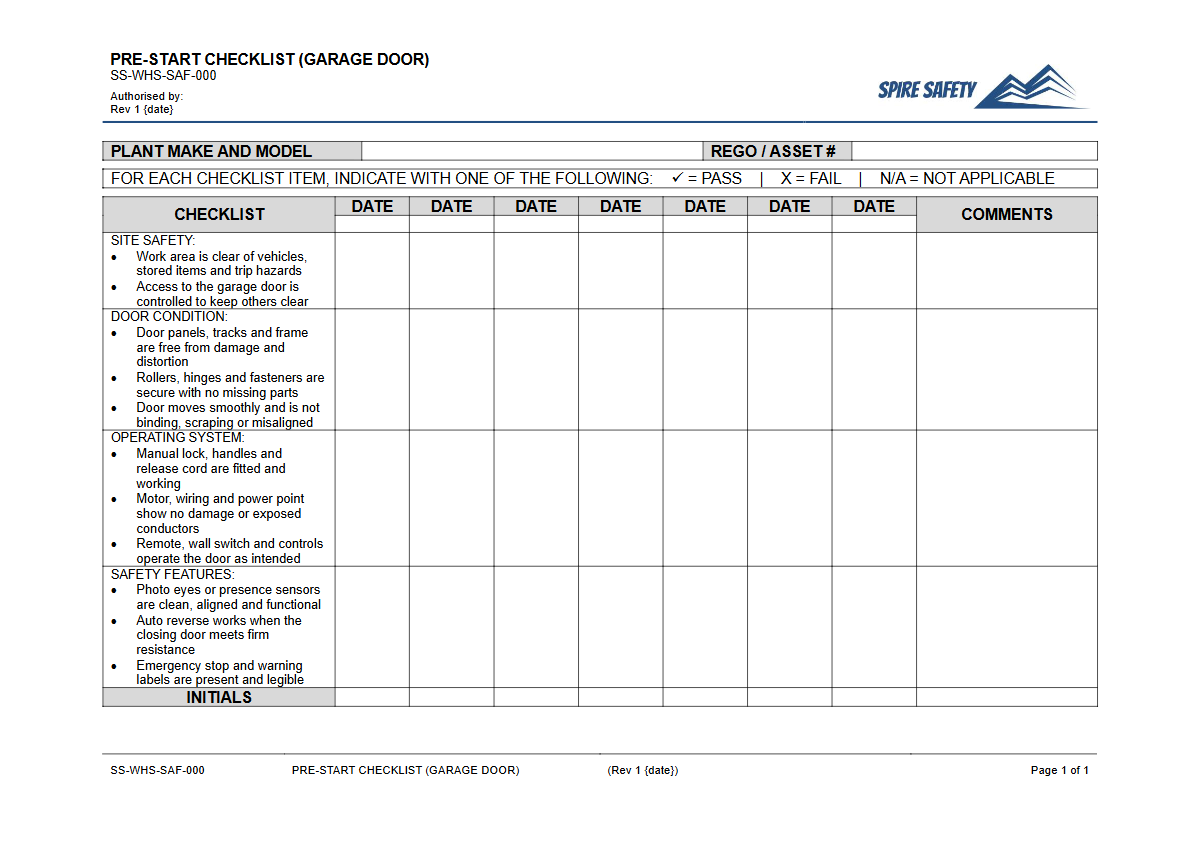
This Free Pre-Start Checklist (Garage Door) Template provides a structured format for operators to conduct and record daily safety inspections before using the equipment. Using a formal checklist helps to identify potential faults with tracks, sensors, motors, and emergency releases before they lead to incidents like crushing, entanglement, or equipment failure.
Formalising this process ensures consistency in safety procedures and creates valuable records for safety monitoring and incident investigation.
These daily checks are a practical component of a broader approach to plant and equipment safety. To reinforce their importance with your team, you can use our Pre-Start Checks and Plant Maintenance Toolbox Talk to facilitate a focused safety discussion.
Video walkthrough
How to use the Free Pre-Start Checklist (Garage Door) Template
This template is designed for immediate use and easy customisation. First, download the document in your preferred format, either DOCX for editing or PDF for printing.
The next step is critical for ensuring the checklist is effective for your specific situation. You must adapt the template to reflect the unique characteristics of the garage doors at your site, including the make, model, and any specific safety features or modifications. Integrating these checks into your daily operational procedures is a key activity in building robust WHS management systems.
Customising Your Checklist
This template provides a solid foundation aligned with Australian WHS practice. However, to ensure it is effective, we advise that you must customise it to your specific workplace. You should incorporate the unique make, model, and configuration of your garage doors, along with any site-specific hazards identified in your risk assessments. Consider factors like:
- The type of door (e.g., roller, sectional, sliding).
- Activation method (e.g., remote, push-button, chain pulley).
- Specific safety features (e.g., photo-electric beams, auto-reverse mechanisms, emergency stop buttons).
- Environmental conditions (e.g., exposure to weather, dust, or corrosive substances).
When to use it
A pre-start check for a garage door should be completed by the operator before the first use of the equipment on each day or at the beginning of each shift. In environments with very high usage, a person conducting a business or undertaking (PCBU) may determine that more frequent checks are necessary based on a risk assessment.
Completed checklists should be filed and retained as part of your safety records. These documents provide evidence of due diligence and are essential during any WHS compliance auditing process, demonstrating a systematic approach to equipment safety.
Who should use it
The checklist should be completed by competent persons who are tasked with operating the garage door. This often includes warehouse staff, forklift operators, delivery drivers, or maintenance personnel.
It is vital that these individuals receive adequate training not only on how to operate the door safely but also on how to properly conduct each check and what to look for. Supervisors have a responsibility to review completed checklists, ensure any reported defects are addressed promptly, and confirm that corrective actions are documented. While this checklist is for a garage door, the same principles apply to other machinery, as seen in our Free Pre-Start Checklist (CNC Router) Template.
For high-risk machinery operations, a pre-start check is often the first control measure. If significant hazards are present, a more detailed procedure like a Safe Work Method Statement may be required. You can see an example of a procedure for heavy equipment with our Safe Work Method Statement (Concrete Truck Operation) Template.
This document is one of many tools designed to help you manage workplace health and safety. You can browse our complete free WHS resources library to find other templates, talks, and guides to support your safety programs.
Common mistakes
Common mistakes to avoid
- Pencilling-in' checks without physically inspecting each item.
- Ignoring minor issues like unusual noises or slow operation, which can be early signs of major failure.
- Using a generic checklist that doesn't cover the specific features of the installed door.
- Failing to tag out and report faulty equipment, allowing others to unknowingly use it.
Legal references
Legal considerations
The following legal requirements may be relevant to this type of work.
- Work Health and Safety Act (Harmonised) — Provides the primary duties for protecting workers and other people from work health and safety risks.
- Work Health and Safety Regulations (Harmonised) — Sets out requirements supporting the management of workplace hazards and risks.
The following codes may be relevant to this type of work.
- Managing WHS Risks Code of Practice — Provides practical guidance on identifying hazards, assessing risks and applying effective controls.
- Work Health and Safety Consultation, Cooperation and Coordination Code of Practice — Provides practical guidance on consulting workers and coordinating with other duty holders.
- Managing the Work Environment and Facilities Code of Practice — Provides practical guidance on safe work environments, workplace facilities and related controls.
Did you know
Door Force
A failing or improperly adjusted commercial garage door can exert over 150kg of closing force, which is more than enough to cause a fatal crushing injury.
Sensor Safety
Safety sensors (photo-electric eyes) on modern garage doors are a critical safety feature. If the infrared beam between them is broken while the door is closing, it should automatically reverse.
FAQ
Frequently asked questions
01What are the most common hazards associated with industrial garage doors?
02How often should a garage door be professionally serviced?
03Can this checklist be used for residential garage doors?
04What should an operator do if they find a fault during a pre-start check?
Share this resource
Free Pre-Start Checklist (Garage Door) Template
Browse Categories
How To Use It
- 1Download and open in Word or PDF.
- 2Replace the placeholders with your business details.
- 3Get it reviewed by a WHS specialist before rollout.
Need it customised?
Our WHS consultants can adapt this template to your site, run a gap analysis, or audit what you already have in place.
Book a Free Consultation WHS consulting servicesor call 1300 156 382