
Free Pre-Start Checklist (Fume Extract) Template
Download our free Pre-Start Checklist for Fume Extractors. This template helps formalise safety checks for airborne contaminants. Get your DOCX & PDF now.
Free Pre-Start Checklist (Fume Extract) Template
DOCX • 125 KB + PDF
Updated Oct 2026
No signup required
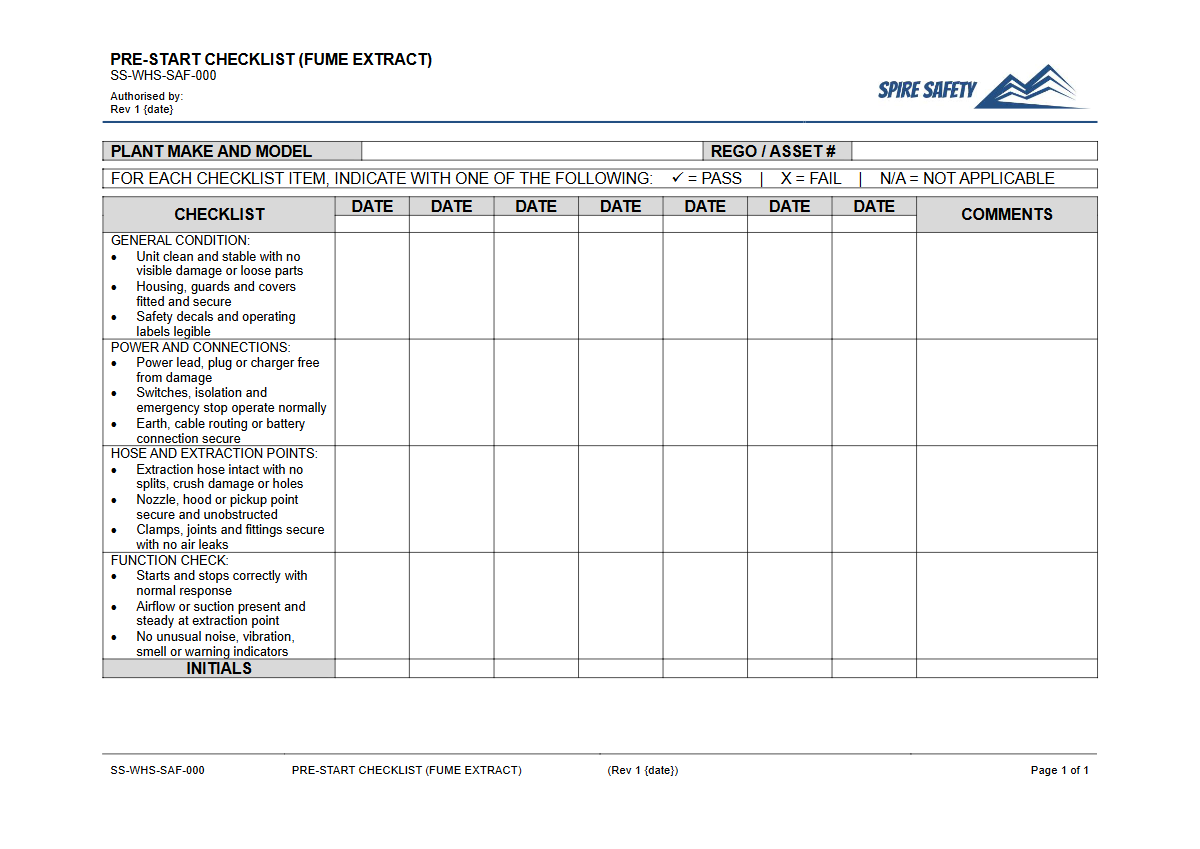
Purpose of the Free Pre-Start Checklist (Fume Extract) Template
Effective management of airborne contaminants is critical for workplace safety, particularly in environments involving welding, soldering, chemical handling, or other processes that generate hazardous fumes. This free Pre-Start Checklist (Fume Extract) Template provides a structured framework for operators to verify that local exhaust ventilation (LEV) systems are safe and functional before each use.
Consistent pre-start inspections help protect workers from respiratory illnesses, ensure equipment longevity, and demonstrate a proactive approach to managing WHS risks.
Using a standardised checklist is a fundamental component of a robust safety management system. It formalises the inspection process, ensuring no critical checks are overlooked and creating a tangible record of due diligence.
Integrating such procedures helps an organisation maintain a safe working environment and align its operations with the principles of Australian work health and safety legislation. These documented checks are invaluable during safety reviews and can form a key part of your overall WHS management systems.
Video walkthrough
How to Use the Free Pre-Start Checklist (Fume Extract) Template
This template is designed for ease of use and customisation. After downloading the DOCX or PDF file, you should adapt it to the specific requirements of your workplace and the fume extraction units you operate. The process is straightforward:
- Customise: Add your company branding and specific check items relevant to your equipment's make and model. This could include checks for specific filter types, alarm indicators, hose materials, or motor specifications.
- Train: Ensure all operators are trained on how to properly conduct the pre-start check, what each item means, and the procedure for reporting faults.
- Implement: Integrate the checklist into your daily or pre-shift routine. Store completed checklists in a designated location for record-keeping purposes.
It’s vital to remember that this is a template. We recommend you customise it to reflect the specific make, model, and operational context of the fume extraction equipment in your workplace.
A generic checklist cannot cover all potential hazards associated with specialised machinery. For similar systems, you might also find our free Pre-Start Checklist for Dust Extractors useful.
When to Use This Pre-Start Checklist
A pre-start checklist for a fume extractor should be completed before the equipment is first used on any given day or shift. For equipment used intermittently, the check should be performed before each use.
The goal is to identify any potential defects or malfunctions before the equipment is operated and before workers are potentially exposed to harmful airborne contaminants. Establishing this routine prevents the use of faulty equipment and reduces the risk of incidents.
Regular use of this checklist is a practical way to manage risks associated with plant and equipment. It serves as a daily reminder of safety standards and complements, but does not replace, the need for scheduled preventative maintenance and servicing by competent personnel.
For guidance on integrating these checks into your broader safety framework, our WHS consulting services can provide tailored advice.
Who Should Use This Checklist
This checklist should be used by any worker tasked with operating fume extraction equipment. This typically includes welders, fabricators, lab technicians, mechanics, and other tradespeople who rely on the equipment to control respiratory hazards at the source.
Supervisors should also be familiar with the checklist to oversee its correct completion and to action any reported defects.
Ensuring that operators are competent to perform these checks is a key responsibility for a Person Conducting a Business or Undertaking (PCBU). Proper use of the checklist demonstrates that operators are actively involved in maintaining a safe work environment. This process is similar for other fixed ventilation systems, as detailed in our free Pre-Start Checklist for Fume Cabinets.
Ultimately, a comprehensive safety strategy involves more than just checklists. These documents are tools that support a culture of safety, which must be championed by management and practised by all staff.
For a deeper analysis of your current processes, a WHS compliance auditing service can identify gaps and opportunities for improvement in your safety systems. If you're looking for other templates and resources, you can browse our complete free WHS resources library.
Common mistakes
Common mistakes to avoid
- Positioning the extractor hood too far from the fume source, resulting in poor capture.
- Using an extractor for a process or substance it is not designed for (e.g., using a dust extractor for chemical fumes).
- Ignoring or disabling filter change alarms and indicators, leading to reduced performance and potential exposure.
- Failing to inspect hoses and ducting for cracks, blockages, or leaks that compromise suction.
Legal references
Legal considerations
The following legal requirements may be relevant to this type of work.
- Work Health and Safety Act (Harmonised) — Provides the primary duties for protecting workers and other people from work health and safety risks.
- Work Health and Safety Regulations (Harmonised) — Sets out requirements supporting the management of workplace hazards and risks.
The following codes may be relevant to this type of work.
- Managing WHS Risks Code of Practice — Provides practical guidance on identifying hazards, assessing risks and applying effective controls.
- Work Health and Safety Consultation, Cooperation and Coordination Code of Practice — Provides practical guidance on consulting workers and coordinating with other duty holders.
- Managing the Work Environment and Facilities Code of Practice — Provides practical guidance on safe work environments, workplace facilities and related controls.
Did you know
Welding Fume Classification
In 2017, the International Agency for Research on Cancer (IARC) reclassified welding fumes as a 'Group 1 carcinogen', placing them in the same category as asbestos and tobacco smoke.
Capture Distance is Key
The capture efficiency of a fume extractor hood decreases exponentially with distance. Doubling the distance between the source and the hood can reduce capture efficiency by up to 75%.
FAQ
Frequently asked questions
01Are pre-start checks for fume extractors a legal requirement in Australia?
02What should an operator do if a fume extractor fails a pre-start check?
03What's the difference between a fume extractor and a fume cabinet?
04How often should fume extractor filters be changed?
Share this resource
Free Pre-Start Checklist (Fume Extract) Template
Browse Categories
How To Use It
- 1Download and open in Word or PDF.
- 2Replace the placeholders with your business details.
- 3Get it reviewed by a WHS specialist before rollout.
Need it customised?
Our WHS consultants can adapt this template to your site, run a gap analysis, or audit what you already have in place.
Book a Free Consultation WHS consulting servicesor call 1300 156 382