
Free Pre-Start Checklist (Gantry Crane) Template
Download our Free Pre-Start Checklist for Gantry Cranes. This DOCX & PDF template helps formalise daily safety inspections and manage WHS risks.
Free Pre-Start Checklist (Gantry Crane) Template
DOCX • 125 KB + PDF
Updated Oct 2026
No signup required
Purpose of the Free Pre-Start Checklist (Gantry Crane) Template
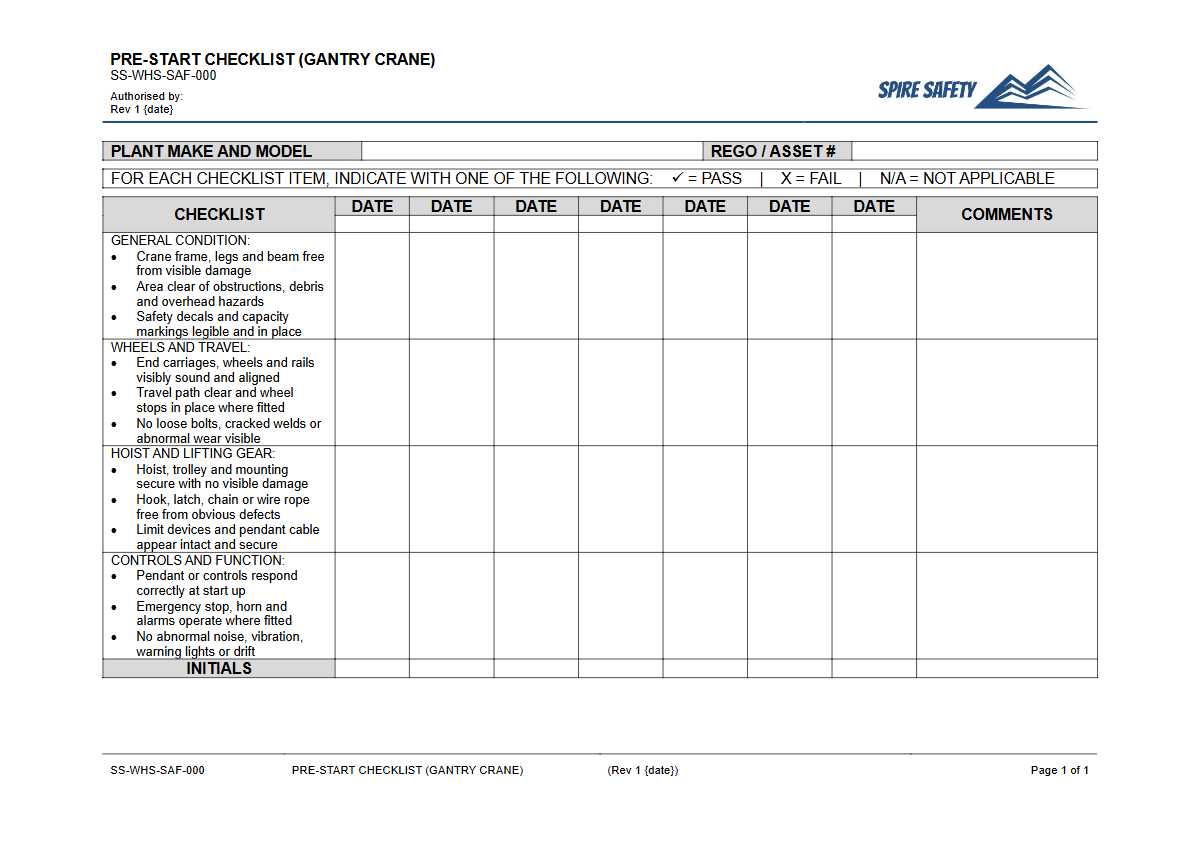
A gantry crane is a critical piece of lifting equipment where operational failure can have severe consequences. This Free Pre-Start Checklist (Gantry Crane) Template provides a structured framework for operators to conduct thorough inspections before use.
Systematically completing a pre-start check helps identify mechanical faults, structural damage, or control system issues before they lead to an incident. Using this document helps a Person Conducting a Business or Undertaking (PCBU) meet their primary duty of care to provide and maintain safe plant.
It formalises a key part of your safe system of work and creates a record of due diligence, demonstrating a proactive approach to risk management.
Video walkthrough
How to use the Free Pre-Start Checklist (Gantry Crane) Template
Download the template in your preferred format (DOCX or PDF) and integrate it into your daily operational procedures. This checklist is a comprehensive starting point aligned with Australian WHS principles, but it is not a complete, out-of-the-box solution.
It is essential that you adapt it to your specific operational context.
Note: We have provided a general starting point, but you must customise this template to include the specific make, model, capacity, and unique configuration of your gantry crane. You must also add any checks relevant to your site-specific environmental conditions or operational risks.
This customisation is a critical step in developing effective WHS management systems that genuinely control hazards.
When to use a Gantry Crane Pre-Start Checklist
A gantry crane pre-start inspection should be conducted before the crane is operated for the first time each day or at the beginning of every shift. It should also be performed after any period of inactivity, following maintenance or repairs, or if there is any reason to suspect that the crane may have been damaged or its condition has changed.
This routine ensures that the equipment's condition is verified before it is used to lift a load, preventing the use of unsafe plant.
Who should use it
This Pre-Start Checklist should be completed by a competent person who is trained and authorised to operate the specific gantry crane. In many cases, this will require the operator to hold a relevant High Risk Work Licence (HRWL).
Supervisors and managers also have a responsibility to ensure that operators are completing these checks correctly and consistently as part of their daily duties. The principles of verifying operator competency and conducting pre-use checks apply to all heavy machinery, as outlined in documents like our Free Pre-Start Checklist (Forwarder) Template.
Key Inspection Areas
Your customised checklist should prompt the operator to visually and physically inspect several key areas, including:
- Structural Components: Check the gantry frame, beams, legs, and end carriages for any signs of cracking, deformation, corrosion, or loose connections.
- Hoisting Mechanism: Inspect the wire rope for any fraying, kinks, broken wires, or corrosion. Check the hook for deformation or cracks and ensure the safety latch is functional. Verify the rope is properly seated in the drum and sheaves.
- Controls: Test all functions on the pendant or remote control, including all directional movements, speed changes, and audible alarms. Critically, the emergency stop button must be tested to ensure it functions immediately.
- Travel System: Ensure the runway rails and travel path are clear of obstructions. Check the wheels for excessive wear or damage and listen for unusual noises during travel. Test the travel brakes to confirm they engage effectively.
- Safety Devices: Verify that all limit switches (hoist, travel, and bridge) are in place and function correctly to prevent over-travel. Check that warning lights and alarms are operational. The principles for checking mechanical safety devices are common across many types of equipment, including those covered by our Free Pre-Start Checklist (Bin Lifter) Template.
After the Inspection
If the inspection reveals no defects, the operator can sign and date the checklist, and proceed with their work. If any faults or damage are identified, the crane must not be used.
The operator should immediately follow the workplace procedure for reporting defects, which typically involves tagging the equipment out of service and notifying a supervisor or the maintenance department. These completed records should be retained and can be a valuable input for periodic WHS compliance auditing to identify recurring issues or trends. Similar documentation processes are vital even for smaller workshop equipment, a concept reinforced in our Free Pre-Start Checklist (Bench Grinder) Template.
By embedding a thorough pre-start inspection into your daily workflow, you create a powerful barrier against equipment-related incidents and foster a stronger safety culture within your organisation. Find more tools to support your safety programs in our comprehensive free WHS resources library.
Common mistakes
Common mistakes to avoid
- Treating the checklist as a 'tick and flick' exercise without physically inspecting each item.
- Failing to immediately tag out and report faulty equipment for repair.
- Using a generic checklist that doesn't match the specific make and model of the gantry crane.
- Inadequate training for operators on how to properly conduct the inspection and what to look for.
Legal references
Legal considerations
The following legal requirements may be relevant to this type of work.
- Work Health and Safety Act (Harmonised) — Provides the primary duties for protecting workers and other people from work health and safety risks.
- Work Health and Safety Regulations (Harmonised) — Sets out requirements supporting the management of workplace hazards and risks.
The following codes may be relevant to this type of work.
- Managing WHS Risks Code of Practice — Provides practical guidance on identifying hazards, assessing risks and applying effective controls.
- Work Health and Safety Consultation, Cooperation and Coordination Code of Practice — Provides practical guidance on consulting workers and coordinating with other duty holders.
- Managing the Work Environment and Facilities Code of Practice — Provides practical guidance on safe work environments, workplace facilities and related controls.
Did you know
High-Risk Work
Operating most gantry cranes in Australia requires a High Risk Work Licence (HRWL), specifically a bridge and gantry crane (CB) licence, depending on the crane's specific type and capacity.
Leading Cause of Failure
According to safety regulators, wire rope failure is one of the most common causes of crane incidents, highlighting the critical importance of daily visual rope inspections as part of a pre-start check.
FAQ
Frequently asked questions
01What should be included in a gantry crane pre-start checklist?
02How often must a gantry crane pre-start check be done?
03Who is responsible for completing the gantry crane inspection?
04Is this gantry crane checklist a legal document?
Share this resource
Free Pre-Start Checklist (Gantry Crane) Template
Browse Categories
How To Use It
- 1Download and open in Word or PDF.
- 2Replace the placeholders with your business details.
- 3Get it reviewed by a WHS specialist before rollout.
Need it customised?
Our WHS consultants can adapt this template to your site, run a gap analysis, or audit what you already have in place.
Book a Free Consultation WHS consulting servicesor call 1300 156 382