
Free Pre-Start Checklist (Furnace) Template
Download our Free Pre-Start Checklist (Furnace) Template (DOCX & PDF) to formalise safety checks on high-temperature equipment.
Free Pre-Start Checklist (Furnace) Template
DOCX • 125 KB + PDF
Updated Oct 2026
No signup required
Purpose of the Free Pre-Start Checklist (Furnace) Template
Operating industrial furnaces involves significant risks, including extreme heat, mechanical failure, and exposure to hazardous substances. A systematic pre-start inspection is a fundamental control measure to ensure the equipment is safe to operate.
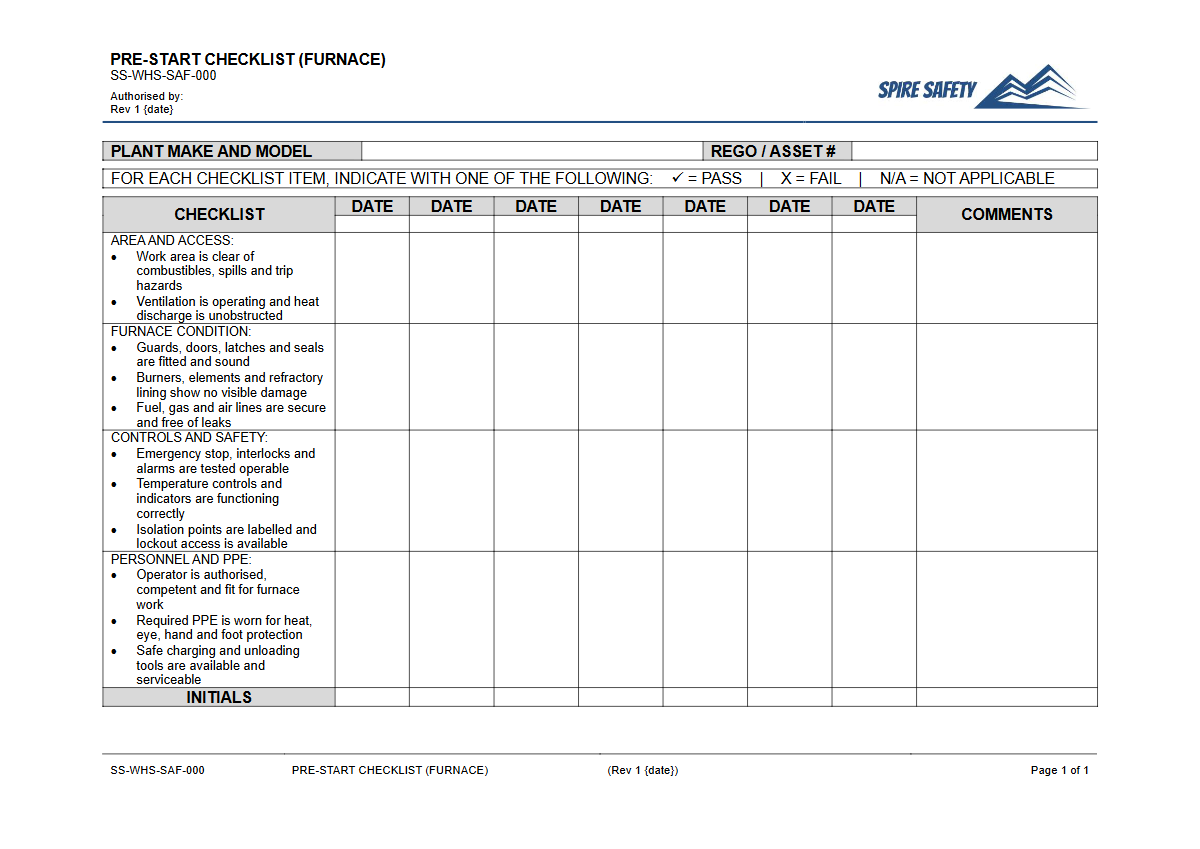
This Free Pre-Start Checklist (Furnace) Template provides a structured starting point for organisations to formalise their daily or pre-shift safety verifications. Using a checklist helps operators methodically inspect critical components, identify potential defects before they lead to incidents, and create a documented record of due diligence.
It promotes a proactive safety culture where potential issues are found and fixed early.
Implementing consistent pre-start checks is a core component of managing plant safety. These procedures should be integrated into your broader safety framework to ensure they are supported by adequate training, reporting, and maintenance schedules.
Documenting these processes helps build robust WHS management systems that are effective and auditable.
Video walkthrough
How to use the Free Pre-Start Checklist (Furnace) Template
This resource is provided as a customisable DOCX file, with a ready-to-use PDF version also included. The checklist contains common inspection points relevant to many types of industrial furnaces, such as checks for controls, safety interlocks, structural integrity, and fuel or power systems.
However, it is essential to adapt it to your specific circumstances.
Important: This is a template, not a finished document. You must customise it to suit the specific make, model, and configuration of your furnace, your unique operational tasks, and the risks identified in your workplace.
We cannot guarantee it addresses every hazard associated with your particular equipment. Consult the manufacturer’s operating manual, conduct a risk assessment, and involve competent operators and maintenance personnel in finalising the checklist.
To implement this checklist effectively:
- Download the DOCX file.
- Review and modify the checklist items, adding or removing points to match your furnace's specific features and safety requirements.
- Involve experienced operators and supervisors in the customisation process to ensure the checklist is practical and comprehensive.
- Formalise the document with your company branding and specific site details.
- Train all operators on how to use the finalised checklist correctly and what to do when a defect is found.
- Establish a clear process for reporting, isolating, and rectifying any faults identified during the pre-start inspection.
When to use it
A pre-start checklist for a furnace should be completed before every use or, at a minimum, at the beginning of each shift where the furnace will be operated. It should also be used after any significant maintenance, repair, or modification to verify that the equipment has been returned to a safe operational state.
The goal is to catch problems early, before the furnace is brought up to operating temperature. Regular reinforcement of this routine can be achieved through sessions like a Pre-Start Checks and Plant Maintenance Toolbox Talk.
Who should use it
This checklist should be used by personnel who are trained, competent, and authorised to operate the furnace. Competency means they not only know how to run the equipment but also understand its specific hazards and how to properly inspect its safety features.
Supervisors and managers can use the completed checklists to verify that inspections are being performed correctly and to track recurring maintenance issues. The principles of verifying equipment safety apply across various types of complex plant, as seen in procedures for a Pre-Start Checklist for a CNC Router.
The information gathered through these checks is invaluable for preventative maintenance planning and for demonstrating compliance during safety assessments. The effectiveness of your pre-start program can be a key focus during an WHS compliance auditing process, providing tangible evidence of your risk management activities.
This systematic approach is a vital part of managing high-risk work, which often requires a Safe Work Method Statement for Concrete Truck Operation or similar documentation for other high-risk tasks. For a wider selection of safety documentation, you can browse our complete free WHS resources library.
Common mistakes
Common mistakes to avoid
- Using a generic checklist without customising it for the specific furnace model and its risks.
- Operators completing the checklist from memory without physically inspecting each item.
- Failing to establish a clear procedure for reporting and rectifying defects found during the check.
- Not providing adequate training to operators on the 'why' behind each checklist item, leading to a 'tick and flick' mentality.
Legal references
Legal considerations
The following legal requirements may be relevant to this type of work.
- Work Health and Safety Act (Harmonised) — Provides the primary duties for protecting workers and other people from work health and safety risks.
- Work Health and Safety Regulations (Harmonised) — Sets out requirements supporting the management of workplace hazards and risks.
The following codes may be relevant to this type of work.
- Managing WHS Risks Code of Practice — Provides practical guidance on identifying hazards, assessing risks and applying effective controls.
- Work Health and Safety Consultation, Cooperation and Coordination Code of Practice — Provides practical guidance on consulting workers and coordinating with other duty holders.
- Managing the Work Environment and Facilities Code of Practice — Provides practical guidance on safe work environments, workplace facilities and related controls.
Did you know
Radiant Heat Hazards
Beyond contact burns, the radiant heat from furnaces can cause serious eye injury (such as cataracts) and heat stress over time. Pre-start checks on shielding, insulation, and warning signage are essential controls.
Combustion Safety
Incomplete combustion in fuel-fired furnaces can produce lethal levels of carbon monoxide (CO). A pre-start check of the ventilation, flue, and exhaust systems is a non-negotiable step to ensure toxic gases are safely removed.
FAQ
Frequently asked questions
01Why is a furnace pre-start checklist so important?
02What are the most critical items on a furnace pre-start checklist?
03What should an operator do if they find a fault during a pre-start check?
04Is this furnace checklist template sufficient for WHS compliance?
Share this resource
Free Pre-Start Checklist (Furnace) Template
Browse Categories
How To Use It
- 1Download and open in Word or PDF.
- 2Replace the placeholders with your business details.
- 3Get it reviewed by a WHS specialist before rollout.
Need it customised?
Our WHS consultants can adapt this template to your site, run a gap analysis, or audit what you already have in place.
Book a Free Consultation WHS consulting servicesor call 1300 156 382