
Free Pre-Start Checklist (Dust Extract) Template
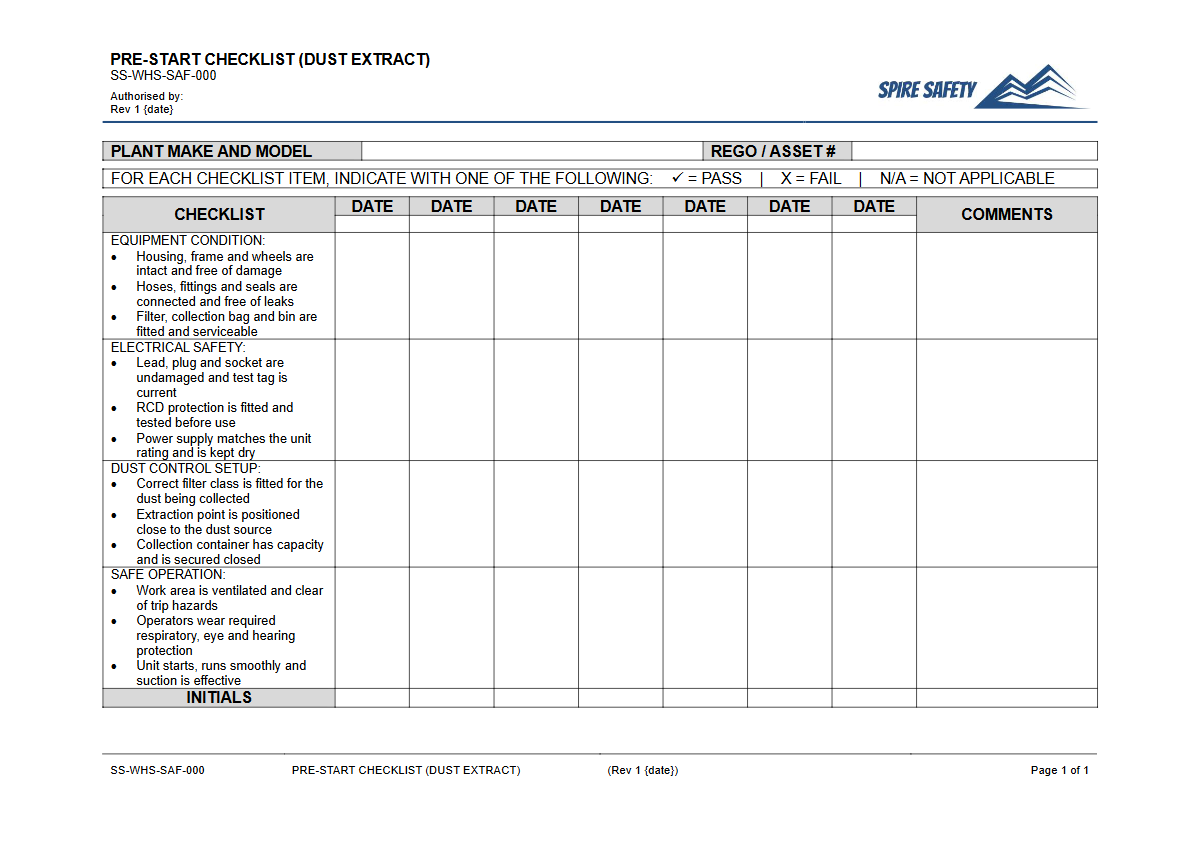
Download our free Pre-Start Checklist for Dust Extractors. This template (DOCX & PDF) helps formalise daily safety checks and manage workplace dust hazards.
Free Pre-Start Checklist (Dust Extract) Template
DOCX • 125 KB + PDF
Updated Oct 2026
No signup required
Purpose of the Free Pre-Start Checklist (Dust Extract) Template
Controlling airborne dust is a critical part of maintaining a safe work environment, particularly in industries like construction, manufacturing, and woodworking. Dust extraction systems are a primary engineering control for minimising worker exposure to harmful particulates.
This Free Pre-Start Checklist (Dust Extract) Template provides a structured framework for operators to inspect equipment before use, ensuring it is functioning correctly and safely. Regular checks help to identify potential faults early, prevent equipment failure, protect worker health by reducing respiratory risks, and demonstrate a proactive approach to WHS management.
A well-maintained dust extractor is your first line of defence against serious occupational lung diseases. By formalising the inspection process, you create a consistent standard of safety across all shifts and operators.
You can reinforce these concepts with your team by using a dedicated Dust and Respiratory Hazards Toolbox Talk Template to discuss risks and controls in detail.
Video walkthrough
How to use the Free Pre-Start Checklist (Dust Extract) Template
This checklist is designed to be straightforward and easy to integrate into your daily operations. Follow these steps to implement it effectively:
- Download and Customise: Download the template in your preferred format (DOCX or PDF). The DOCX version is fully editable to suit your specific equipment.
- Consult and Finalise: Work with equipment operators and supervisors to add, remove, or modify checklist items based on the manufacturer's instructions and the specific risks in your workplace.
- Train Your Team: Ensure all operators are trained on how to properly conduct the pre-start inspection using the finalised checklist. They must understand what each item means and what to do if a fault is found.
- Implement and Monitor: Make the checklist a mandatory step before any dust extraction unit is operated. Supervisors should periodically review completed forms to ensure checks are being performed diligently.
Please note: This document is a template and must be customised to suit the specific make, model, and operational context of the dust extraction equipment used at your workplace. We cannot guarantee its suitability for your specific circumstances. For specific high-risk dusts, further specific training is essential, which can be supported with resources like our Silica Dust Awareness Toolbox Talk Template.
When to conduct a Dust Extractor Pre-Start Checklist
Consistency is key to an effective pre-start inspection program. The check should be performed:
- Before the first use of each shift: This establishes a baseline of safety for the day's work.
- Before use by a new operator: If operators change mid-shift, the incoming operator should perform their own check to verify the equipment's condition.
- After maintenance or repairs: A check ensures that the equipment has been returned to service in a safe and fully functional state.
These checks are a fundamental component of equipment safety. For a broader discussion on this topic with your team, consider using our Pre-Start Checks and Plant Maintenance Toolbox Talk Template.
Who should use this Pre-Start Checklist
Several roles within an organisation have a responsibility regarding the safety of plant and equipment:
- Equipment Operators: As the primary users, they are responsible for conducting the daily pre-start check before operating the machinery.
- Supervisors and Team Leaders: They are responsible for ensuring operators are trained and that the checks are being completed correctly and consistently. They must also take action on any reported defects.
- Maintenance Personnel: This checklist helps them identify recurring issues that may signal a need for preventative maintenance or repair.
- WHS Managers/Officers: They use the completed records as evidence of risk management activities and to identify trends that may require changes to the safety system.
Integrating such procedures into daily workflows is a cornerstone of effective WHS management systems, helping to embed safety into your organisation's culture.
Key Checks for a Dust Extractor
While your customised checklist will be more detailed, key areas for inspection on any dust extraction unit typically include:
- Hoses and Ducting: Check for cracks, holes, blockages, or loose connections that could compromise suction.
- Filters: Inspect for damage or excessive buildup. Ensure any filter cleaning mechanisms are operational. The consequences of failed ventilation can be severe, as shown in a case study on cobalt dust exposure where a defective system led to serious illness.
- Collection Bag/Bin: Confirm it is correctly attached and has sufficient capacity.
- Power Cords and Switches: Look for any damage to cords, plugs, or emergency stops.
- Alarms and Gauges: Test any warning lights, alarms, or pressure gauges to ensure they are functional.
- Overall Condition: Check for any visible damage, missing guards, or excessive vibration during operation.
Records of these checks should be retained and periodically reviewed. They provide valuable data that can be cross-referenced during internal safety reviews or WHS compliance audits.
Common mistakes
Common mistakes to avoid
- Using a generic, non-customised checklist that doesn't match the specific equipment.
- "Pencil-whipping" the form—ticking boxes without performing a thorough physical inspection.
- Failing to immediately tag out and report faulty equipment for repair.
- Not retaining completed checklists as records for audits, incident investigations, or maintenance planning.
Legal references
Legal considerations
The following legal requirements may be relevant to this type of work.
- Work Health and Safety Act (Harmonised) — Provides the primary duties for protecting workers and other people from work health and safety risks.
- Work Health and Safety Regulations (Harmonised) — Sets out requirements supporting the management of workplace hazards and risks.
The following codes may be relevant to this type of work.
- Managing WHS Risks Code of Practice — Provides practical guidance on identifying hazards, assessing risks and applying effective controls.
- Work Health and Safety Consultation, Cooperation and Coordination Code of Practice — Provides practical guidance on consulting workers and coordinating with other duty holders.
- Managing the Work Environment and Facilities Code of Practice — Provides practical guidance on safe work environments, workplace facilities and related controls.
Did you know
Invisible Danger
Respirable crystalline silica (RCS) particles are at least 100 times smaller than a grain of sand, allowing them to penetrate deep into the lungs when inhaled, causing irreversible damage.
Australian Impact
According to Safe Work Australia, approximately 3,900 new cases of occupational lung disease are diagnosed each year in Australia, many of which are preventable with proper dust control measures.
FAQ
Frequently asked questions
01What is the main purpose of a dust extractor pre-start check?
02How often should I conduct a dust extractor inspection?
03Can I use this template for any type of dust extractor?
04Who is responsible for signing off on a pre-start checklist?
Share this resource
Free Pre-Start Checklist (Dust Extract) Template
Browse Categories
How To Use It
- 1Download and open in Word or PDF.
- 2Replace the placeholders with your business details.
- 3Get it reviewed by a WHS specialist before rollout.
Need it customised?
Our WHS consultants can adapt this template to your site, run a gap analysis, or audit what you already have in place.
Book a Free Consultation WHS consulting servicesor call 1300 156 382