
Free Pre-Start Checklist (ECG Machine) Template
Formalise your equipment safety checks with our free Pre-Start Checklist (ECG Machine) Template, available in DOCX and PDF. Download your free template today.
Free Pre-Start Checklist (ECG Machine) Template
DOCX • 125 KB + PDF
Updated Oct 2026
No signup required
Purpose of the Free Pre-Start Checklist (ECG Machine) Template
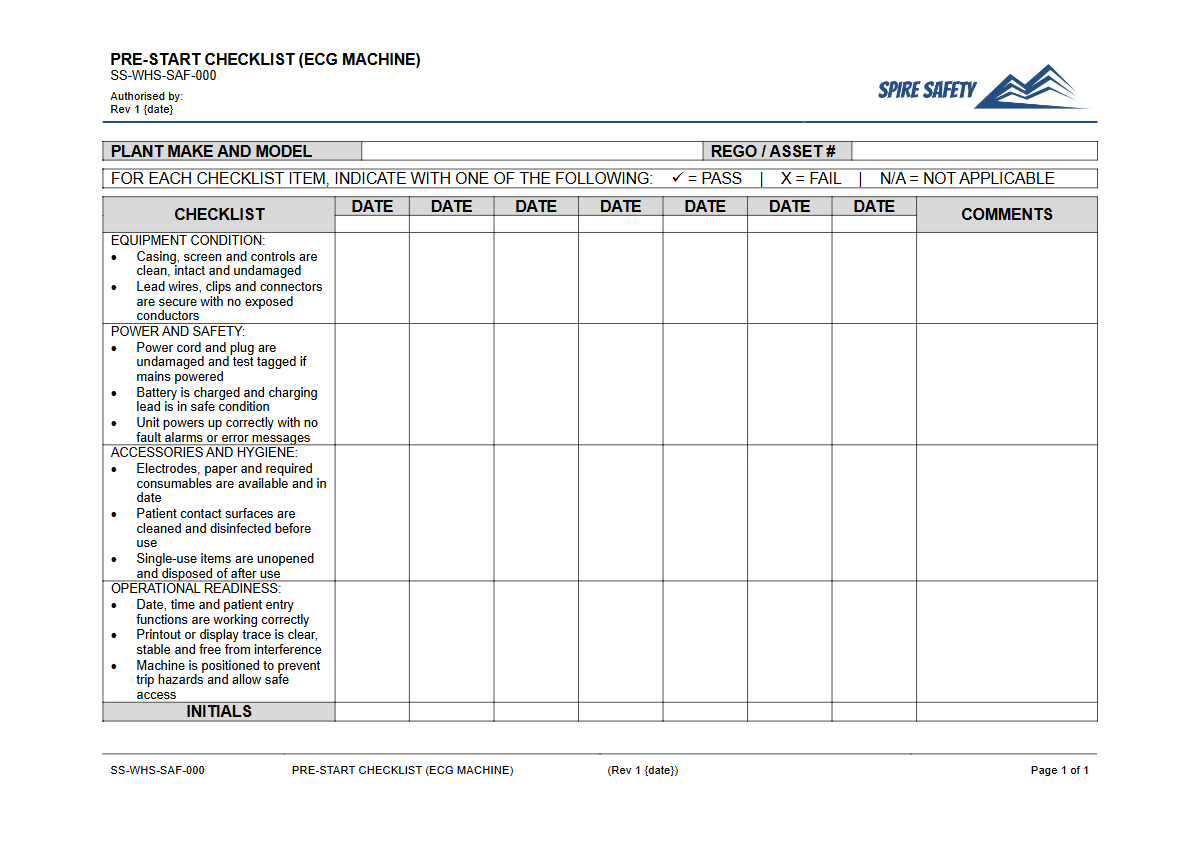
Ensuring medical equipment is safe and functional before use is a critical component of patient and operator safety. This Free Pre-Start Checklist (ECG Machine) Template provides a structured starting point for organisations to formalise their daily equipment inspection process.
Using a checklist helps standardise safety checks, ensuring that key components like cables, electrodes, power supply, and the display are inspected consistently every time, reducing the risk of equipment failure during a procedure. It serves as a practical tool to help meet duties under WHS legislation regarding the provision and maintenance of safe plant and equipment.
Regularly completing pre-start checklists creates a documented history of the equipment's condition. This record is invaluable for maintenance scheduling, fault identification, and demonstrating due diligence in safety management.
In environments like hospitals and aged care facilities, where equipment is used frequently by multiple operators, these checks are essential. Integrating such procedures is also a key part of risk management, a topic covered in resources like our aged care manual handling toolbox talk, which addresses specific hazards in that sector.
A systematic approach to equipment safety not only protects people from harm but also enhances the reliability of diagnostic procedures. By identifying potential issues early, organisations can prevent unexpected downtime and costly emergency repairs.
Formalising this process within your safety framework demonstrates a commitment to a proactive safety culture. For businesses looking to embed these practices more broadly, implementing robust WHS management systems provides a comprehensive structure for managing all aspects of workplace health and safety.
Video walkthrough
How to use the Free Pre-Start Checklist (ECG Machine) Template
This template is provided in both DOCX and PDF formats for your convenience. The DOCX version is fully editable, allowing you to tailor the checklist to the specific make and model of the ECG machines used in your workplace, as well as your operational context.
It is crucial to adapt this document to reflect your unique environment and the specific risks you have identified.
Important: This is a template, not a finished document. We have provided a solid foundation based on Australian WHS principles, but it must be customised to your specific workplace, equipment, and procedures.
Consult with operators, maintenance personnel, and the equipment manufacturer's instructions to ensure your final checklist is comprehensive and effective.
To implement the checklist, train all relevant personnel on how and when to complete it. Store completed checklists in an accessible location for review and auditing.
Any faults or issues identified during a pre-start check must be reported immediately through your organisation's hazard and maintenance reporting channels. The machine should be taken out of service until it is inspected and cleared by a competent person. Reinforcing this process can be achieved through regular training, such as with our toolbox talk on pre-start checks and plant maintenance.
When to use it
An ECG machine pre-start checklist should be completed before the first use of the machine on any given day or shift. This ensures the equipment is verified as safe and operational at the beginning of its work cycle.
If the machine is moved to a different location or if there is a change in operator during a shift, a supplementary check may be warranted to confirm its condition has not changed. It should also be used after any maintenance or repair work has been performed to verify that the equipment is safe to return to service.
Who should use it
This checklist is designed for use by any person who operates an ECG machine, including nurses, doctors, medical technicians, and other qualified healthcare professionals. The person conducting business or undertaking (PCBU) is responsible for ensuring that operators are trained and competent not only in using the equipment but also in performing these essential safety checks.
Supervisors or managers should periodically review completed checklists to ensure the process is being followed correctly and to identify any recurring equipment issues.
Ensuring these procedures are consistently followed is a key part of operational governance. The records generated from these checklists can be a vital input for regular WHS compliance auditing, helping to verify that safety processes are effective and being implemented as intended.
Explore our wider free WHS resources library for more templates and guides to support your safety management system.
Common mistakes
Common mistakes to avoid
- Failing to customise the generic template for the specific ECG machine model in use.
- Operators 'pencil-whipping' the form without physically inspecting the items.
- Not immediately removing faulty equipment from service and reporting the issue.
- Neglecting to train new or temporary staff on the pre-start check procedure.
Legal references
Legal considerations
The following legal requirements may be relevant to this type of work.
- Work Health and Safety Act (Harmonised) — Provides the primary duties for protecting workers and other people from work health and safety risks.
- Work Health and Safety Regulations (Harmonised) — Sets out requirements supporting the management of workplace hazards and risks.
The following codes may be relevant to this type of work.
- Managing WHS Risks Code of Practice — Provides practical guidance on identifying hazards, assessing risks and applying effective controls.
- Work Health and Safety Consultation, Cooperation and Coordination Code of Practice — Provides practical guidance on consulting workers and coordinating with other duty holders.
- Managing the Work Environment and Facilities Code of Practice — Provides practical guidance on safe work environments, workplace facilities and related controls.
Did you know
Definition of Plant
Under the model WHS Act, 'plant' is a broad term that includes any machinery, equipment, appliance, container, implement, and tool. This definition covers medical devices like ECG machines, which are subject to specific duties regarding their safe use and maintenance.
First Practical ECG
The Dutch physician Willem Einthoven is credited with inventing the first practical electrocardiogram (ECG) in 1903. His string galvanometer was enormous, weighing over 270 kilograms and requiring five people to operate.
FAQ
Frequently asked questions
01What should be included in an ECG machine pre-start check?
02Why is a pre-start check important for medical equipment like ECG machines?
03How often should an ECG machine pre-start check be performed?
04Is this template a substitute for professional maintenance and calibration?
Share this resource
Free Pre-Start Checklist (ECG Machine) Template
Browse Categories
How To Use It
- 1Download and open in Word or PDF.
- 2Replace the placeholders with your business details.
- 3Get it reviewed by a WHS specialist before rollout.
Need it customised?
Our WHS consultants can adapt this template to your site, run a gap analysis, or audit what you already have in place.
Book a Free Consultation WHS consulting servicesor call 1300 156 382