
Free Pre-Start Checklist (Fork Attachment) Template
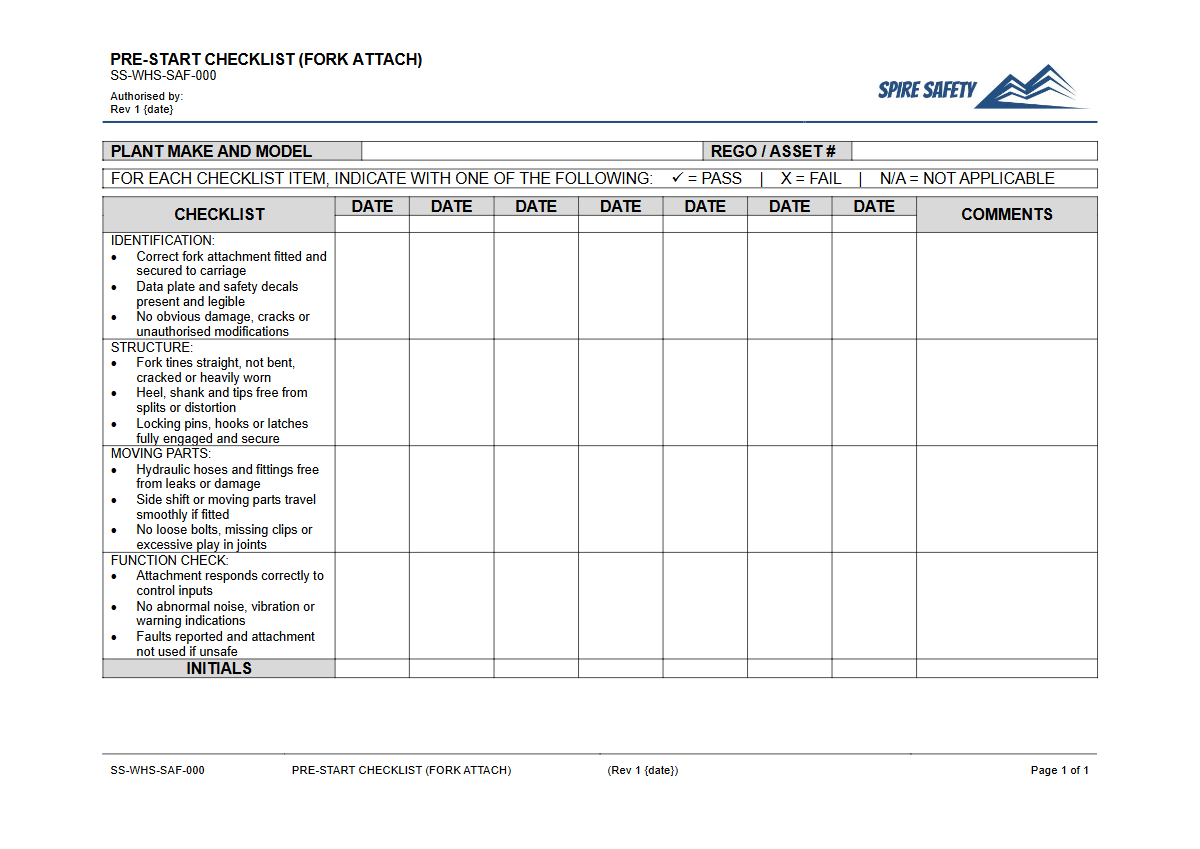
Download our Free Pre-Start Checklist for Fork Attachments. This template helps formalise daily safety checks for crane forks, jibs, and lifting hooks.
Free Pre-Start Checklist (Fork Attachment) Template
DOCX • 125 KB + PDF
Updated Oct 2026
No signup required
Purpose of the Free Pre-Start Checklist (Fork Attachment) Template
Forklift attachments like jibs, slippers, and lifting hooks transform a standard forklift into a multi-purpose lifting machine. However, each attachment introduces unique risks that must be managed.
Our Free Pre-Start Checklist (Fork Attachment) Template provides a structured framework to help operators conduct thorough, daily inspections before use. Systematically checking an attachment's condition helps identify defects, damage, or wear and tear that could lead to load failure, equipment damage, or serious injuries.
Using a documented checklist ensures that critical safety components are not overlooked. It creates a formal record of inspection, demonstrating due diligence and contributing to a safer work environment.
This process is a fundamental part of managing risks associated with powered mobile plant and is a key element within robust WHS management systems. This template serves as a practical tool to support your organisation's safety procedures, aligned with Australian WHS practice.
Video walkthrough
How to use the Free Pre-Start Checklist (Fork Attachment) Template
This resource is provided as a starting point in DOCX and PDF formats. To integrate it effectively into your safety management system, follow these steps:
- Download: Choose the DOCX file for easy editing or the PDF for immediate printing.
- Customise: This is the most critical step. Adapt the checklist to suit the specific types of fork attachments used in your workplace (e.g., rotators, drum clamps, work platforms). Add or remove items to align with the manufacturer's instructions and your site-specific risks. Note: This document is a template. We strongly advise that you customise it to reflect the specific equipment, operational procedures, and WHS risks unique to your workplace.
- Train: Ensure all relevant operators and supervisors are trained on how to correctly complete the checklist, what each item means, and the procedure for reporting defects.
- Implement: Integrate the checklist into your daily start-up procedure. Store completed records in a central, accessible location for auditing and review.
- Review: Periodically review the checklist's effectiveness and update it following any incidents, changes in equipment, or feedback from operators. This continuous improvement cycle is often verified during WHS compliance audits.
When to use it
A pre-start checklist for a fork attachment should be completed before its first use on any given shift. If an attachment is swapped out mid-shift, the new attachment should also undergo a pre-start check before it is put into operation.
This high frequency ensures that any damage sustained during a previous shift or while in storage is identified before the attachment is subjected to a load. This routine is just as important as the check for the forklift itself. For other types of machinery, similar principles apply, as shown in our Pre-Start Checklist for a Bench Grinder.
Who should use it
This checklist is designed to be used primarily by competent and authorised forklift operators who are tasked with using the attachments. These are the individuals at the coalface who are best positioned to identify faults or changes in the equipment's condition.
Supervisors and WHS managers should also be familiar with the checklist to ensure it is being completed correctly and to follow up on any reported defects. Proper implementation may require input from specialist WHS consulting to ensure procedures are practical and effective for your specific operational context. While this checklist is for attachments, we offer many other equipment-specific templates in our free WHS resources library.
The responsibility for providing a safe system of work, which includes tools like this checklist, ultimately lies with the Person Conducting a Business or Undertaking (PCBU). The consistent use of such checks for all types of plant, including heavy machinery covered by our Pre-Start Checklist (Forwarder) Template, is a cornerstone of proactive safety management.
Common mistakes
Common mistakes to avoid
- Using a generic forklift checklist that doesn't cover attachment-specific inspection points.
- Failing to check that the attachment's data plate is legible and matches the forklift.
- Operators completing the checklist from memory without physically inspecting the item ('pencil-whipping').
- Continuing to use an attachment after a minor defect is noted, without assessing the risk.
Legal references
Legal considerations
The following legal requirements may be relevant to this type of work.
- Work Health and Safety Act (Harmonised) — Provides the primary duties for protecting workers and other people from work health and safety risks.
- Work Health and Safety Regulations (Harmonised) — Sets out requirements supporting the management of workplace hazards and risks.
The following codes may be relevant to this type of work.
- Managing WHS Risks Code of Practice — Provides practical guidance on identifying hazards, assessing risks and applying effective controls.
- Work Health and Safety Consultation, Cooperation and Coordination Code of Practice — Provides practical guidance on consulting workers and coordinating with other duty holders.
- Managing the Work Environment and Facilities Code of Practice — Provides practical guidance on safe work environments, workplace facilities and related controls.
Did you know
Attachment Derating
Using an attachment almost always reduces the forklift's true lifting capacity. The forklift's data plate must be updated to show the combined capacity of the forklift and attachment working together.
Locking Pins are Critical
The simple locking pins or mechanisms that secure an attachment to the forklift carriage are a critical safety component. Failure to properly engage them is a leading cause of attachment-related incidents.
FAQ
Frequently asked questions
01What should a fork attachment pre-start check include?
02Is a pre-start checklist legally required for fork attachments in Australia?
03How often should fork attachment inspections be performed?
04What happens if a defect is found during a pre-start check?
Share this resource
Free Pre-Start Checklist (Fork Attachment) Template
Browse Categories
How To Use It
- 1Download and open in Word or PDF.
- 2Replace the placeholders with your business details.
- 3Get it reviewed by a WHS specialist before rollout.
Need it customised?
Our WHS consultants can adapt this template to your site, run a gap analysis, or audit what you already have in place.
Book a Free Consultation WHS consulting servicesor call 1300 156 382