
Free Pre-Start Checklist (Fork Clamp) Template
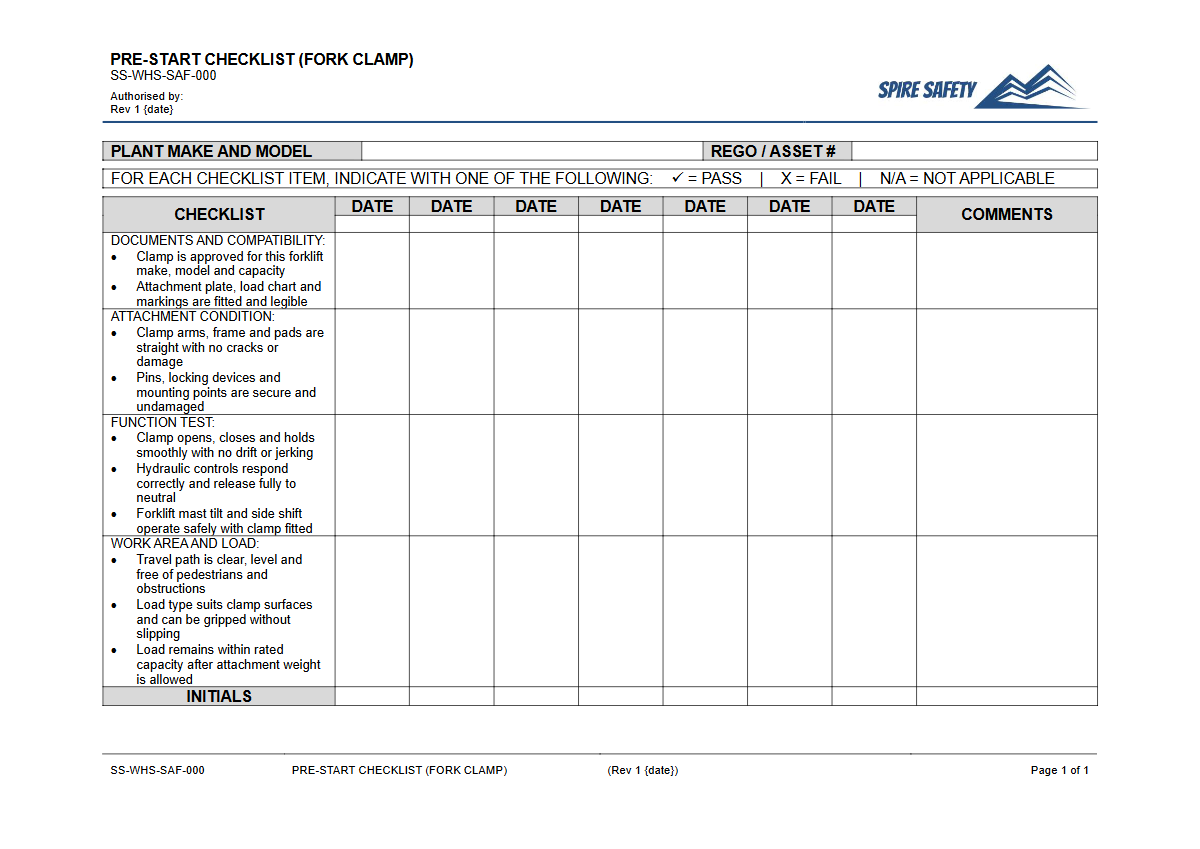
Download our free Pre-Start Checklist (Fork Clamp) Template. This structured DOCX & PDF resource helps formalise daily equipment checks.
Free Pre-Start Checklist (Fork Clamp) Template
DOCX • 125 KB + PDF
Updated Oct 2026
No signup required
Purpose of the Free Pre-Start Checklist (Fork Clamp) Template
Operating a forklift with a clamp attachment introduces unique risks not covered by standard forklift inspections. This free Pre-Start Checklist (Fork Clamp) Template provides a structured framework for operators to conduct thorough, daily inspections before use.
Fork clamps, used for handling non-palletised loads like drums, bales, or paper rolls, have hydraulic arms and specialised gripping pads that require careful assessment. Using a dedicated checklist helps ensure the attachment is in safe working order, securely mounted, and ready for the specific tasks of the day.
Regular checks are a fundamental part of proactive safety, helping to prevent equipment failure, property damage, and serious injuries to operators and pedestrians.
A documented pre-start process demonstrates a commitment to workplace health and safety. It formalises the operator's responsibility to verify equipment condition and provides a record that can be reviewed during safety audits or incident investigations.
Consistent use of this checklist supports the operational integrity of your plant and machinery, aligning with the principles of effective WHS management systems. By identifying defects early, organisations can schedule maintenance before minor issues escalate into costly breakdowns or dangerous failures. This process is a key element of any robust plant safety program and can be reinforced with regular training sessions.
Video walkthrough
How to Use the Free Pre-Start Checklist (Fork Clamp) Template
This resource is available for immediate download in both DOCX and PDF formats. The DOCX version is fully editable, allowing you to tailor the checklist to the specific makes and models of fork clamps used in your workplace, as well as your site-specific procedures and environment.
The PDF is ready for printing and immediate use if the existing fields are suitable for your operations. To use the template effectively, operators should be trained to work through each item systematically, physically checking each component and marking its condition.
The checklist includes sections for visual inspections, operational checks of the hydraulic clamping function, and verification of attachment security.
Important: This template provides a solid foundation, but it is essential that you customise it to reflect the specific fork clamp models, workplace environment, and operational tasks at your site. We have designed it as a starting point, not a final, universally applicable document.
A critical part of customisation is ensuring the checklist prompts operators to check for hazards unique to their work area. You can find more practical ways to discuss plant safety with your team in our Pre-Start Checks and Plant Maintenance Toolbox Talk template.
When to Use It
The fork clamp pre-start check should be completed at the beginning of every shift or before the attachment is used for the first time each day. If multiple operators use the same equipment during a single shift, a new check or at least a documented handover inspection should be conducted at the changeover.
This ensures that the incoming operator is fully aware of the equipment's condition and does not unknowingly use a faulty attachment. The checklist should also be used after the attachment has been fitted to a forklift to confirm it has been mounted correctly and is functioning as intended.
Documenting these checks is a critical part of a robust safety framework. Regular review of completed checklists can help safety managers and supervisors identify recurring faults or patterns of wear, informing preventative maintenance schedules.
Periodic reviews of your safety procedures and records are also a core component of formal WHS compliance auditing, helping to verify that your safety processes are being followed correctly and are effective in managing risk.
Who Should Use It
This checklist must be used by a competent person. In this context, that means a licensed forklift operator who has also received specific training and instruction on the operation of the fork clamp attachment.
Competency involves more than just holding a high-risk work licence; the operator must understand the clamp's unique operating characteristics, its effect on the forklift's stability and capacity, and the specific hazards it introduces. Simply providing the checklist is not sufficient; the organisation must also ensure operators have the knowledge and skill to identify defects and understand when the equipment is unsafe to use.
Supervisors and managers also have a role in ensuring the pre-start system is working effectively. They should periodically observe checks being performed and review completed forms to ensure diligence and accuracy.
This oversight helps maintain high safety standards across all types of equipment, from specialised forklift attachments to other machinery detailed in resources like our Pre-Start Checklist (CNC Router) Template. Ultimately, everyone from the operator to senior management shares responsibility for implementing and upholding plant safety procedures. You can browse our entire collection of checklists, SWMS, and toolbox talks in our free WHS resources library to support your safety program.
Common mistakes
Common mistakes to avoid
- Using a generic forklift checklist that ignores clamp-specific components like hydraulic arms and hoses.
- Failing to physically check the security of the attachment on the forklift carriage, assuming it is mounted correctly.
- Ignoring minor hydraulic fluid weeps or leaks, which can signal an impending hose or seal failure.
- Not verifying that the operator is specifically trained and deemed competent on the clamp attachment, not just the forklift.
Legal references
Legal considerations
The following legal requirements may be relevant to this type of work.
- Work Health and Safety Act (Harmonised) — Provides the primary duties for protecting workers and other people from work health and safety risks.
- Work Health and Safety Regulations (Harmonised) — Sets out requirements supporting the management of workplace hazards and risks.
The following codes may be relevant to this type of work.
- Managing WHS Risks Code of Practice — Provides practical guidance on identifying hazards, assessing risks and applying effective controls.
- Work Health and Safety Consultation, Cooperation and Coordination Code of Practice — Provides practical guidance on consulting workers and coordinating with other duty holders.
- Managing the Work Environment and Facilities Code of Practice — Provides practical guidance on safe work environments, workplace facilities and related controls.
Did you know
Load Centre Impact
Using a fork clamp attachment shifts the forklift's load centre forward, which can significantly reduce its effective lifting capacity. Operators must always refer to the revised capacity plate or chart for the forklift and attachment combination.
Hydraulic Risks
Fork clamps rely on hydraulic systems. A pinhole leak in a hydraulic hose can inject fluid under the skin at extremely high pressure, causing severe tissue damage, gangrene, and other serious injuries.
FAQ
Frequently asked questions
01What specific items should be checked on a fork clamp before use?
02Is a separate pre-start checklist needed for a fork clamp attachment?
03How often should a fork clamp pre-start check be performed?
04Who is responsible for completing the fork clamp checklist?
Share this resource
Free Pre-Start Checklist (Fork Clamp) Template
Browse Categories
How To Use It
- 1Download and open in Word or PDF.
- 2Replace the placeholders with your business details.
- 3Get it reviewed by a WHS specialist before rollout.
Need it customised?
Our WHS consultants can adapt this template to your site, run a gap analysis, or audit what you already have in place.
Book a Free Consultation WHS consulting servicesor call 1300 156 382