
Free Pre-Start Checklist (Food Display) Template
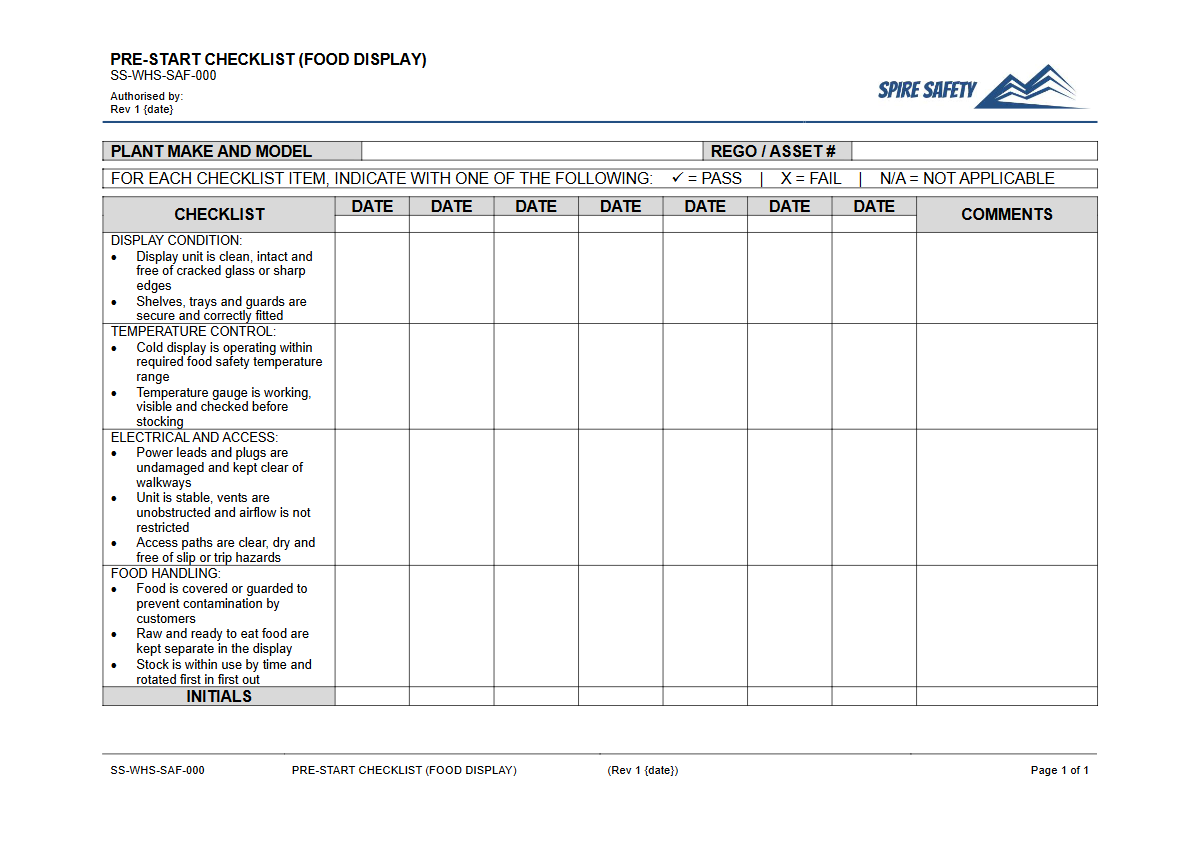
Download our free Pre-Start Checklist for Food Display units. This DOCX & PDF template helps formalise daily safety and hygiene checks in your workplace.
Free Pre-Start Checklist (Food Display) Template
DOCX • 125 KB + PDF
Updated Oct 2026
No signup required
Purpose of the Free Pre-Start Checklist (Food Display) Template
Maintaining the safety and integrity of food display units is critical in any hospitality or food service environment. A systematic pre-start check ensures that equipment like refrigerated bain-maries, hot food bars, and display fridges are clean, sanitary, and operating at correct temperatures before use.
Using this Free Pre-Start Checklist (Food Display) Template provides a structured way to formalise these daily inspections. It helps workers verify that equipment is safe to use, food is held at safe temperatures to prevent bacterial growth, and hygiene standards are consistently met.
This process is a fundamental part of a food safety program and demonstrates due diligence in managing risks associated with foodborne illnesses.
Regularly completing these checks helps identify potential faults early, reducing the risk of equipment failure, food spoilage, and costly repairs. It also reinforces safe work practices among staff, creating a culture of safety and accountability.
For a deeper dive into fostering this culture, our Food Safety Awareness Toolbox Talk template can be an excellent supporting resource for team training sessions.
Video walkthrough
How to use the Free Pre-Start Checklist (Food Display) Template
This checklist provides a comprehensive starting point for developing a procedure tailored to your specific equipment and workplace. To implement it effectively, follow these steps:
- Download and Customise: Download the template in your preferred format (DOCX or PDF). Review each checkpoint and adapt it to match the specific models of food display units used in your business. Add or remove items as necessary to reflect their unique features and risks.
- Train Your Staff: Ensure all relevant workers, including kitchen hands, chefs, and service staff, are trained on how to properly complete the checklist. They must understand what to look for during each check and the correct procedure for reporting any faults or issues.
- Integrate and Implement: Incorporate the checklist into your daily opening procedures. Store completed records in a designated location for a set period, as required by your food safety program or local regulations. These records serve as evidence of your commitment to safety and compliance.
It is crucial to remember that this document is a template. We recommend you customise it to align with the unique risks, equipment, and operational procedures of your specific workplace. A generalised approach to pre-start checks can miss critical safety issues; a broader discussion on this topic can be facilitated with our Pre-Start Checks and Plant Maintenance Toolbox Talk.
Key Checks for Food Display Units
While your customised checklist will be specific to your equipment, it should generally cover several key areas to ensure both WHS and food safety:
- Structural Integrity: Check for any damage, sharp edges, or loose parts on the unit's body, doors, and shelving. Ensure glass panels are free from cracks or chips.
- Cleanliness and Sanitation: Verify that all food-contact and non-food-contact surfaces are visibly clean and have been sanitised according to procedure. Check for any old food residue or spills.
- Temperature Control: For refrigerated units, ensure the temperature is at or below 5°C. For heated units, ensure it is at or above 60°C. Check that the thermostat is functioning and the digital display is accurate.
- Seals and Gaskets: Inspect door seals for any splits, cracks, or perishing, as damaged seals can lead to temperature fluctuations and energy waste.
- Electrical Safety: Check that power cords and plugs are in good condition, with no exposed wires or damage. Ensure the unit is plugged into a suitable outlet that is not overloaded.
When to use it
A pre-start checklist for a food display unit should be completed at the beginning of each day or shift, before the unit is stocked with food. This timing is critical to ensure any identified issues can be rectified before they pose a risk to food safety or worker health.
It should be considered an essential part of the opening process for any area where food is displayed for sale or service.
Who should use it
This checklist is designed for any person responsible for the operation and daily setup of food display equipment. This typically includes roles such as:
- Chefs and Cooks
- Kitchen Hands and Caterers
- Café and Restaurant Staff
- Supervisors and Managers
- Business Owners in the food service industry
These workers are often the first to interact with the equipment each day and are best placed to spot any deviations from normal operating conditions. In many cafes and restaurants, other equipment like coffee machines is also in constant use, making our Pre-Start Checklist (Coffee Grinder) template another valuable tool for daily safety routines.
Integrating Checklists into Your Safety Framework
Using standalone checklists is a good first step, but their true value is realised when they are part of a complete safety management system. By integrating this pre-start check into your broader operational procedures, you create a seamless and auditable safety process.
This systematic approach not only improves safety outcomes but also simplifies compliance verification. If your organisation is looking to develop or refine its overarching safety framework, exploring formalised WHS management systems provides a pathway to best-practice safety organisation.
Regular reviews and audits ensure your safety processes remain effective and relevant. An independent assessment can identify gaps and opportunities for improvement in your food safety and WHS programs.
Professional WHS compliance auditing can provide valuable insights and assurance that your documented procedures are being followed correctly in practice.
Common mistakes
Common mistakes to avoid
- Using the template without customising it for the specific make and model of the display unit.
- Forgetting to check and clean hard-to-reach areas like fans, coils, and drainage ports.
- Inconsistently logging temperatures or 'pencil-whipping' the checklist without performing the checks.
- Failing to have a clear procedure for staff to follow when a fault or non-conformance is identified.
Legal references
Legal considerations
The following legal requirements may be relevant to this type of work.
- Work Health and Safety Act (Harmonised) — Provides the primary duties for protecting workers and other people from work health and safety risks.
- Work Health and Safety Regulations (Harmonised) — Sets out requirements supporting the management of workplace hazards and risks.
The following codes may be relevant to this type of work.
- Managing WHS Risks Code of Practice — Provides practical guidance on identifying hazards, assessing risks and applying effective controls.
- Work Health and Safety Consultation, Cooperation and Coordination Code of Practice — Provides practical guidance on consulting workers and coordinating with other duty holders.
- Managing the Work Environment and Facilities Code of Practice — Provides practical guidance on safe work environments, workplace facilities and related controls.
Did you know
Temperature Control is Key
According to Food Standards Australia New Zealand (FSANZ), keeping food at the correct temperature is one of the simplest and most effective ways to prevent food poisoning.
FSANZ Estimates
It's estimated that there are approximately 4.1 million cases of foodborne gastroenteritis in Australia each year, highlighting the critical importance of robust food safety practices.
FAQ
Frequently asked questions
01What is the 'temperature danger zone' for food in a display unit?
02How often should food display pre-start checks be conducted?
03Is using a food display checklist a legal requirement in Australia?
04What is the difference between cleaning and sanitising a food display?
Share this resource
Free Pre-Start Checklist (Food Display) Template
Browse Categories
How To Use It
- 1Download and open in Word or PDF.
- 2Replace the placeholders with your business details.
- 3Get it reviewed by a WHS specialist before rollout.
Need it customised?
Our WHS consultants can adapt this template to your site, run a gap analysis, or audit what you already have in place.
Book a Free Consultation WHS consulting servicesor call 1300 156 382