
Free Pre-Start Checklist (Food Processor) Template
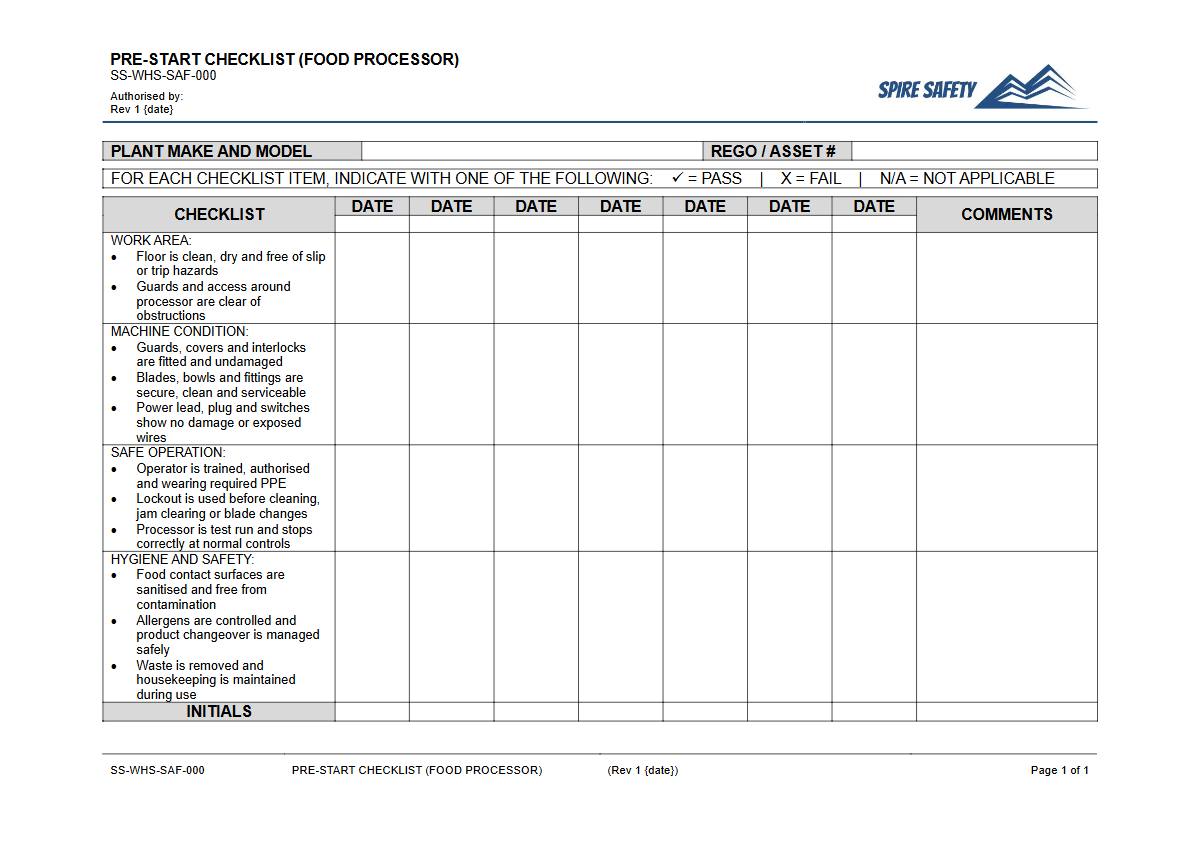
Formalise your equipment safety checks with our free Pre-Start Checklist (Food Processor) Template. Available in DOCX & PDF for Australian workplaces.
Free Pre-Start Checklist (Food Processor) Template
DOCX • 125 KB + PDF
Updated Oct 2026
No signup required
Purpose of the Free Pre-Start Checklist (Food Processor) Template
Operating a commercial food processor involves significant risks, including cuts, amputations, and electric shock. A consistent pre-start inspection process is a fundamental control measure to ensure the equipment is safe to use before each shift.
This free Pre-Start Checklist (Food Processor) Template provides a structured starting point for formalising these essential safety checks.
Using this checklist helps your organisation identify potential hazards, mechanical faults, or missing guards before they lead to an incident. It promotes a proactive safety culture by empowering operators to take responsibility for their equipment. Regular checks not only protect workers but also assist in preventing cross-contamination and ensuring product quality, which can be further supported by resources like a Food Safety Awareness Toolbox Talk Template.
Video walkthrough
How to use the Free Pre-Start Checklist (Food Processor) Template
This document is a template designed for adaptation. To implement it effectively in your workplace, follow these steps:
1. Customise the Checklist
Download the DOCX file and modify it to match the specific make and model of the food processors used at your site. Add or remove items based on the manufacturer's safety recommendations, your operational context, and any site-specific risks identified in your risk assessment. Important note: We are not a law firm. This document is a template and requires customisation for your specific business, equipment, and operational needs. You must adapt it to ensure it is fit for your purpose.
2. Train Your Team
Ensure all operators are trained on how to properly inspect the food processor and accurately complete the checklist. Training should cover what each checkpoint means, how to identify defects, and the procedure for reporting faults.
3. Implement and Monitor
Integrate the checklist into your daily operational routine. Supervisors should periodically review completed checklists to verify they are being filled out correctly and to identify recurring equipment issues.
This process forms a vital part of your overall WHS management systems, providing auditable records of your safety diligence.
Key Items on a Food Processor Pre-Start Checklist
While you must customise your checklist, a comprehensive inspection should generally cover several key areas. These points ensure both the mechanical integrity and the hygienic state of the equipment before use.
- Guards and Interlocks: Check that all physical guards are in place, securely fastened, and free from damage. Test safety interlock switches to confirm they stop the machine when a guard is opened.
- Blades and Attachments: Inspect blades and cutting discs for sharpness, cracks, or chips. Ensure they are correctly and securely mounted.
- Controls and E-Stops: Verify that start/stop buttons function correctly. Critically, test the emergency stop button to ensure it immediately halts all machine operations.
- Cords and Plugs: Examine the power cord for cuts, fraying, or exposed wires. Check the plug for damage.
- General Condition: Look for cracks in the housing, worn seals, or loose components. Ensure the machine is stable and does not vibrate excessively during a brief test run (if safe to do so).
- Cleanliness: Before the first use of the day, confirm the machine and all its components have been properly cleaned and sanitised to prevent food contamination. The principles are similar for other kitchen equipment, as seen in our Free Pre-Start Checklist (Coffee Grinder) Template.
For more complex food production machinery, such as industrial mixers, you might also consider checklists that cover gearboxes and motors, like those found in our Free Pre-Start Checklist (Agitator) Template.
When to use a Food Processor Pre-Start Checklist
The Pre-Start Checklist should be completed by the operator before the first use of the food processor on every shift. If the machine is used by multiple people throughout the day, a new check may be warranted at operator changeover.
It should not be a once-a-week task; daily checks are crucial for catching developing faults. This daily discipline can be reinforced through regular safety discussions, such as those facilitated by a Pre-Start Checks and Plant Maintenance Toolbox Talk.
Who should use this Pre-Start Checklist
Several roles within an organisation are involved with this checklist:
- Operators/Workers: The primary user who physically inspects the equipment and completes the checklist before starting work.
- Supervisors/Team Leaders: Responsible for ensuring operators are trained and are completing the checks correctly. They review the completed forms and take action on reported faults.
- Maintenance Personnel: Act on the information from failed checklists to repair equipment and make it safe for use again.
- WHS Managers: Use the collected data to analyse trends, identify unreliable equipment, and improve safety procedures. The records can be a key piece of evidence during a WHS compliance audit.
By integrating this simple but effective tool, your organisation can take a significant step toward safer and more reliable food processing operations. You can find more templates and tools in our free WHS resources library.
Common mistakes
Common mistakes to avoid
- Using a generic checklist without customising it for the specific machine's features and risks.
- Ignoring 'minor' issues like a cracked guard, worn seal, or faulty interlock, which can lead to catastrophic failure.
- Completing the checklist from memory or 'pencil-whipping' it without physically inspecting the equipment.
- Failing to immediately remove faulty equipment from service and clearly tag it as unsafe.
Legal references
Legal considerations
The following legal requirements may be relevant to this type of work.
- Work Health and Safety Act (Harmonised) — Provides the primary duties for protecting workers and other people from work health and safety risks.
- Work Health and Safety Regulations (Harmonised) — Sets out requirements supporting the management of workplace hazards and risks.
The following codes may be relevant to this type of work.
- Managing WHS Risks Code of Practice — Provides practical guidance on identifying hazards, assessing risks and applying effective controls.
- Work Health and Safety Consultation, Cooperation and Coordination Code of Practice — Provides practical guidance on consulting workers and coordinating with other duty holders.
- Managing the Work Environment and Facilities Code of Practice — Provides practical guidance on safe work environments, workplace facilities and related controls.
Did you know
Blade Speeds
The blades in some commercial food processors can reach tip speeds of over 150 km/h. Correctly functioning guards and interlocks are critical for preventing severe laceration injuries.
Lockout/Tagout
Many serious injuries involving food processors occur during cleaning or clearing blockages when the machine has not been properly isolated from its power source through a lockout/tagout procedure.
FAQ
Frequently asked questions
01Is this food processor checklist suitable for all models?
02How often should a food processor pre-start check be done?
03What is the difference between a pre-start check and maintenance?
04What should an operator do if a fault is found during the pre-start check?
Share this resource
Free Pre-Start Checklist (Food Processor) Template
Browse Categories
How To Use It
- 1Download and open in Word or PDF.
- 2Replace the placeholders with your business details.
- 3Get it reviewed by a WHS specialist before rollout.
Need it customised?
Our WHS consultants can adapt this template to your site, run a gap analysis, or audit what you already have in place.
Book a Free Consultation WHS consulting servicesor call 1300 156 382