
Free Pre-Start Checklist (Food Conveyor) Template
Download our free Pre-Start Checklist (Food Conveyor) Template in DOCX & PDF.
Free Pre-Start Checklist (Food Conveyor) Template
DOCX • 125 KB + PDF
Updated Oct 2026
No signup required
Purpose of the Free Pre-Start Checklist (Food Conveyor) Template
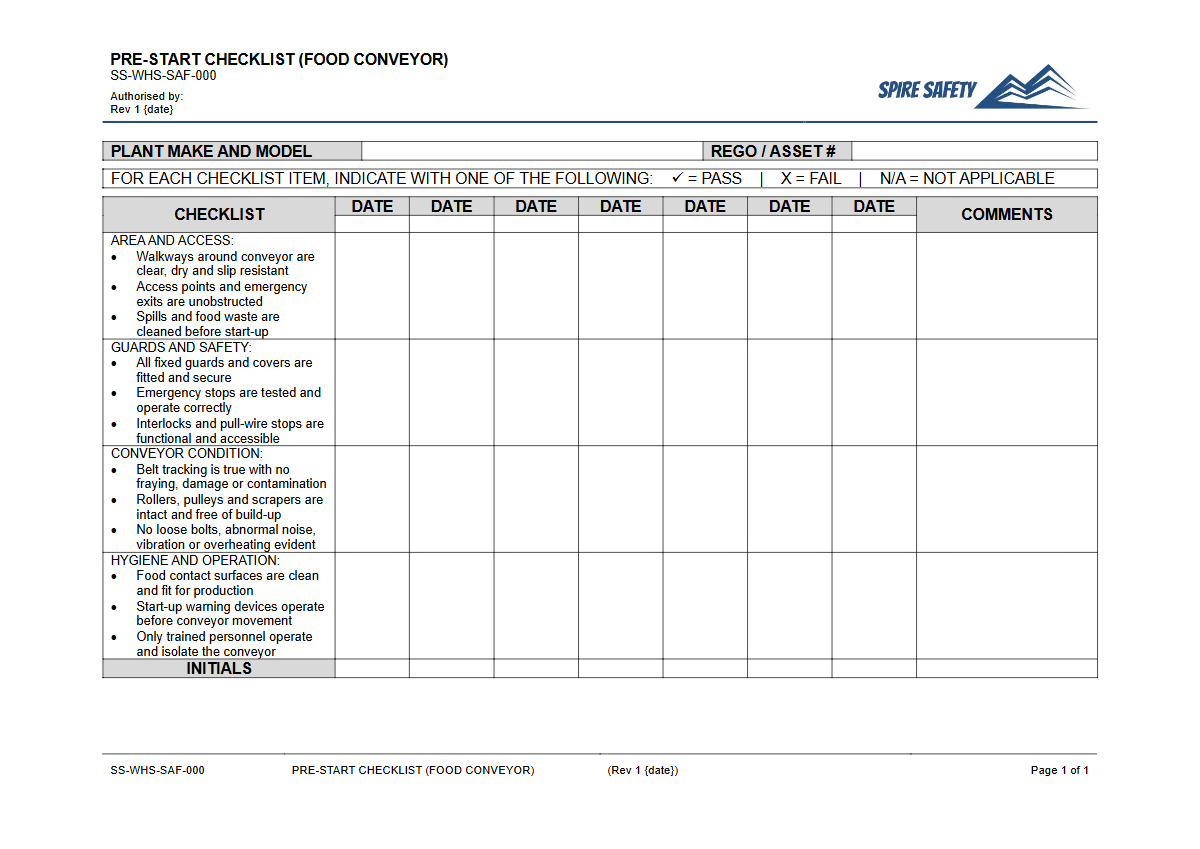
This Free Pre-Start Checklist (Food Conveyor) Template provides a structured starting point for organisations to formalise daily safety and hygiene inspections of food conveyor systems. Using this checklist helps operators verify that equipment is safe to use, clean, and functioning correctly before commencing work, which is critical for preventing injuries and maintaining food safety standards.
Regular pre-start checks are a fundamental component of proactive risk management, helping to identify potential faults, damage, or contamination hazards before they can cause harm or disrupt production. This document is aligned with Australian WHS principles for plant and equipment inspection.
Implementing consistent checks also reinforces a positive safety culture. When operators are required to inspect their equipment daily, it fosters a sense of ownership and heightened hazard awareness.
This process is not just about ticking boxes; it's a practical step towards identifying issues like worn belts, loose guards, or malfunctioning emergency stops. Furthermore, integrating such checks is a key part of upholding food hygiene.
To support this, you might also find our Food Safety Awareness Toolbox Talk Template useful for reinforcing good practices among your team.
Video walkthrough
How to use the Free Pre-Start Checklist (Food Conveyor) Template
This Pre-Start Checklist for Food Conveyors is provided as a downloadable DOCX and PDF file. The DOCX version is fully editable, allowing you to tailor the inspection points to the specific makes and models of conveyors used in your workplace, as well as any unique operational risks.
To use the template effectively:
- Download the DOCX file and open it.
- Review the existing checklist items, such as guards, emergency stops, belt condition, cleanliness, and structural integrity.
- Add, remove, or modify items to reflect the specific features of your equipment and the hazards identified in your risk assessments.
- Incorporate fields for operator details, date, time, and a sign-off area.
- Train all relevant operators and supervisors on how to complete the checklist correctly and what actions to take if a fault is found (e.g., tag out procedures, reporting to a supervisor).
Important: This is a template only. To be effective, you must customise it to suit the specific equipment, processes, and risks unique to your workplace.
We are not responsible for your WHS compliance; this document is a starting point, not a complete solution.
A well-maintained checklist system provides valuable data for maintenance planning and demonstrates due diligence in managing workplace risks. These daily inspections are a core part of equipment safety, a topic covered more broadly in our Pre-Start Checks and Plant Maintenance Toolbox Talk.
When to use it
A food conveyor pre-start checklist should be completed at the beginning of every shift or before the equipment is used for the first time each day. It is particularly important after maintenance, cleaning, or any period of inactivity where the equipment's condition may have changed.
The check ensures that the conveyor is operationally safe and hygienically prepared for handling food products before production begins. For environments with multiple types of processing equipment, you might use similar checks for other machinery, such as what is covered in our Free Pre-Start Checklist (Agitator) Template.
Who should use it
The primary user of this checklist is the trained and authorised operator of the food conveyor system. They are best placed to notice subtle changes or developing issues with the equipment they use daily.
Supervisors or team leaders should also be involved in the process, responsible for reviewing completed checklists, ensuring corrective actions are taken for any reported faults, and verifying that the checks are being performed consistently and correctly. This process should be integrated into your broader WHS management systems to ensure records are kept and trends are analysed.
Periodically, a WHS manager or maintenance supervisor may use the completed checklists to identify recurring problems, which could indicate a need for revised maintenance schedules or operator retraining. Regularly reviewing these documented checks is a key activity in any internal audit.
If you need external support in this area, consider professional WHS compliance auditing to validate your processes. For workplaces that also handle beverages, a similar rigour can be applied using resources like our Free Pre-Start Checklist (Coffee Grinder) Template. You can explore our complete collection of templates in our free WHS resources library.
Common mistakes
Common mistakes to avoid
- Failing to physically test emergency stops and instead just visually checking them.
- Ignoring minor belt fraying or damage that can worsen quickly and become a contamination or entanglement hazard.
- Completing the checklist from memory without actually inspecting the conveyor.
- Not properly cleaning the conveyor before inspection, which can hide underlying cracks, damage, or pests.
Legal references
Legal considerations
The following legal requirements may be relevant to this type of work.
- Work Health and Safety Act (Harmonised) — Provides the primary duties for protecting workers and other people from work health and safety risks.
- Work Health and Safety Regulations (Harmonised) — Sets out requirements supporting the management of workplace hazards and risks.
The following codes may be relevant to this type of work.
- Managing WHS Risks Code of Practice — Provides practical guidance on identifying hazards, assessing risks and applying effective controls.
- Work Health and Safety Consultation, Cooperation and Coordination Code of Practice — Provides practical guidance on consulting workers and coordinating with other duty holders.
- Managing the Work Environment and Facilities Code of Practice — Provides practical guidance on safe work environments, workplace facilities and related controls.
Did you know
Conveyor Entanglement Risk
According to Safe Work Australia, being trapped in machinery is a leading cause of workplace fatalities and serious injuries. Conveyor belts are a common source of these incidents, often involving hair, clothing, or limbs getting caught in moving parts.
HACCP and Equipment
Properly maintained and clean equipment is a prerequisite for any Hazard Analysis and Critical Control Points (HACCP) system. A failed pre-start check can indicate a breakdown in these prerequisite programs, compromising the entire food safety plan.
FAQ
Frequently asked questions
01What is the most important check on a food conveyor pre-start?
02How often should a food conveyor be inspected?
03What happens if a fault is found during a pre-start check?
04Can this checklist be used for non-food conveyor systems?
Share this resource
Free Pre-Start Checklist (Food Conveyor) Template
Browse Categories
How To Use It
- 1Download and open in Word or PDF.
- 2Replace the placeholders with your business details.
- 3Get it reviewed by a WHS specialist before rollout.
Need it customised?
Our WHS consultants can adapt this template to your site, run a gap analysis, or audit what you already have in place.
Book a Free Consultation WHS consulting servicesor call 1300 156 382