
Free Pre-Start Checklist (Dust Collector) Template
Download our Free Pre-Start Checklist (Dust Collector) Template (DOCX & PDF).
Free Pre-Start Checklist (Dust Collector) Template
DOCX • 125 KB + PDF
Updated Oct 2026
No signup required
Purpose of the Free Pre-Start Checklist (Dust Collector) Template
Effective dust collection is critical in workplaces where processes generate airborne particles. A malfunctioning dust collector not only fails to protect workers from respiratory hazards but can also create fire and explosion risks from combustible dusts.
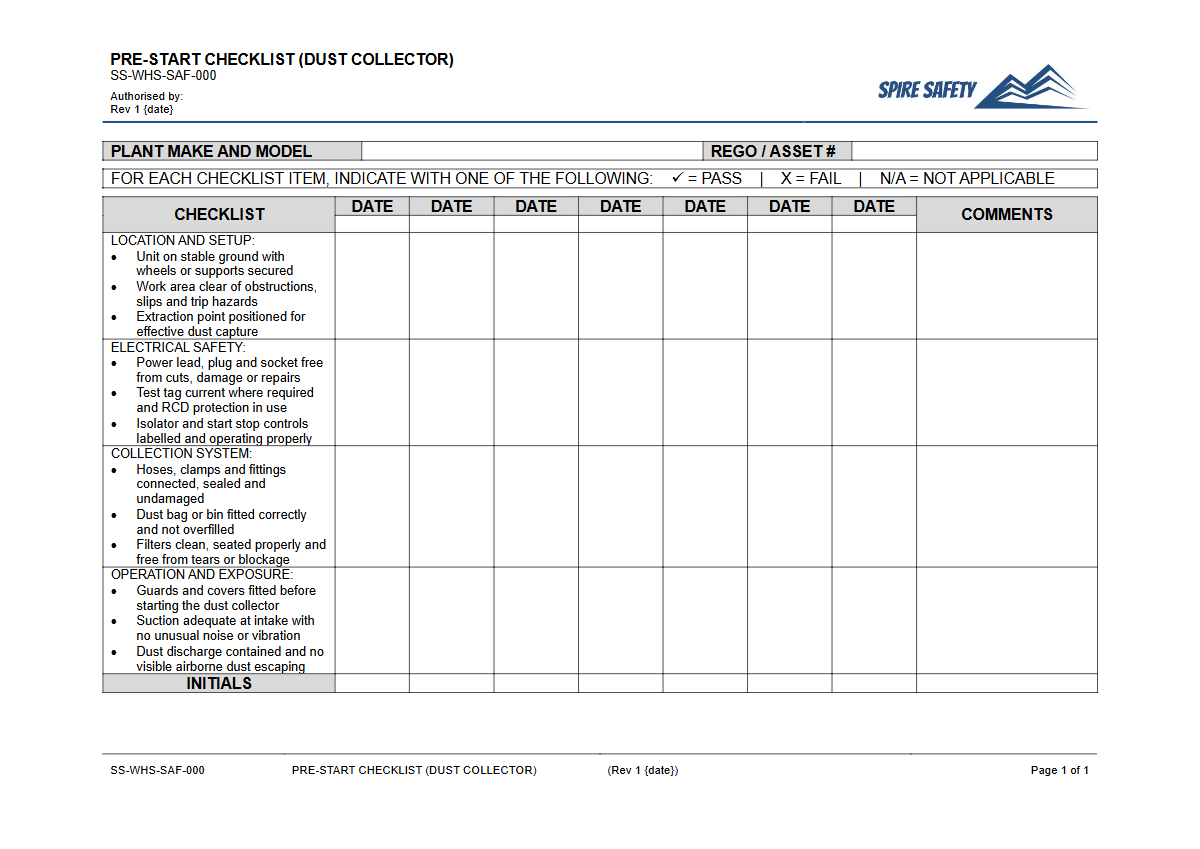
Using our Free Pre-Start Checklist (Dust Collector) Template helps formalise the daily inspection process, ensuring the equipment is safe and effective before operation. This checklist serves as a practical tool for identifying potential faults in filters, ductwork, fans, and electrical systems, which is a key step in controlling workplace hazards.
A systematic pre-start inspection helps a Person Conducting a Business or Undertaking (PCBU) meet their primary duty of care under Australian WHS laws. By documenting these checks, you create a record of your safety procedures and demonstrate proactive risk management.
Consistently using this checklist helps to minimise exposure to harmful substances and maintain a safer work environment for everyone. For a broader discussion on airborne risks, our Dust and Respiratory Hazards Toolbox Talk Template provides a great starting point for team safety meetings.
Video walkthrough
How to use the Free Pre-Start Checklist (Dust Collector) Template
This Pre-Start Checklist is provided as a user-friendly template in both DOCX and PDF formats. Download the file and integrate it into your daily operational safety procedures.
The checklist guides operators through a logical inspection sequence, covering critical components like filter condition, hopper or collection bin levels, duct integrity, fan operation, and safety guards.
Important: This is a template and must be customised to your specific workplace. We are not familiar with your operations, the specific make and model of your dust collector, the materials it handles, or your unique site risks.
You must adapt this document by adding or removing items to ensure it is suitable for your equipment and environment. A generic checklist is a good start, but a site-specific one is essential for effective safety management.
Integrating these checks into your overall WHS management systems ensures they become a routine part of your safety culture.
When to use this Pre-Start Checklist
A pre-start inspection of a dust collector should be conducted at the beginning of every shift or before the equipment is used for the first time each day. This frequency ensures that any issues that may have developed overnight or since the last use are identified before the system is relied upon to protect workers.
It should also be performed after any maintenance, servicing, or adjustments have been made to the unit to verify it has been returned to a safe operational state.
These regular checks are fundamental to preventative maintenance and overall plant safety. By making them a non-negotiable part of the daily routine, you help prevent small, unaddressed faults from escalating into major equipment failures or safety incidents. To reinforce this practice with your team, consider using our Pre-Start Checks and Plant Maintenance Toolbox Talk Template.
Who should use this Pre-Start Checklist
The pre-start checklist should be completed by the operator assigned to use the dust collector or associated machinery. This person must be trained and competent not only in operating the equipment but also in understanding what they are checking and why it is important.
Supervisors should review completed checklists to ensure diligence and follow up on any reported faults or required actions.
It is crucial that anyone performing these checks is authorised and understands the procedure for reporting defects and tagging out unsafe equipment. Inadequate safety measures can have severe consequences, as highlighted by cases where poor ventilation led to serious health issues and significant legal penalties.
The tragic outcomes in the Cobalt Exposure Leads to $1.2m Fine case study underscore the importance of maintaining ventilation systems. Ensuring your safety systems are robust and fit for purpose can be verified through a professional WHS compliance auditing process.
The principles of pre-start inspections apply to a wide range of machinery. For example, in environments with both dust collectors and computer-controlled machinery, it's equally important to use specific checks like those found in our Free Pre-Start Checklist (CNC Router) Template to address the unique risks of each piece of equipment.
Common mistakes
Common mistakes to avoid
- Treating the checklist as a paperwork exercise ('pencil-whipping') without physically performing the checks.
- Failing to customise the template for the specific dust collector model and the type of dust being collected.
- Ignoring 'minor' issues like small leaks in ductwork, which can compromise the entire system's effectiveness.
- Neglecting to empty collection bins or hoppers before they become overfull, which can cause blockages and reduce suction.
Legal references
Legal considerations
The following legal requirements may be relevant to this type of work.
- Work Health and Safety Act (Harmonised) — Provides the primary duties for protecting workers and other people from work health and safety risks.
- Work Health and Safety Regulations (Harmonised) — Sets out requirements supporting the management of workplace hazards and risks.
The following codes may be relevant to this type of work.
- Managing WHS Risks Code of Practice — Provides practical guidance on identifying hazards, assessing risks and applying effective controls.
- Work Health and Safety Consultation, Cooperation and Coordination Code of Practice — Provides practical guidance on consulting workers and coordinating with other duty holders.
- Managing the Work Environment and Facilities Code of Practice — Provides practical guidance on safe work environments, workplace facilities and related controls.
Did you know
Combustible Dust
Many seemingly harmless dusts, such as from wood, flour, or certain metals, can be explosive when suspended in air in the right concentration. A faulty dust collector can create these exact conditions, turning a safety device into a serious hazard.
Latency of Dust Diseases
Many serious respiratory diseases caused by workplace dust, like silicosis or asbestosis, have a long latency period. Symptoms may not appear for 10-30 years after exposure, highlighting the critical importance of immediate and consistent protection.
FAQ
Frequently asked questions
01What are the main risks if a dust collector is not properly inspected?
02How often should dust collector filters be checked?
03Can this checklist be used for any brand of dust collector?
04What should an operator do if a fault is found during a pre-start check?
Share this resource
Free Pre-Start Checklist (Dust Collector) Template
Browse Categories
How To Use It
- 1Download and open in Word or PDF.
- 2Replace the placeholders with your business details.
- 3Get it reviewed by a WHS specialist before rollout.
Need it customised?
Our WHS consultants can adapt this template to your site, run a gap analysis, or audit what you already have in place.
Book a Free Consultation WHS consulting servicesor call 1300 156 382