
Free Pre-Start Checklist (Breaker) Template
Download our free Pre-Start Checklist (Breaker) Template.
Free Pre-Start Checklist (Breaker) Template
DOCX • 125 KB + PDF
Updated Oct 2026
No signup required
Purpose of the Free Pre-Start Checklist (Breaker) Template
Operating a hydraulic or electric breaker involves significant risks, including exposure to high-impact vibration, noise, dust, and potential equipment failure. This Free Pre-Start Checklist (Breaker) Template provides a structured framework for operators to conduct consistent, thorough safety inspections before each use.
Systematically checking the equipment helps identify potential faults, damage, or wear and tear that could lead to an incident, injury, or costly downtime.
Formalising this process is a critical component of managing plant safety in the workplace. Using a checklist ensures that key safety features are not overlooked and creates a documented record of due diligence.
These records can be invaluable for incident investigations, maintenance planning, and demonstrating compliance with WHS duties. Integrating these checks is a practical step toward establishing more robust WHS management systems within your organisation.
Video walkthrough
How to use the Free Pre-Start Checklist (Breaker) Template
This template is designed to be a practical tool for your worksite. To implement it effectively, follow these steps:
- Download: Get the template in your preferred format, DOCX for easy editing or PDF for straightforward printing.
- Customise: This is the most important step. We must stress that you need to customise the checklist to reflect the specific make and model of your breaker(s), your operational environment, and any unique site hazards. Add or remove items to ensure it is perfectly aligned with your equipment and risk assessment.
- Train: Ensure all operators are trained on not just how to use the breaker safely, but also how to complete the pre-start checklist correctly. They must understand what each item means and what constitutes a pass or fail.
- Implement: Make the checklist readily available at the point of use or storage. Enforce the rule that a pre-start check is mandatory before any operation begins.
- Review: Supervisors should regularly review completed checklists to identify recurring faults, operator knowledge gaps, or opportunities for improving the checklist itself. The process is similar for other high-vibration tools; for related tasks, you may find our Pre-Start Checklist for Floor Saws a useful reference.
Key Inspection Points for Breakers
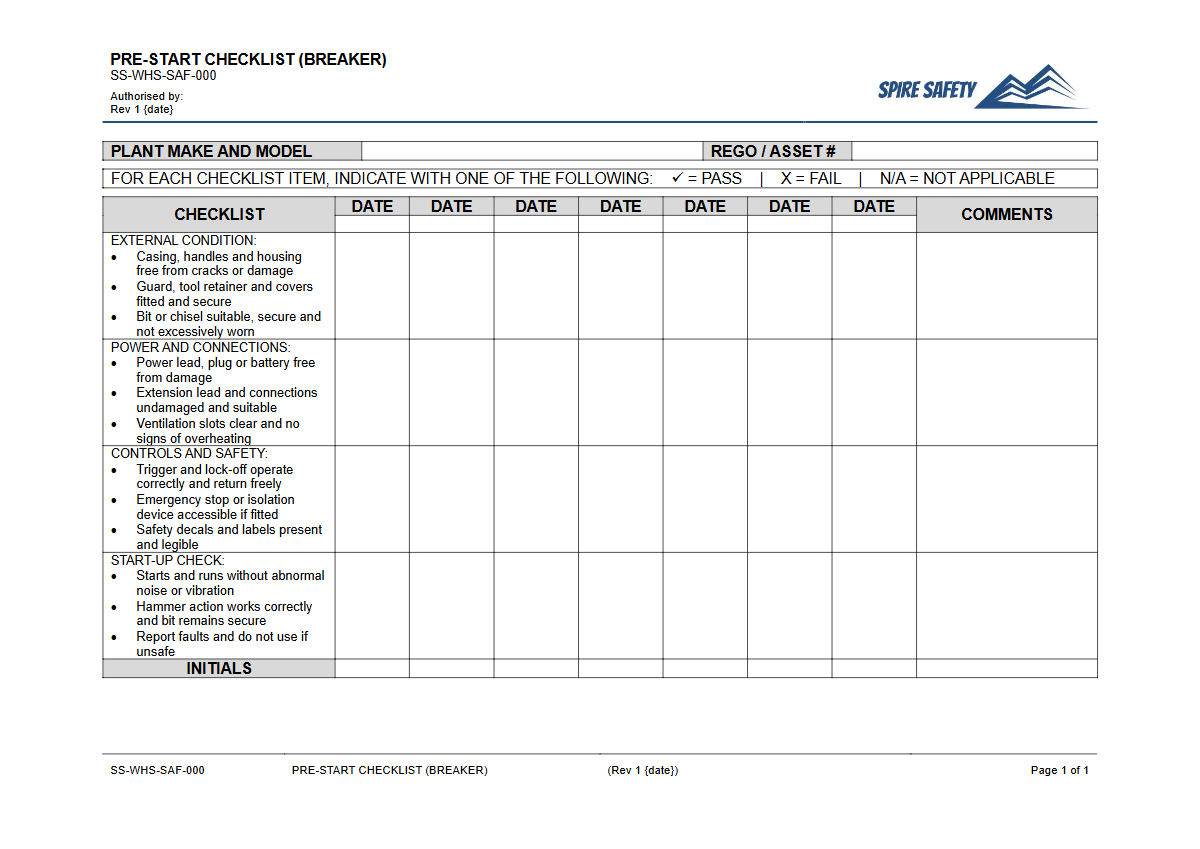
While you must customise the document, a comprehensive checklist for a breaker should generally include verification of:
- General Condition: Check for cracks, dents, or other damage to the housing and handles.
- Hydraulic Hoses & Connections: Inspect for leaks, bulges, cracks, or abrasion. Ensure couplings are secure.
- Electrical Cords & Plugs: For electric models, check for cuts, fraying, or exposed wires. Ensure the plug and any extension leads are in good condition.
- Tool Bit/Chisel: Confirm the bit is the correct type for the job, is sharp, free of damage, and securely latched.
- Controls: Test the trigger, switches, and any emergency stop or lock-off functions to ensure they work correctly.
- Safety Guards & Features: Verify that all guards, vibration-dampening handles, and other safety features are in place and functional.
- Warning Labels: Ensure all safety and instructional decals are present and legible.
For workshop equipment used in the maintenance of tools like breakers, a similar structured approach is vital. Consider implementing a pre-start checklist for a bench grinder to manage associated risks.
When to use it
A pre-start checklist for a breaker should be completed:
- Before the first use at the start of every shift.
- Before each use if the equipment is used intermittently throughout the day.
- When an operator takes over from another during a shift.
- After the equipment has undergone maintenance or repair, to ensure it is safe to return to service.
Who should use it
Multiple roles are involved in the effective use of this checklist:
- Operators: The primary person responsible for physically conducting the inspection and completing the checklist before using the breaker.
- Supervisors and Managers: Responsible for implementing the procedure, ensuring operators are trained, reviewing the completed records, and taking prompt action on any reported faults (e.g., tagging out unsafe equipment). Completed checklists serve as important evidence during a WHS compliance auditing process.
- Maintenance Personnel: Can use the information from completed checklists to diagnose recurring problems and prioritise preventative maintenance tasks.
This template is one of many documents available to help improve safety in your workplace. Explore our complete free WHS resources library for more checklists, templates, and guides.
Common mistakes
Common mistakes to avoid
- Pencil-whipping' the checklist without physically inspecting the item.
- Using a generic plant checklist that doesn't cover breaker-specific hazards like hydraulic fluid injection or tool bit security.
- Failing to immediately tag out and report faulty equipment, leaving it for the next person to potentially use.
- Ignoring minor damage like small cracks in hoses or frayed cords, which can lead to catastrophic failure under pressure.
Legal references
Legal considerations
The following legal requirements may be relevant to this type of work.
- Work Health and Safety Act (Harmonised) — Provides the primary duties for protecting workers and other people from work health and safety risks.
- Work Health and Safety Regulations (Harmonised) — Sets out requirements supporting the management of workplace hazards and risks.
The following codes may be relevant to this type of work.
- Managing WHS Risks Code of Practice — Provides practical guidance on identifying hazards, assessing risks and applying effective controls.
- Work Health and Safety Consultation, Cooperation and Coordination Code of Practice — Provides practical guidance on consulting workers and coordinating with other duty holders.
- Managing the Work Environment and Facilities Code of Practice — Provides practical guidance on safe work environments, workplace facilities and related controls.
Did you know
Vibration Risk
Prolonged use of breakers is a leading cause of Hand-Arm Vibration Syndrome (HAVS), a painful and disabling condition affecting nerves, blood vessels, and joints. Pre-start checks ensure vibration-dampening features are working correctly.
FAQ
Frequently asked questions
01What specific checks should be on a breaker pre-start checklist?
02How often should a breaker be formally inspected?
03Who is responsible for ensuring pre-start checks are done on a breaker?
04What happens if a fault is found during a breaker pre-start check?
Share this resource
Free Pre-Start Checklist (Breaker) Template
Browse Categories
How To Use It
- 1Download and open in Word or PDF.
- 2Replace the placeholders with your business details.
- 3Get it reviewed by a WHS specialist before rollout.
Need it customised?
Our WHS consultants can adapt this template to your site, run a gap analysis, or audit what you already have in place.
Book a Free Consultation WHS consulting servicesor call 1300 156 382