
Free Pre-Start Checklist (Buffing Wheel) Template
Download our free Pre-Start Checklist (Buffing Wheel) Template to formalise daily equipment checks and manage WHS risks.
Free Pre-Start Checklist (Buffing Wheel) Template
DOCX • 125 KB + PDF
Updated Oct 2026
No signup required
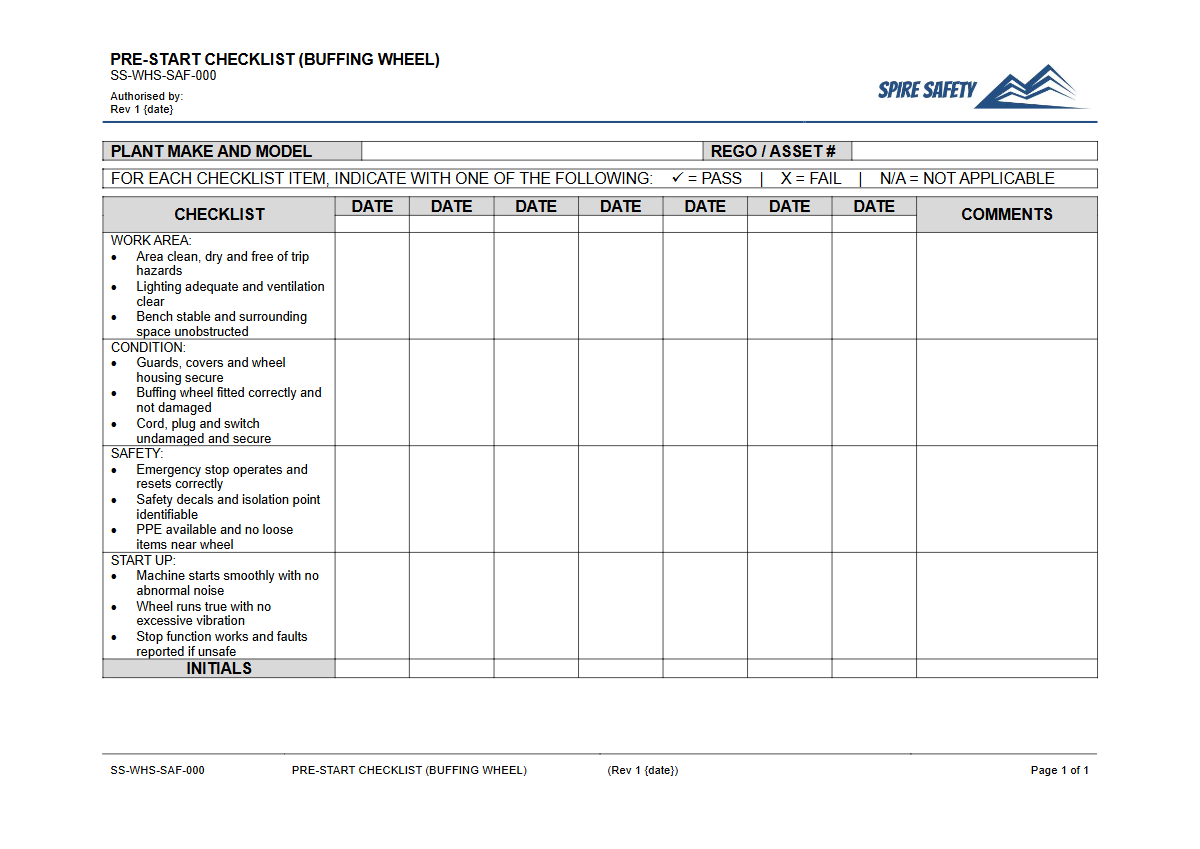
Purpose of the Free Pre-Start Checklist (Buffing Wheel) Template
Operating a buffing wheel, polisher, or linisher presents significant risks, including entanglement with the rotating spindle, projectiles from a disintegrating wheel, and respiratory exposure to dust and fumes. This free Pre-Start Checklist (Buffing Wheel) Template provides a structured framework to help workers systematically inspect the equipment before use.
Its purpose is to formalise daily safety checks, ensuring that any mechanical faults, damage, or missing safeguards are identified and addressed before work begins. Using this checklist helps create a documented record of inspections, demonstrating due diligence and contributing to a safer work environment.
The checklist guides operators to verify critical safety components like guards, work rests, wheel integrity, and emergency stops. By standardising this process, your organisation can reduce the likelihood of incidents and promote a consistent, safety-first approach to using workshop machinery.
For similar rotating equipment, our Pre-Start Checklist (Bench Grinder) Template offers a comparable level of structured inspection.
Video walkthrough
How to use the Free Pre-Start Checklist (Buffing Wheel) Template
This template is designed for straightforward implementation. First, download the file in your preferred format (DOCX for easy customisation or PDF for immediate printing).
The next crucial step is to adapt the checklist to your specific operational context. Review each checkpoint against the manufacturer's instructions and the specific buffing wheel model in use at your site.
Important Note: This document is a template only. We have designed it as a starting point, but it must be customised to suit the specific make and model of the buffing wheel, the materials being worked on, and the unique environment of your workplace.
Integrating this process into your broader safety framework is key to its effectiveness. A robust safety system ensures procedures like this are consistently followed, reviewed, and improved upon, forming part of comprehensive WHS management systems that protect your entire team.
Key Inspection Areas
While customisation is essential, a thorough buffing wheel pre-start check generally covers:
- Guarding: Ensure all guards are in place, secure, and correctly adjusted to enclose the wheel as much as possible.
- Work Rest: Check that the work rest (if fitted) is secure and adjusted to the correct distance from the wheel face (typically 2-3 mm) to prevent the workpiece from being jammed.
- Wheel Condition: Inspect the buffing wheel for fraying, tearing, excessive wear, or contamination. Ensure it is securely mounted and that the RPM rating of the wheel meets or exceeds the machine's spindle speed.
- Power & Controls: Verify that the power switch and any emergency stops are clearly accessible and function correctly.
- Dust & Fume Control: Check that any integrated or local exhaust ventilation systems are turned on and operating effectively. If your risk assessment identifies airborne contaminants as a hazard, a dedicated pre-start checklist for a fume cabinet might also be relevant.
- Work Area: Ensure the surrounding area is clean, well-lit, and free from slip or trip hazards like loose cables or debris.
When to use it
A pre-start check should be completed by the operator at the beginning of each shift or before using the buffing wheel for the first time that day. It should also be performed whenever a different operator takes over the machine.
Additionally, a full check is advisable after any maintenance, adjustment, or repair work has been carried out on the equipment. Regular checks are a cornerstone of proactive risk management, similar to the process outlined in our Pre-Start Checklist for an English Wheel.
Who should use it
This Pre-Start Checklist should be used by any worker who is trained, authorised, and deemed competent to operate a buffing wheel. Supervisors or team leaders should also use the document to verify that inspections are being completed correctly and to sign off on any reported faults or required actions.
Furthermore, WHS managers and safety committees can use the completed records as part of their routine workplace inspection and auditing processes. These records can provide valuable data during formal WHS compliance auditing to identify trends and assess the overall effectiveness of machinery safety protocols.
By embedding this checklist into your daily operations, you reinforce individual responsibility and create a culture where safety is a shared priority. Explore our free WHS resources library for more tools to support your safety management system.
Common mistakes
Common mistakes to avoid
- Using a generic checklist that doesn't match the specific machine model and its unique features.
- Failing to check that the buffing wheel's maximum RPM rating is higher than the machine's spindle speed.
- Ignoring 'minor' issues like a frayed wheel, a loose guard, or a poorly adjusted work rest.
- Completing the checklist from memory or 'pencil-whipping' it without physically performing each inspection point.
Legal references
Legal considerations
The following legal requirements may be relevant to this type of work.
- Work Health and Safety Act (Harmonised) — Provides the primary duties for protecting workers and other people from work health and safety risks.
- Work Health and Safety Regulations (Harmonised) — Sets out requirements supporting the management of workplace hazards and risks.
The following codes may be relevant to this type of work.
- Managing WHS Risks Code of Practice — Provides practical guidance on identifying hazards, assessing risks and applying effective controls.
- Work Health and Safety Consultation, Cooperation and Coordination Code of Practice — Provides practical guidance on consulting workers and coordinating with other duty holders.
- Managing the Work Environment and Facilities Code of Practice — Provides practical guidance on safe work environments, workplace facilities and related controls.
Did you know
Rotational Hazards
The high rotational speed of a buffing wheel means that even a small snag on loose clothing, gloves, or hair can cause a severe entanglement injury in a fraction of a second.
Hidden Respiratory Risks
The material being polished and the type of buffing compound used can release hazardous dust or fumes. Some metal dusts are combustible, and some polishing compounds can contain silica or other harmful substances, often requiring specific respiratory protection or ventilation.
FAQ
Frequently asked questions
01Why is a pre-start check important for a buffing wheel?
02What's the main difference between a buffing wheel and a bench grinder?
03Does this template cover scheduled maintenance requirements?
04How often should our customised buffing wheel checklist be reviewed?
Share this resource
Free Pre-Start Checklist (Buffing Wheel) Template
Browse Categories
How To Use It
- 1Download and open in Word or PDF.
- 2Replace the placeholders with your business details.
- 3Get it reviewed by a WHS specialist before rollout.
Need it customised?
Our WHS consultants can adapt this template to your site, run a gap analysis, or audit what you already have in place.
Book a Free Consultation WHS consulting servicesor call 1300 156 382