
Free Pre-Start Checklist (Cake Mixer) Template
Download our Free Pre-Start Checklist for Cake Mixers.
Free Pre-Start Checklist (Cake Mixer) Template
DOCX • 125 KB + PDF
Updated Oct 2026
No signup required
Purpose of the Free Pre-Start Checklist (Cake Mixer) Template
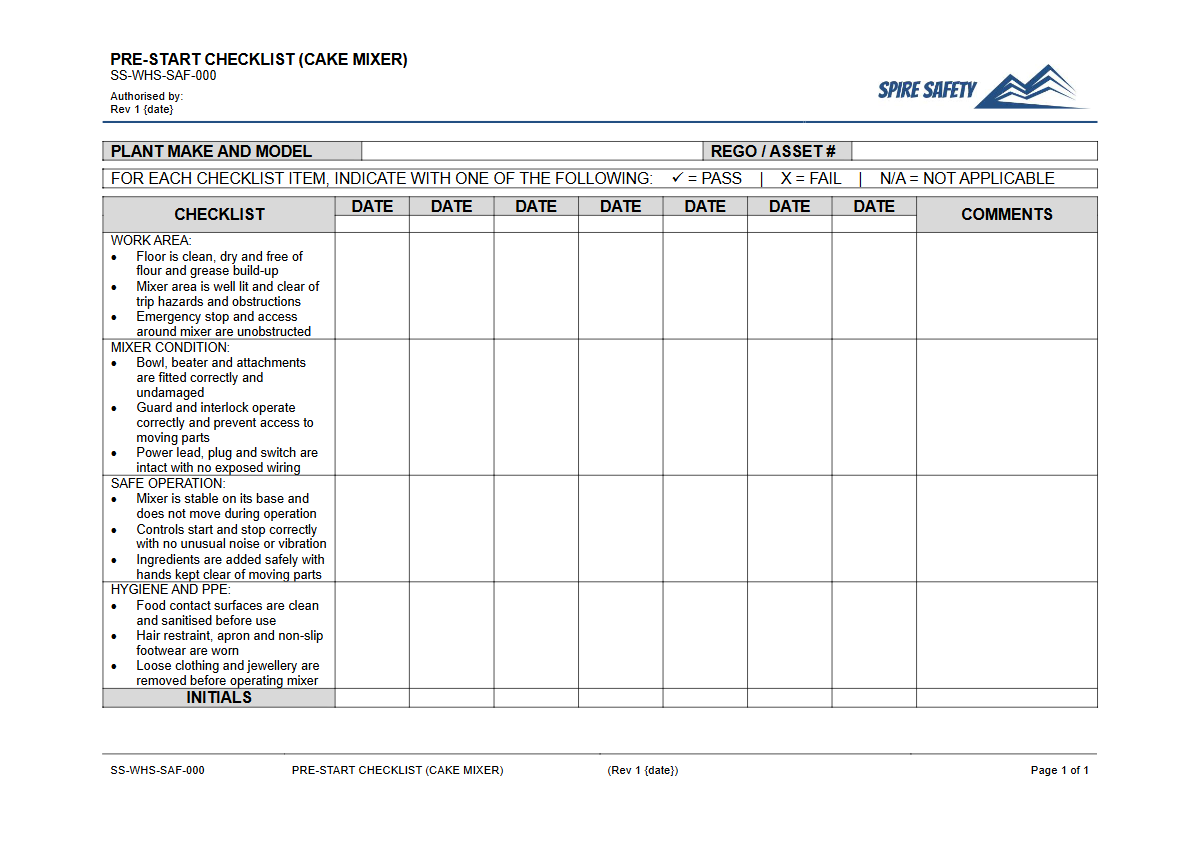
Using commercial cake mixers, whether in a bakery, commercial kitchen, or food manufacturing facility, involves specific risks that must be managed. This Free Pre-Start Checklist (Cake Mixer) Template provides a structured starting point for formalising daily equipment inspections.
Regular checks are a fundamental part of workplace safety, helping to identify potential faults before they lead to incidents, equipment damage, or costly downtime. By systematically inspecting critical components like guards, emergency stops, and electrical connections, you can ensure the mixer is safe for use at the start of every shift.
Implementing consistent pre-start checks demonstrates a commitment to proactive risk management. It helps your organisation meet its duties under Australian WHS laws to provide and maintain safe plant and equipment.
These records also serve as valuable documentation in the event of an incident or audit. Integrating this process into your broader safety framework is crucial for its effectiveness.
A robust safety system ensures that procedures like pre-start checks are consistently followed, reviewed, and improved upon. For businesses looking to develop or enhance their overall safety structure, understanding the components of effective WHS management systems is a critical next step.
Video walkthrough
How to use the Free Pre-Start Checklist (Cake Mixer) Template
This template is designed to be adapted to your specific operational needs. Follow these steps to implement it effectively:
- Download: Choose either the DOCX or PDF format. The DOCX version is fully editable.
- Customise: This is the most important step. You must review and modify the checklist to reflect the specific make, model, and configuration of the cake mixers used in your workplace. Add or remove items to align with the manufacturer’s instructions and your own risk assessments. We cannot provide a universally document because we don't know your specific equipment or operational risks.
- Train: Ensure all operators are trained on how to conduct the checks thoroughly. They must understand what each item means and what constitutes a pass or a fail. A great way to reinforce this is through targeted training sessions, and our Pre-Start Checks and Plant Maintenance Toolbox Talk Template can help structure these discussions.
- Implement: Integrate the checklist into your daily opening procedures. Store completed records in a designated location for easy access and review.
What to do if a fault is found
A checklist is only effective if action is taken when a defect is identified. Your procedure should clearly state that if a mixer fails any check, it must not be used.
The operator should immediately apply a 'Do Not Operate' tag, remove the equipment from service if possible, and report the fault to a supervisor or maintenance personnel. This 'lockout/tagout' process is a non-negotiable safety control.
When to use it
A pre-start checklist for a commercial cake mixer should be completed by the operator before the first use on any given day or shift. This frequency ensures that any damage or faults that may have occurred overnight, during cleaning, or from previous use are identified before the machine is operated again.
For equipment that is used infrequently, a check should still be performed before each use.
Who should use it
The checklist should be completed by the person operating the cake mixer. The operator is in the best position to notice subtle changes in the machine's condition or performance.
Supervisors or managers are responsible for ensuring these checks are being completed correctly and for taking action on any reported faults. Verifying that an operator is competent to not only use the machine but also inspect it is a key part of a supervisor's role.
While we offer a Verification of Competency (Cement Mixer) Template for a different machine type, the principles of assessing competency are transferable.
Integrating with other equipment checks
The principles of pre-start checks apply to all types of powered plant and equipment in the workplace. You can adapt the structure of this template for other machinery.
For instance, the safety checks for a large industrial mixer share similarities with those for other rotating equipment. Our Free Pre-Start Checklist (Agitator) Template provides another example of how to structure checks for similar hazards.
For expert assistance in developing a comprehensive plant safety program, our WHS consulting services can provide tailored support. If you're looking for other document templates, you can browse our complete free WHS resources library.
Common mistakes
Common mistakes to avoid
- Using the generic template without customising it for the specific mixer model and workplace risks.
- Operators 'pencil-whipping' the form without physically performing each check.
- Failing to immediately remove a faulty mixer from service and clearly tag it as 'Out of Service'.
- Not providing adequate training to operators on how to properly complete the checklist and what to look for.
Legal references
Legal considerations
The following legal requirements may be relevant to this type of work.
- Work Health and Safety Act (Harmonised) — Provides the primary duties for protecting workers and other people from work health and safety risks.
- Work Health and Safety Regulations (Harmonised) — Sets out requirements supporting the management of workplace hazards and risks.
The following codes may be relevant to this type of work.
- Managing WHS Risks Code of Practice — Provides practical guidance on identifying hazards, assessing risks and applying effective controls.
- Work Health and Safety Consultation, Cooperation and Coordination Code of Practice — Provides practical guidance on consulting workers and coordinating with other duty holders.
- Managing the Work Environment and Facilities Code of Practice — Provides practical guidance on safe work environments, workplace facilities and related controls.
Did you know
Machine Guarding
The Safe Work Australia 'Managing Risks of Plant in the Workplace' Code of Practice explicitly states that if a guard is intended to be opened or removed for operational needs, it must be interlocked to prevent the machine from starting or running.
Entanglement Risk
Contact and entanglement with moving parts of machinery is a leading cause of serious injury in manufacturing and food processing. Even a moment of inattention can lead to devastating consequences, highlighting the importance of functional guards and emergency stops.
FAQ
Frequently asked questions
01What are the main hazards of a commercial cake mixer?
02Is a pre-start checklist a legal requirement in Australia?
03How often should a pre-start check be done on a commercial cake mixer?
04Who is qualified to conduct a pre-start inspection on a cake mixer?
Share this resource
Free Pre-Start Checklist (Cake Mixer) Template
Browse Categories
How To Use It
- 1Download and open in Word or PDF.
- 2Replace the placeholders with your business details.
- 3Get it reviewed by a WHS specialist before rollout.
Need it customised?
Our WHS consultants can adapt this template to your site, run a gap analysis, or audit what you already have in place.
Book a Free Consultation WHS consulting servicesor call 1300 156 382