
Free Pre-Start Checklist (Carpark Fan) Template
Download our free Pre-Start Checklist (Carpark Fan) Template to formalise your safety inspections.
Free Pre-Start Checklist (Carpark Fan) Template
DOCX • 125 KB + PDF
Updated Oct 2026
No signup required
Purpose of the Free Pre-Start Checklist (Carpark Fan) Template
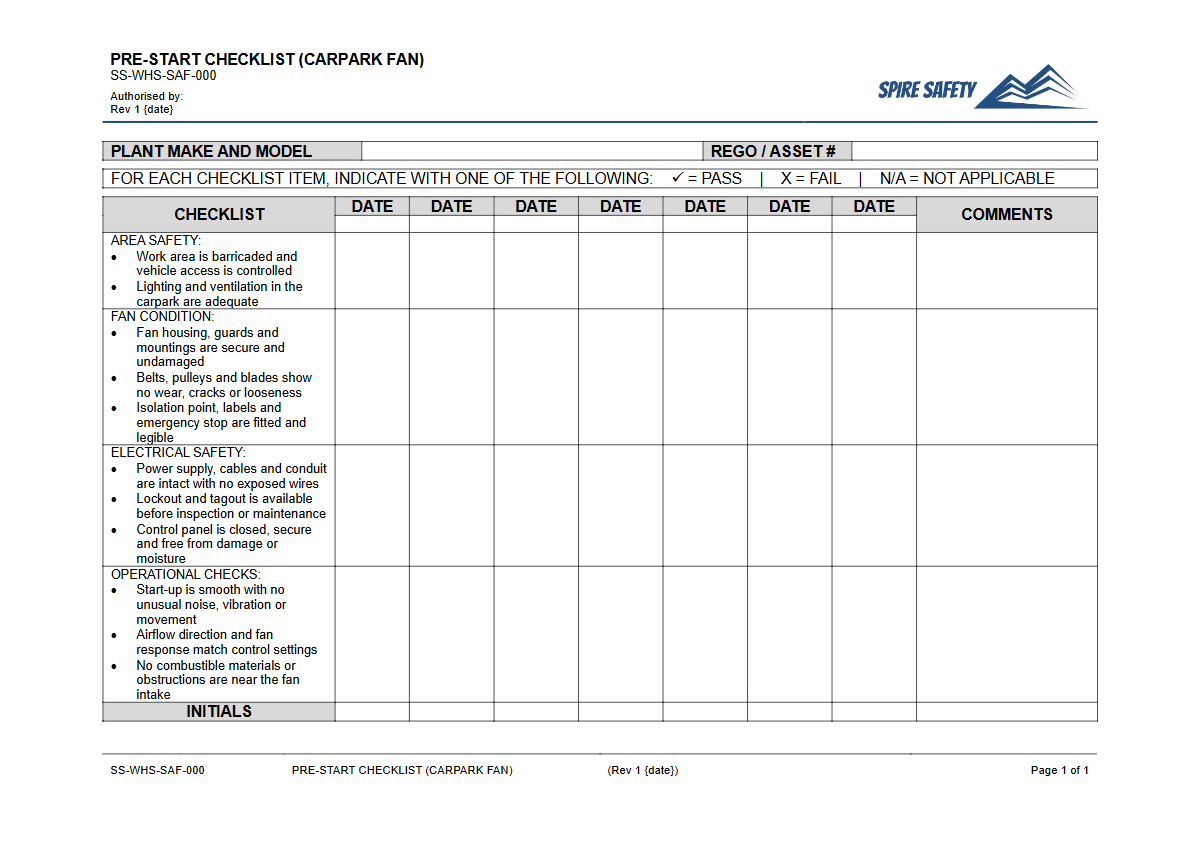
Properly functioning carpark fans are critical for maintaining safe air quality and managing fire risks in enclosed and underground spaces. This Free Pre-Start Checklist (Carpark Fan) Template provides a structured format for conducting routine safety and operational checks before use.
Regular inspections help identify potential faults or damage early, preventing equipment failure that could lead to hazardous accumulations of carbon monoxide (CO) or ineffective smoke extraction during an emergency. Using a checklist formalises this process, ensuring no critical step is missed and creating a verifiable record of due diligence.
Integrating such procedures is a fundamental part of proactive risk management. By consistently verifying the condition of essential plant like ventilation fans, your organisation can uphold its duty of care to workers, visitors, and the public.
These daily checks form a practical component of broader WHS management systems, demonstrating a commitment to maintaining a safe physical environment.
Video walkthrough
How to use the Free Pre-Start Checklist (Carpark Fan) Template
This resource is available in two formats. The DOCX file can be easily edited to suit the specific requirements of your facility and the fan models you use.
The PDF version is ready for immediate printing and use. The checklist guides the operator or maintenance person through a logical sequence of visual and operational checks, covering key components like fan blades, motor, guards, mounts, and electrical connections.
Important Customisation Note
This document is a template and must be adapted to your workplace. We recommend you customise it to reflect the specific make, model, and operational context of the carpark fans used in your facility, as well as your site-specific risk controls and procedures. Your final document should be comprehensive and tailored to your unique operational environment.
The Inspection Process
The process is straightforward:
- Before starting the equipment, the user methodically works through the checklist, inspecting each item listed.
- Each item is marked as satisfactory or unsatisfactory. If a defect is found, details should be recorded in the comments section.
- Any identified fault must be reported immediately according to your organisation's procedure. The faulty equipment should be isolated and tagged out of service to prevent use until it is repaired by a qualified person.
- Once the check is complete, the user signs and dates the form. These completed records should be filed and stored, as they provide valuable data for maintenance planning and can be reviewed during WHS compliance auditing.
When to use it
A pre-start check should be conducted at the frequency determined by a risk assessment, which typically aligns with the manufacturer's recommendations or the start of each operational period (e.g., daily). For critical safety equipment like carpark fans, daily checks are a common and sensible control measure.
This routine ensures the equipment's readiness and helps catch developing issues before they escalate into major failures and costly repairs.
Regular use of this checklist reinforces a safety-first culture. To further embed this behaviour, consider discussing the importance of equipment inspections using a Pre-Start Checks and Plant Maintenance Toolbox Talk. This helps ensure all relevant personnel understand the 'why' behind the 'what'.
Who should use it
This Pre-Start Checklist should be used by personnel who are trained, competent, and authorised to operate or maintain the carpark ventilation system. This may include facility managers, building maintenance staff, or specialist technicians.
The user must be familiar with the specific fan system, understand its operational principles, and be able to recognise signs of wear, damage, or malfunction. Competence should be verified and documented as part of your training and induction processes.
Formalising these roles and responsibilities is a key element of structured safety management. For organisations seeking certification, integrating procedures like this helps meet the operational control requirements of international standards, a process that can be guided by specialist ISO 45001 consulting.
This template serves as a robust starting point for improving your equipment safety procedures. For more templates and guidance documents, explore our complete free WHS resources library.
Common mistakes
Common mistakes to avoid
- Ticking boxes on the checklist without physically inspecting the item.
- Failing to report defects or tag out faulty equipment, allowing it to remain in service.
- Using a generic checklist that doesn't match the specific fan model and its unique components.
- Not retaining completed checklists for auditing, trend analysis, and maintenance planning.
Legal references
Legal considerations
The following legal requirements may be relevant to this type of work.
- Work Health and Safety Act (Harmonised) — Provides the primary duties for protecting workers and other people from work health and safety risks.
- Work Health and Safety Regulations (Harmonised) — Sets out requirements supporting the management of workplace hazards and risks.
The following codes may be relevant to this type of work.
- Managing WHS Risks Code of Practice — Provides practical guidance on identifying hazards, assessing risks and applying effective controls.
- Work Health and Safety Consultation, Cooperation and Coordination Code of Practice — Provides practical guidance on consulting workers and coordinating with other duty holders.
- Managing the Work Environment and Facilities Code of Practice — Provides practical guidance on safe work environments, workplace facilities and related controls.
Did you know
A Silent Hazard
Carbon monoxide (CO) is colourless, odourless, and a primary danger in enclosed carparks. Effective mechanical ventilation is the main engineering control used to keep CO levels below hazardous exposure limits.
Australian Standard
Australian Standard AS 1668.2 specifies the minimum requirements for mechanical ventilation systems to ensure safe air quality in buildings, including carparks. It provides detailed guidance on ventilation rates and system design.
FAQ
Frequently asked questions
01What is the main purpose of a carpark fan pre-start check?
02How often should carpark fan inspections be conducted?
03Who is responsible for completing a pre-start checklist for a carpark fan?
04Can this template be used for any type of ventilation fan?
Share this resource
Free Pre-Start Checklist (Carpark Fan) Template
Browse Categories
How To Use It
- 1Download and open in Word or PDF.
- 2Replace the placeholders with your business details.
- 3Get it reviewed by a WHS specialist before rollout.
Need it customised?
Our WHS consultants can adapt this template to your site, run a gap analysis, or audit what you already have in place.
Book a Free Consultation WHS consulting servicesor call 1300 156 382