
Free Pre-Start Checklist (Cattle Crush) Template
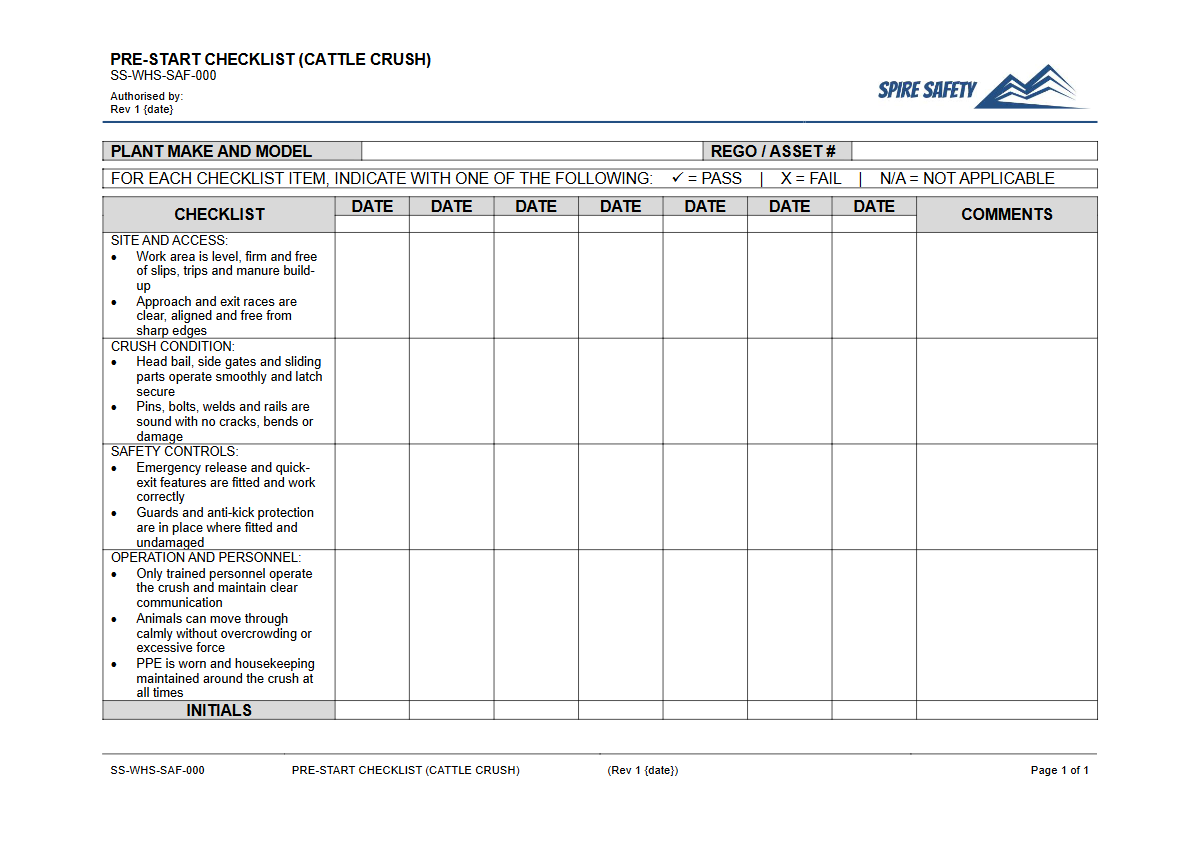
Download our free Pre-Start Checklist for Cattle Crushes.
Free Pre-Start Checklist (Cattle Crush) Template
DOCX • 125 KB + PDF
Updated Oct 2026
No signup required
Purpose of the Free Pre-Start Checklist (Cattle Crush) Template
Operating heavy agricultural equipment like a cattle crush requires a systematic approach to safety. To help your organisation formalise this process, Spire Safety offers this Free Pre-Start Checklist (Cattle Crush) Template.
This structured document provides a reliable starting point for identifying potential hazards before work begins, reducing the risk of injury to both operators and livestock. By implementing a consistent inspection routine, you can ensure the crush is in safe working order, protecting your workers from mechanical failures, crushing injuries, and other common farm-related incidents.
The primary purpose of the Free Pre-Start Checklist (Cattle Crush) Template is to guide a competent operator through a systematic inspection of the equipment before it is used. This process helps verify that all critical safety components—such as gates, latches, head bails, and hydraulic or pneumatic systems—are functioning correctly.
Regularly completing these checks helps create a safer working environment by proactively identifying wear, damage, or faults that could lead to accidents. This structured approach is a key part of any effective WHS management system, demonstrating a commitment to risk management and due diligence.
Video walkthrough
How to use the Free Pre-Start Checklist (Cattle Crush) Template
To effectively implement this checklist, download the DOCX or PDF file and integrate it into your operational procedures. It is crucial to customise the template to reflect the specific make, model, and configuration of the cattle crush used at your workplace.
We provide this as a starting point; you must adapt it to your unique equipment and operational risks. Once customised, ensure all operators are trained on how to properly complete the checklist and what actions to take if a fault is found.
This training should be documented and refreshed periodically.
When to use it
The pre-start checklist should be completed before the first use of the cattle crush on any given day or shift. It should also be used after any maintenance or repair work has been carried out to verify the equipment is safe to return to service.
Establishing this routine is a fundamental aspect of proactive equipment care. For a broader perspective on this topic, our Pre-Start Checks and Plant Maintenance Toolbox Talk provides excellent material for team safety meetings.
Who should use it
This checklist is designed for use by competent and authorised personnel. This includes farm workers, stock handlers, and station hands who have received specific training on the safe operation of the cattle crush.
Supervisors and farm managers should also be familiar with the checklist to oversee its correct implementation and ensure that any identified issues are addressed promptly. Verifying competency is a critical step in ensuring safety with all types of farm machinery, not just cattle crushes. Similar principles apply to equipment like those covered in our Free Pre-Start Checklist (Air Seeder) Template.
A well-maintained cattle crush not only protects workers but also improves animal welfare by ensuring a smoother, less stressful handling process. Faulty equipment can cause unnecessary distress or injury to livestock.
Incorporating daily checks helps maintain the operational integrity of all components, from the floor grip to the squeeze mechanism. Similar structured checks are vital for other specialised agricultural equipment, as seen in our Free Pre-Start Checklist (Aerator) Template, which helps manage different but equally important risks.
Beyond individual equipment checks, creating a comprehensive safety framework for your agricultural business is essential. This involves identifying all hazards, assessing risks, and implementing robust control measures across all operations.
If your organisation requires expert guidance in developing or refining your safety protocols, Spire Safety offers professional WHS consulting services tailored to the unique challenges of the agricultural sector.
This template is just one of many resources available to support your WHS obligations. By fostering a culture where safety checks are second nature, you significantly reduce the likelihood of preventable incidents. For more templates, guides, and toolbox talks, explore our complete free WHS resources library.
Common mistakes
Common mistakes to avoid
- Failing to customise the generic template to the specific make and model of the crush.
- Operators 'pencil-whipping' the checklist without physically performing the inspections.
- Not training workers on how to use the checklist or what to do when a defect is found.
- Continuing to use the cattle crush after a fault has been identified and reported.
Legal references
Legal considerations
The following legal requirements may be relevant to this type of work.
- Work Health and Safety Act (Harmonised) — Provides the primary duties for protecting workers and other people from work health and safety risks.
- Work Health and Safety Regulations (Harmonised) — Sets out requirements supporting the management of workplace hazards and risks.
The following codes may be relevant to this type of work.
- Managing WHS Risks Code of Practice — Provides practical guidance on identifying hazards, assessing risks and applying effective controls.
- Work Health and Safety Consultation, Cooperation and Coordination Code of Practice — Provides practical guidance on consulting workers and coordinating with other duty holders.
- Managing the Work Environment and Facilities Code of Practice — Provides practical guidance on safe work environments, workplace facilities and related controls.
Did you know
Flight Zone
Understanding a cow's 'flight zone'—the personal space around it—is key to low-stress handling. When a handler enters this zone, the animal will move away; skillful positioning can guide cattle through the crush with minimal force.
Agricultural Injuries
According to Safe Work Australia, the agriculture, forestry, and fishing industry consistently has one of the highest rates of worker fatalities and serious injuries, with machinery and animal handling being major contributors.
FAQ
Frequently asked questions
01What are the main hazards associated with using a cattle crush?
02How often should a cattle crush be inspected?
03Who is considered a 'competent person' to operate a cattle crush?
04Is a pre-start checklist a legal requirement for farm equipment in Australia?
Share this resource
Free Pre-Start Checklist (Cattle Crush) Template
Browse Categories
How To Use It
- 1Download and open in Word or PDF.
- 2Replace the placeholders with your business details.
- 3Get it reviewed by a WHS specialist before rollout.
Need it customised?
Our WHS consultants can adapt this template to your site, run a gap analysis, or audit what you already have in place.
Book a Free Consultation WHS consulting servicesor call 1300 156 382