
Free Pre-Start Checklist (Chaff Cutter) Template
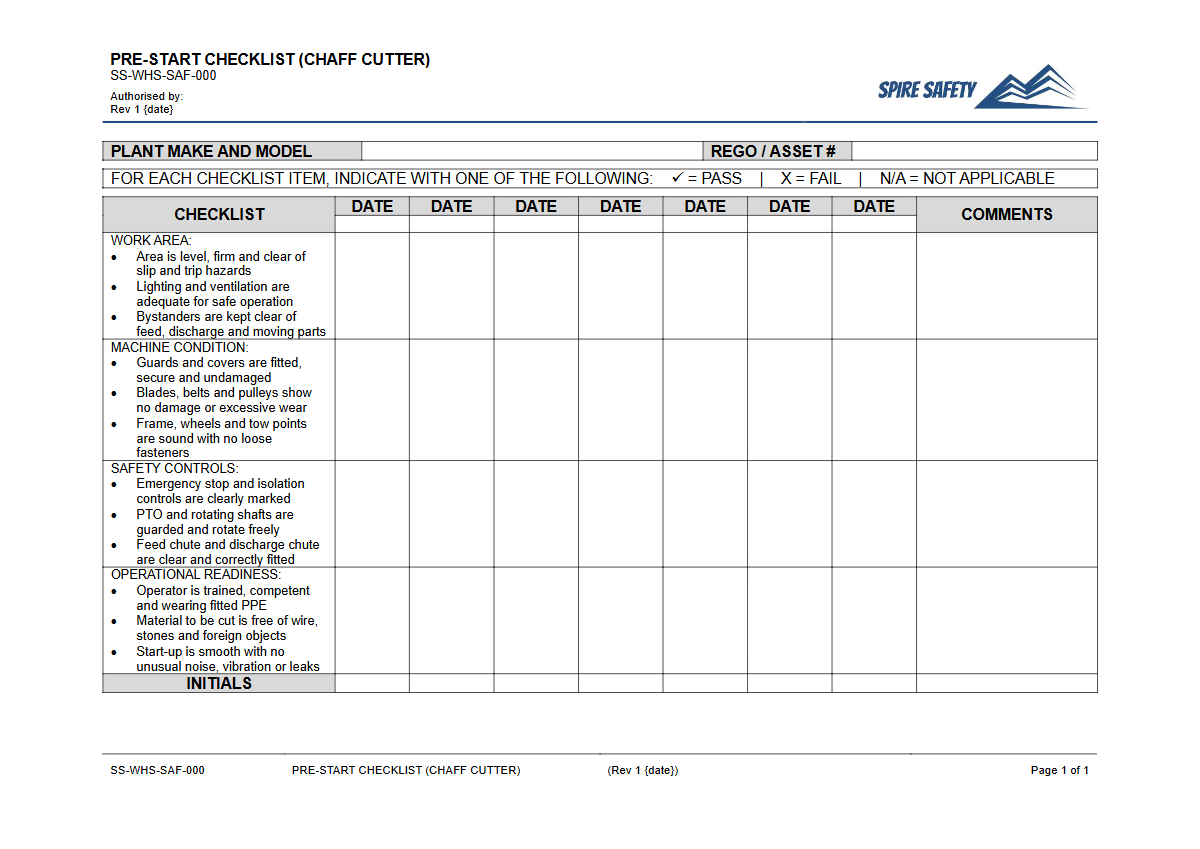
Download our free Pre-Start Checklist (Chaff Cutter) Template to formalise daily equipment inspections. Aligned with Australian WHS practice. Download now.
Free Pre-Start Checklist (Chaff Cutter) Template
DOCX • 125 KB + PDF
Updated Oct 2026
No signup required
Purpose of the Free Pre-Start Checklist (Chaff Cutter) Template
Operating agricultural machinery like a chaff cutter introduces significant workplace hazards. This free Pre-Start Checklist (Chaff Cutter) Template provides a structured framework for operators to conduct thorough, documented inspections before each use.
Consistent pre-start checks are a fundamental control measure to identify mechanical faults, damage, or missing guards before they can lead to an incident. By formalising this process, you create a verifiable record of due diligence and help foster a proactive safety culture within your organisation.
Using a checklist helps systematically verify that critical safety components are in place and functioning correctly. This includes checking guards, emergency stops, drive belts, and the general structural integrity of the machine.
The goal is to minimise risks such as entanglement, cutting, and unexpected movement, which are common causes of serious injury with this type of plant. Integrating these checks into daily operations is a key part of any effective plant safety program, a topic covered in depth in our Pre-Start Checks and Plant Maintenance Toolbox Talk.
Video walkthrough
How to use the Free Pre-Start Checklist (Chaff Cutter) Template
This resource is available as a fully editable Microsoft Word (DOCX) file and a print-ready PDF. The DOCX version allows for complete customisation to align with your specific machinery, operational context, and risk assessment findings.
You can add, remove, or modify checklist items to ensure they are relevant to the make and model of the chaff cutter used in your workplace. It's crucial that the checklist reflects the unique hazards and controls of your site.
Important: This is a template, not a finished document. We don't know your specific machinery, site conditions, or operational procedures.
You must customise this checklist to suit your business's specific needs and ensure it aligns with the manufacturer's instructions and your own risk assessments. Failure to do so may leave critical safety elements uninspected.
Once customised, the checklist should form part of your broader WHS management systems. The process typically involves the operator walking around the machine and physically verifying each item on the list, ticking it off as they go. Any identified faults or deficiencies must be recorded in the 'Corrective Actions' section. Similar structured approaches can be adapted for other agricultural equipment, as seen in our Free Pre-Start Checklist (Air Seeder) template.
What to do if a fault is found
If an operator identifies a defect during the pre-start inspection that poses a risk to health and safety, the chaff cutter must not be used. The machine should be immediately isolated, and a 'Do Not Operate' tag or similar lockout device should be attached.
The fault must be reported to a supervisor or the designated maintenance person according to your organisation's procedures. The equipment should only be returned to service once the fault has been rectified by a competent person and is confirmed to be safe.
Regular reviews of completed checklists can also inform your maintenance schedule and may trigger a more formal WHS compliance auditing process to ensure procedures are being followed.
When to use it
A pre-start checklist for a chaff cutter should be completed before every shift or period of use. It is not a weekly or monthly task.
Machinery condition can change overnight due to damage, tampering, environmental factors, or incomplete maintenance from a previous shift. Performing the check at the start of the day ensures the operator has verified the equipment's safe state immediately before they are exposed to its hazards.
This routine reinforces safe work habits and ensures no assumptions are made about the machine's condition.
Who should use it
The pre-start checklist must be completed by a worker who is trained and competent to operate the specific chaff cutter in use. 'Competence' involves more than just knowing how to turn the machine on; it means the operator understands its functions, is aware of the potential hazards, and knows the safe operating procedures, including how to perform the pre-start inspection correctly.
A person cannot competently check a machine they are not competent to use. For some high-risk equipment, organisations use formal processes to confirm operator skill, such as our Verification of Competency (Rebar Cutter) template.
Supervisors and managers also have a role in ensuring the checklists are being completed correctly and that any reported faults are addressed in a timely manner. They are responsible for providing the necessary resources, training, and time for operators to conduct these vital safety checks without pressure. For more templates and safety documents, browse our complete free WHS resources library.
Common mistakes
Common mistakes to avoid
- Failing to properly guard all moving parts, especially the infeed hopper, blades, and discharge chute.
- Attempting to clear blockages while the machine is still running or has stored energy.
- Operating the machine without adequate training or understanding of its specific risks and controls.
- Skipping pre-start checks because the machine 'worked fine yesterday'.
Legal references
Legal considerations
The following legal requirements may be relevant to this type of work.
- Work Health and Safety Act (Harmonised) — Provides the primary duties for protecting workers and other people from work health and safety risks.
- Work Health and Safety Regulations (Harmonised) — Sets out requirements supporting the management of workplace hazards and risks.
The following codes may be relevant to this type of work.
- Managing WHS Risks Code of Practice — Provides practical guidance on identifying hazards, assessing risks and applying effective controls.
- Work Health and Safety Consultation, Cooperation and Coordination Code of Practice — Provides practical guidance on consulting workers and coordinating with other duty holders.
- Managing the Work Environment and Facilities Code of Practice — Provides practical guidance on safe work environments, workplace facilities and related controls.
Did you know
Entanglement Risk
Entanglement in moving parts of machinery is a leading cause of serious injury and death in Australian agriculture. Even a single loose thread of clothing can be enough to pull a worker into a machine.
PCBU Duties
The model WHS Regulations place specific duties on PCBUs to manage risks associated with plant, including ensuring it is regularly inspected by a competent person and maintained in safe working order.
FAQ
Frequently asked questions
01What are the main hazards associated with a chaff cutter?
02How often should a chaff cutter pre-start check be done?
03Who is responsible for ensuring pre-start checks are completed?
04Can a digital checklist be used instead of this paper template?
Share this resource
Free Pre-Start Checklist (Chaff Cutter) Template
Browse Categories
How To Use It
- 1Download and open in Word or PDF.
- 2Replace the placeholders with your business details.
- 3Get it reviewed by a WHS specialist before rollout.
Need it customised?
Our WHS consultants can adapt this template to your site, run a gap analysis, or audit what you already have in place.
Book a Free Consultation WHS consulting servicesor call 1300 156 382