
Free Pre-Start Checklist (Chain Hoist) Template
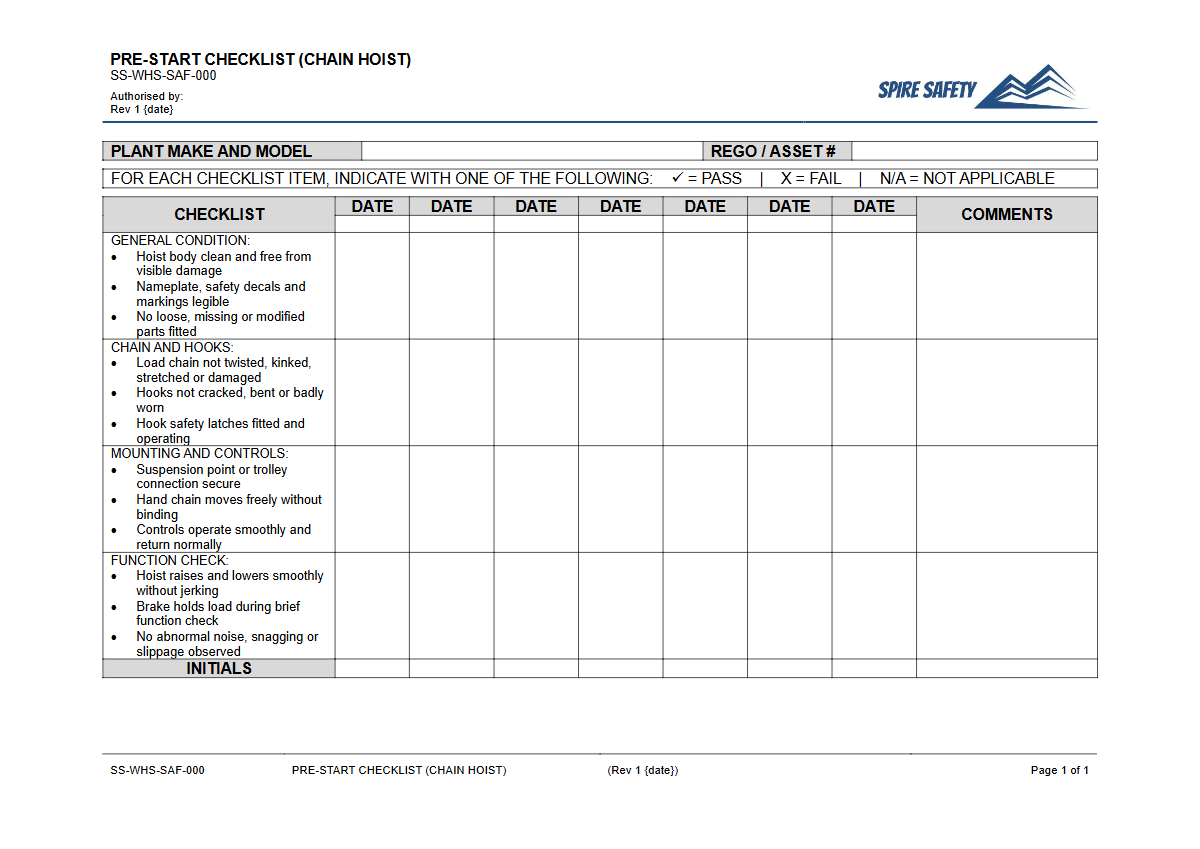
Download our Free Pre-Start Checklist (Chain Hoist) Template. This structured DOCX & PDF resource helps formalise safety checks and manage WHS risks.
Free Pre-Start Checklist (Chain Hoist) Template
DOCX • 125 KB + PDF
Updated Oct 2026
No signup required
Purpose of the Free Pre-Start Checklist (Chain Hoist) Template
Chain hoists are powerful tools for lifting heavy loads, but they introduce significant risks if not properly maintained and inspected. A pre-start check is a simple but critical safety procedure performed before each use to identify any visible defects or operational issues.
Using our Free Pre-Start Checklist (Chain Hoist) Template helps your organisation formalise this process, ensuring that operators systematically inspect equipment for damage, wear, and correct functionality before commencing work. This creates a documented record of due diligence and promotes a proactive safety culture, reducing the likelihood of equipment failure, property damage, or serious injury.
This checklist is designed as a structured starting point, aligned with Australian WHS principles for managing risks associated with plant. It guides operators through inspecting key components like the load chain, hooks, safety latches, and braking systems.
For similar equipment, you may also find our Free Pre-Start Checklist (Electric Hoist) Template useful in your workplace.
Video walkthrough
How to use the Free Pre-Start Checklist (Chain Hoist) Template
Integrating this checklist into your daily operations is straightforward. First, download the template in your preferred format (DOCX for easy editing or PDF for direct printing).
The next step is the most important: customisation. No generic template can perfectly match every worksite or piece of equipment.
A person with the right knowledge and experience must adapt the checklist to reflect the specific make and model of your chain hoists, the unique environmental conditions of your workplace, and the types of loads being lifted.
Important: You must customise this template to suit your specific workplace needs. We have provided a comprehensive starting point based on common industry practice, but you are responsible for adding, removing, or modifying checks to ensure it is suitable for your equipment, tasks, and operational environment.
Once customised, provide training to all operators and supervisors on how to complete the checklist correctly and what actions to take if a fault is identified. Completed checklists should be filed as part of your safety records, contributing to your overall WHS management systems and demonstrating a commitment to workplace safety.
When to use it
A chain hoist pre-start checklist should be completed before the first use of the hoist on any shift or work day. It should also be used whenever a new operator takes over the equipment during a shift.
Additionally, it is good practice to perform a check if the hoist has been moved to a new location, has undergone maintenance or repairs, or if there is any reason to suspect it may have been damaged. Consistent daily checks are fundamental to identifying and controlling hazards before they escalate.
The principles of pre-use inspection apply to all types of lifting apparatus, not just industrial chain hoists. For example, in healthcare settings, similar checks are vital, as covered in our Free Pre-Start Checklist (Patient Hoist) Template.
Who should use it
This checklist is designed for competent operators who have been trained and authorised to use the chain hoist. The person conducting the check must have a thorough understanding of the equipment's functions and be able to recognise signs of wear, damage, or malfunction.
Supervisors also have a key role; they are responsible for ensuring operators are completing the checks consistently and correctly, and that any hoists identified as unsafe are immediately tagged out of service and reported for repair. A Person Conducting a Business or Undertaking (PCBU) holds the primary duty of care to ensure these systems are implemented and effective.
Records from these checklists can be a valuable input for periodic WHS compliance auditing to verify that safe work procedures are being followed. The same diligence applies to permanently installed lifting devices, which you can manage using resources like our Free Pre-Start Checklist (Ceiling Hoist) Template. You can find more templates covering a wide range of plant and equipment in our free WHS resources library.
Common mistakes
Common mistakes to avoid
- Exceeding the Working Load Limit (WLL) of the hoist.
- Lifting loads at an angle ('side pulling'), which puts undue stress on the hoist components.
- Using the load chain to wrap around a load instead of using appropriate, rated slings.
- Failing to tag-out and report a hoist that is found to be faulty during the pre-start inspection.
Legal references
Legal considerations
The following legal requirements may be relevant to this type of work.
- Work Health and Safety Act (Harmonised) — Provides the primary duties for protecting workers and other people from work health and safety risks.
- Work Health and Safety Regulations (Harmonised) — Sets out requirements supporting the management of workplace hazards and risks.
The following codes may be relevant to this type of work.
- Managing WHS Risks Code of Practice — Provides practical guidance on identifying hazards, assessing risks and applying effective controls.
- Work Health and Safety Consultation, Cooperation and Coordination Code of Practice — Provides practical guidance on consulting workers and coordinating with other duty holders.
- Managing the Work Environment and Facilities Code of Practice — Provides practical guidance on safe work environments, workplace facilities and related controls.
Did you know
Two Chains, Two Jobs
A manual chain hoist has two separate chains. The smaller, looped hand chain is used by the operator to apply lifting force, while the heavier, single-strand load chain is what actually holds and lifts the load.
Mechanical Advantage
Chain hoists work on the principle of mechanical advantage, using a series of gears to multiply the force applied by the operator. This allows a person to lift loads many times their own weight with relatively little effort.
FAQ
Frequently asked questions
01What should a chain hoist pre-start inspection include?
02How often must a chain hoist be inspected in Australia?
03Is a logbook or record required for a chain hoist pre-start check?
04Who is responsible for chain hoist safety in the workplace?
Share this resource
Free Pre-Start Checklist (Chain Hoist) Template
Browse Categories
How To Use It
- 1Download and open in Word or PDF.
- 2Replace the placeholders with your business details.
- 3Get it reviewed by a WHS specialist before rollout.
Need it customised?
Our WHS consultants can adapt this template to your site, run a gap analysis, or audit what you already have in place.
Book a Free Consultation WHS consulting servicesor call 1300 156 382