
Free Pre-Start Checklist (Car Hoist) Template
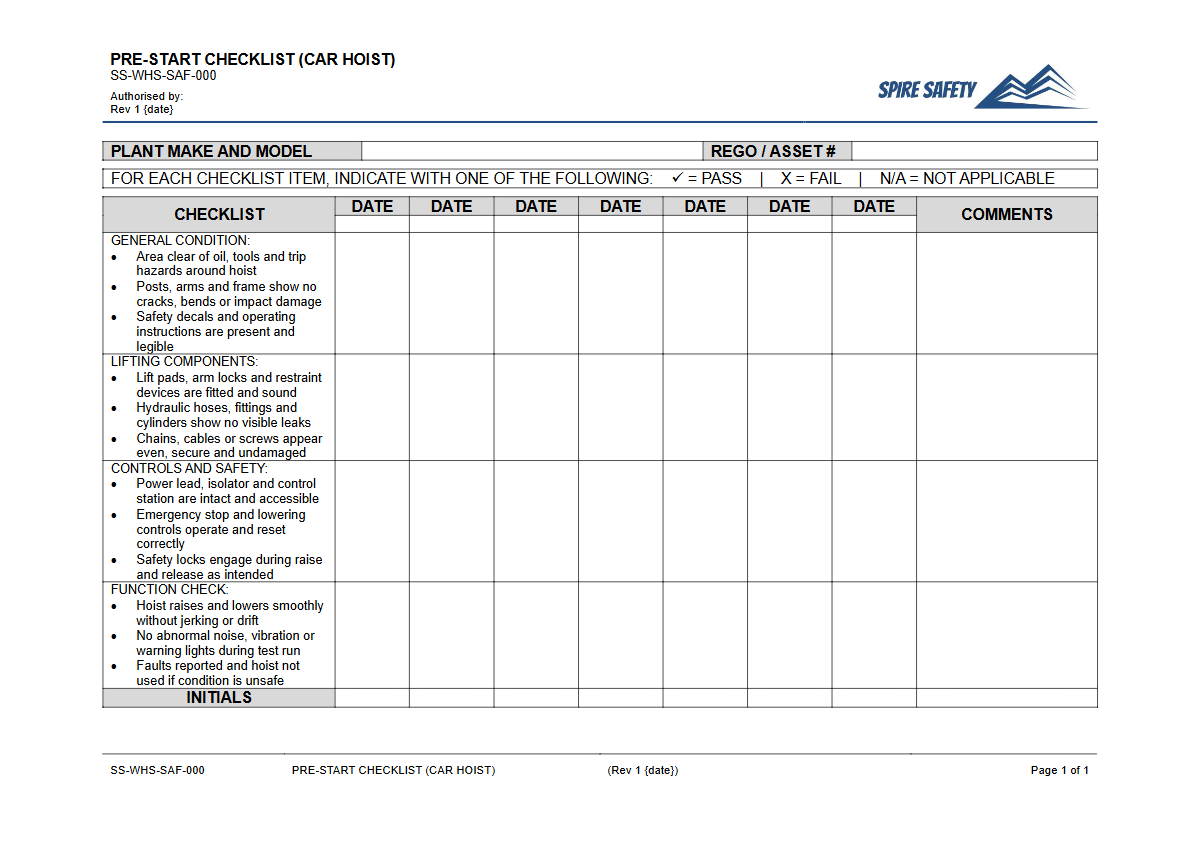
Formalise vehicle hoist inspections in your workshop. Download our Free Pre-Start Checklist (Car Hoist) Template to improve safety and record-keeping.
Free Pre-Start Checklist (Car Hoist) Template
DOCX • 125 KB + PDF
Updated Oct 2026
No signup required
Purpose of the Free Pre-Start Checklist (Car Hoist) Template
Operating a car hoist presents significant risks if the equipment is faulty or used incorrectly. This Free Pre-Start Checklist (Car Hoist) Template provides a structured method for operators to conduct essential safety checks before each shift or use.
Implementing this process helps your organisation meet its duty of care under Australian WHS laws by proactively identifying and managing hazards. Regular, documented checks demonstrate a commitment to safety, reduce the likelihood of catastrophic failure, and create a historical record of the hoist's condition, which is invaluable during safety audits and incident investigations.
A systematic pre-start inspection is a fundamental component of safe plant operation. This template helps formalise that process, ensuring that key safety features such as locking mechanisms, hydraulic systems, and structural components are verified before the hoist is placed under load.
While this checklist is designed for vehicle hoists, the same principles apply to other lifting equipment. For example, similar checks are crucial for general workshop lifting, as detailed in our Free Pre-Start Checklist (Electric Hoist) Template.
Video walkthrough
How to use the Free Pre-Start Checklist (Car Hoist) Template
To integrate this Pre-Start Checklist effectively, download the DOCX or PDF file and incorporate it into your workshop's daily opening procedures. The DOCX version is fully editable, allowing you to tailor the checklist items to your specific equipment and operational needs.
Important: This template provides a strong foundation aligned with Australian WHS practice, but it must be customised. We recommend a competent person reviews and adapts the checklist to reflect the specific makes and models of car hoists in your workshop, your unique operational procedures, and any site-specific hazards.
This ensures the checks are relevant and comprehensive for your environment.
Once customised, ensure all operators are trained on how to complete the checklist correctly and understand the reporting process for any identified faults. The checklist should be easily accessible at the point of use.
This process is a key control measure within broader WHS management systems, linking daily actions to overall safety objectives.
When to use it
The Pre-Start Checklist should be completed before the first use of the car hoist on any given day or shift. If the hoist is used by multiple operators across different shifts, each operator should perform their own check before commencing work.
This ensures a continuous chain of verification. The checklist should also be used after any maintenance or repair work has been performed on the hoist, to confirm it has been returned to a safe operational state. Documenting these regular checks provides tangible evidence that your organisation is proactively managing risks, a key focus of any WHS compliance auditing.
Who should use it
This checklist is designed for use by competent and trained vehicle mechanics, workshop technicians, and any other personnel authorised to operate a car hoist. A 'competent person' is someone who has acquired the knowledge and skills to perform a task through training, qualification, or experience.
Supervisors and workshop managers should also be familiar with the checklist to ensure its consistent and correct application. They are responsible for reviewing completed checklists, ensuring that any reported defects are addressed promptly, and that the hoist is removed from service until it is deemed safe. The principle of operator-led checks is universal for high-risk equipment, extending even to permanently installed systems like those covered by a Free Pre-Start Checklist (Ceiling Hoist) Template.
By embedding this tool into your daily workflow, you not only enhance the safety of your operators but also protect your business from the significant financial and reputational damage that can result from a preventable equipment failure. For more tools to support your safety framework, you can browse our complete free WHS resources library.
Common mistakes
Common mistakes to avoid
- Ignoring minor hydraulic fluid leaks, which can indicate a developing system failure.
- Failing to check the condition and operation of safety locking mechanisms (pawls).
- Skipping the pre-start check entirely during busy periods.
- Not formally reporting and documenting faults, leading to them being forgotten or overlooked.
Legal references
Legal considerations
The following legal requirements may be relevant to this type of work.
- Work Health and Safety Act (Harmonised) — Provides the primary duties for protecting workers and other people from work health and safety risks.
- Work Health and Safety Regulations (Harmonised) — Sets out requirements supporting the management of workplace hazards and risks.
The following codes may be relevant to this type of work.
- Managing WHS Risks Code of Practice — Provides practical guidance on identifying hazards, assessing risks and applying effective controls.
- Work Health and Safety Consultation, Cooperation and Coordination Code of Practice — Provides practical guidance on consulting workers and coordinating with other duty holders.
- Managing the Work Environment and Facilities Code of Practice — Provides practical guidance on safe work environments, workplace facilities and related controls.
Did you know
Asymmetric Loading
Most two-post hoist collapses are not caused by overloading the hoist's total capacity, but by improper, asymmetric loading of the vehicle, which creates unbalanced forces the hoist is not designed to handle.
Australian Standards
Two key Australian Standards govern vehicle hoists: AS/NZS 1418.9 for design and manufacturing, and AS/NZS 2550.9 for safe use, inspection, and maintenance.
FAQ
Frequently asked questions
01Is a daily check on a car hoist legally required in Australia?
02What happens if a fault is found during the car hoist pre-start check?
03Who is qualified to inspect a car hoist?
04How long should we keep car hoist pre-start check records?
Share this resource
Free Pre-Start Checklist (Car Hoist) Template
Browse Categories
How To Use It
- 1Download and open in Word or PDF.
- 2Replace the placeholders with your business details.
- 3Get it reviewed by a WHS specialist before rollout.
Need it customised?
Our WHS consultants can adapt this template to your site, run a gap analysis, or audit what you already have in place.
Book a Free Consultation WHS consulting servicesor call 1300 156 382