
Free Pre-Start Checklist (Cardboard Baler) Template
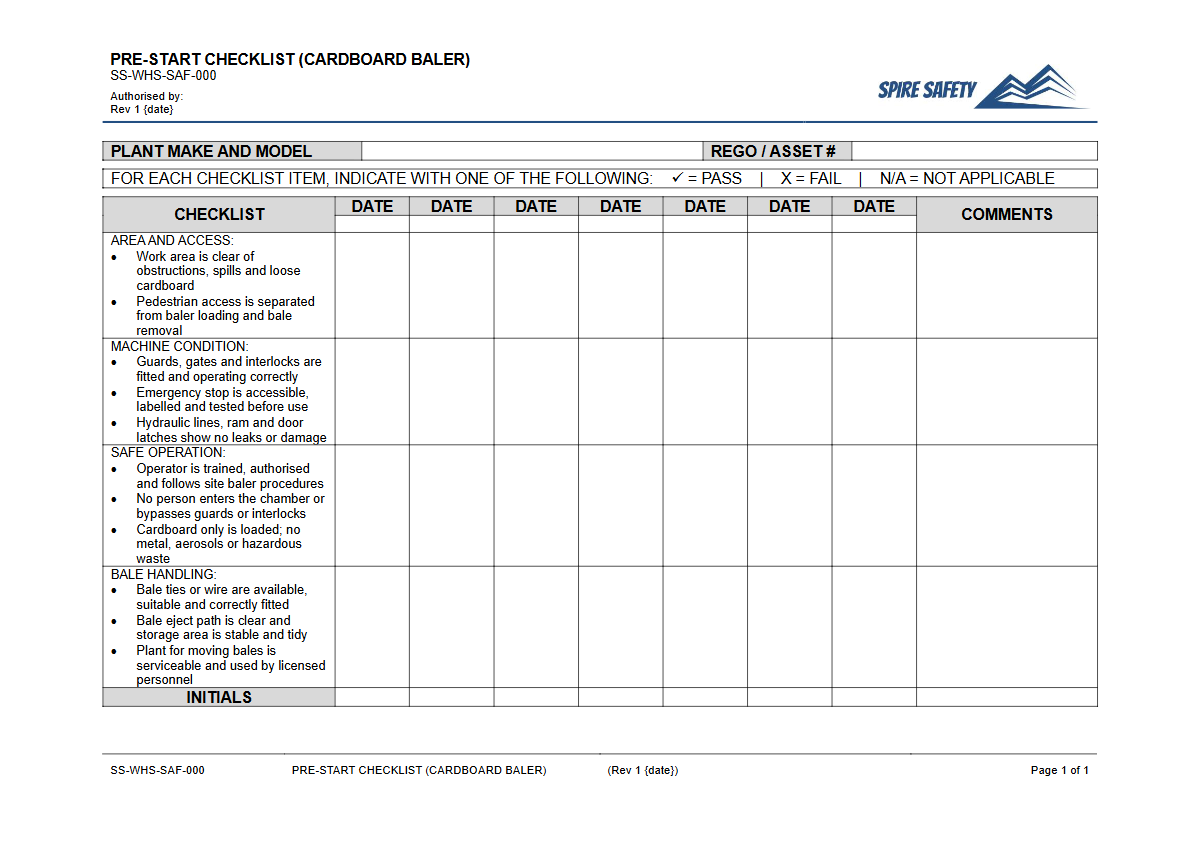
Download our free Pre-Start Checklist for Cardboard Balers to formalise your equipment inspections. This DOCX and PDF template is a structured starting point.
Free Pre-Start Checklist (Cardboard Baler) Template
DOCX • 125 KB + PDF
Updated Oct 2026
No signup required
Purpose of the Free Pre-Start Checklist (Cardboard Baler) Template
Cardboard balers are powerful machines essential in many retail, manufacturing, and waste management settings. Due to their hydraulic and mechanical components, they pose significant risks, including crushing and amputation hazards, if not properly maintained.
Using a formalised checklist before operation is a critical control measure. This Free Pre-Start Checklist (Cardboard Baler) Template provides a structured starting point for organisations to formalise their daily equipment inspections.
Systematically checking the machine's condition helps operators identify potential faults, damage, or wear and tear before they lead to catastrophic failure or injury. Regular checks are a key part of proactive plant maintenance and demonstrate a commitment to workplace health and safety.
The checklist serves as a daily record, supporting compliance with WHS duties to provide and maintain safe plant and equipment. For a complete safety framework, this checklist should be used alongside a comprehensive Baler Safe Operating Procedure (SOP).
Video walkthrough
How to use the Free Pre-Start Checklist (Cardboard Baler) Template
Our template is available for immediate download in both DOCX and PDF formats. The DOCX file is fully editable, allowing you to tailor it to your specific operational needs.
While this template is aligned with Australian WHS principles, it is vital to adapt it to your unique circumstances.
Important: This document is a template and must be customised to suit your business. We recommend you review it against the specific make and model of your cardboard baler, the manufacturer's operating manual, and your own internal risk assessments.
Consultation with your operators and maintenance personnel is crucial to ensure the checklist is practical and effective for your workplace. Integrating customised documents like this into your daily operations is a core component of effective WHS management systems.
When to use this Pre-Start Checklist
A pre-start check should be conducted by the operator before the first use of the cardboard baler on any shift or work day. It is designed to be a quick yet thorough inspection, taking only a few minutes to complete.
Making this check a non-negotiable daily habit is fundamental to maintaining a safe working environment. The importance of this routine can be regularly reinforced with staff through practical training sessions, such as a Pre-Start Checks and Plant Maintenance Toolbox Talk. If a fault is identified, the machine must not be used until it is repaired by a competent person.
Who should use this Pre-Start Checklist
The pre-start checklist should be completed by a worker who is trained, competent, and authorised to operate the specific model of cardboard baler. The operator is the person most familiar with the machine's normal sounds and functions, making them the ideal person to spot subtle changes or developing issues.
Supervisors also have a responsibility to ensure that operators are diligently performing these checks and to review the completed records periodically. These records can provide valuable data on equipment reliability and can be reviewed during internal or external WHS compliance auditing activities.
By implementing a consistent inspection process, your organisation can significantly reduce the risk of incidents associated with plant and equipment. Explore our complete free WHS resources library for more templates to support your safety management system.
Common mistakes
Common mistakes to avoid
- "Pencil-whipping" the checklist without physically inspecting the items.
- Failing to apply a lockout/tagout procedure before investigating or clearing a jam.
- Using a generic checklist that hasn't been customised for the specific make and model of the baler.
- Neglecting to report minor issues like small hydraulic leaks, which can escalate into major failures.
Legal references
Legal considerations
The following legal requirements may be relevant to this type of work.
- Work Health and Safety Act (Harmonised) — Provides the primary duties for protecting workers and other people from work health and safety risks.
- Work Health and Safety Regulations (Harmonised) — Sets out requirements supporting the management of workplace hazards and risks.
The following codes may be relevant to this type of work.
- Managing WHS Risks Code of Practice — Provides practical guidance on identifying hazards, assessing risks and applying effective controls.
- Work Health and Safety Consultation, Cooperation and Coordination Code of Practice — Provides practical guidance on consulting workers and coordinating with other duty holders.
- Managing the Work Environment and Facilities Code of Practice — Provides practical guidance on safe work environments, workplace facilities and related controls.
Did you know
A Leading Cause of Injury
The US Bureau of Labor Statistics has identified balers as a leading source of amputations for young workers. The most common cause is attempting to clear a jam without following proper lockout/tagout procedures to de-energise the machine.
FAQ
Frequently asked questions
01What key items should be on a cardboard baler pre-start checklist?
02How often should a cardboard baler be inspected?
03What should an operator do if a fault is found during a pre-start check?
04Is operator training required to use a cardboard baler?
Share this resource
Free Pre-Start Checklist (Cardboard Baler) Template
Browse Categories
How To Use It
- 1Download and open in Word or PDF.
- 2Replace the placeholders with your business details.
- 3Get it reviewed by a WHS specialist before rollout.
Need it customised?
Our WHS consultants can adapt this template to your site, run a gap analysis, or audit what you already have in place.
Book a Free Consultation WHS consulting servicesor call 1300 156 382