
Free Pre-Start Checklist (Can Crusher) Template
Download our free Pre-Start Checklist (Can Crusher) Template.
Free Pre-Start Checklist (Can Crusher) Template
DOCX • 125 KB + PDF
Updated Oct 2026
No signup required
Purpose of the Free Pre-Start Checklist (Can Crusher) Template
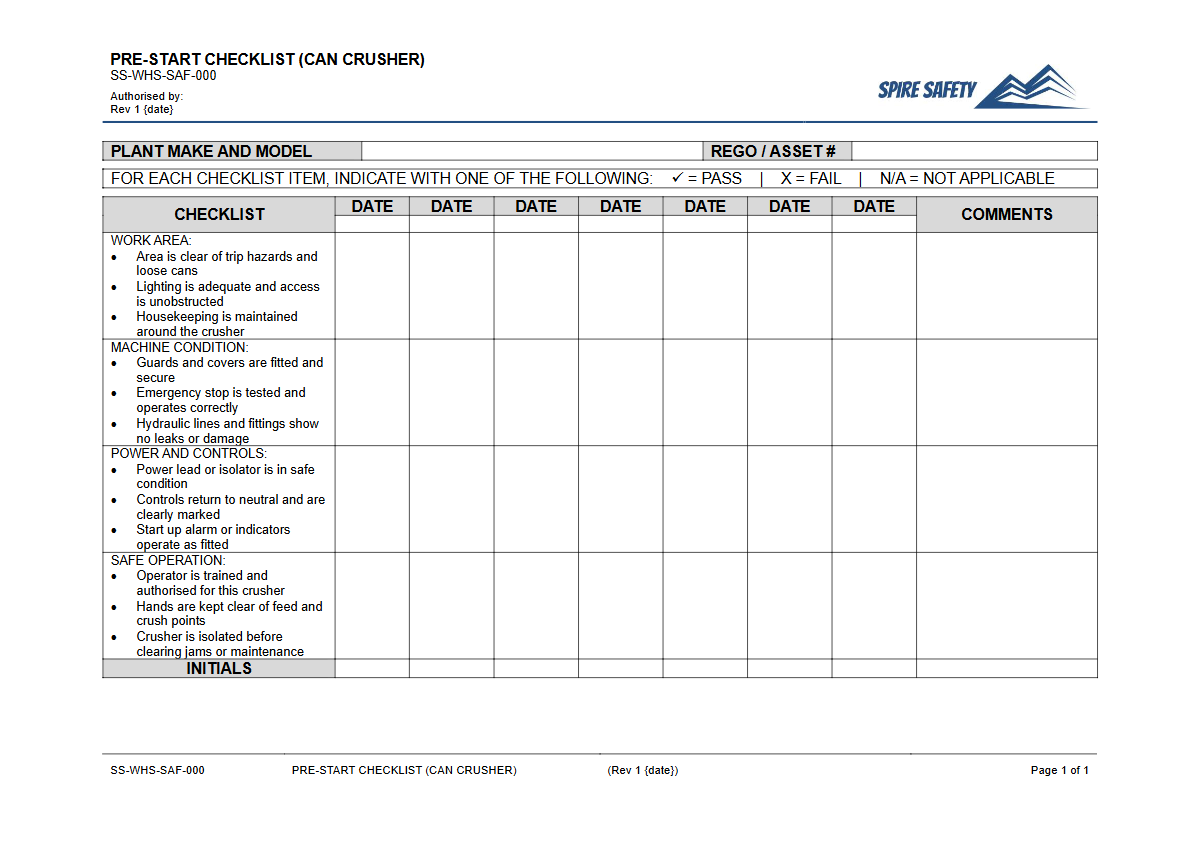
Using a structured checklist before operating any machinery is a fundamental safety practice. This free Pre-Start Checklist (Can Crusher) Template provides a systematic way for operators to verify that the equipment is safe to use before they begin work.
Can crushers, whether hydraulic or pneumatic, pose significant risks of crushing, amputation, and entanglement if not properly maintained and operated. Formalising these checks helps your organisation meet its primary duty of care under WHS law to provide and maintain safe plant and structures.
Implementing this checklist helps to identify potential faults, damage, or missing safety components like guards and emergency stops before they lead to an incident. A consistent pre-start inspection routine is a key component of proactive risk management, helping to prevent injuries, minimise equipment downtime, and demonstrate due diligence. Integrating such procedures is a core element of building robust comprehensive WHS management systems.
Video walkthrough
How to Use the Free Pre-Start Checklist (Can Crusher) Template
This template is available for instant download in both DOCX and PDF formats. The DOCX file is fully editable, allowing you to adapt the checklist to the specific requirements of your workplace and the particular make and model of your can crusher.
Important: This resource is a template that provides a structured starting point. It must be reviewed and customised by a competent person to ensure it is appropriate for your specific machinery, operational risks, and work environment.
We are not responsible for your safety outcomes; you are responsible for implementing safe systems of work.
Once customised, the checklist should be used to train operators on what to look for during their inspection. Reinforce this training with regular refreshers, such as a dedicated Pre-Start Checks and Plant Maintenance Toolbox Talk, to ensure the process remains effective and is not just a 'tick-and-flick' exercise.
Key Checklist Items to Consider
While customising your checklist, ensure it covers critical safety components, including:
- Guarding: Check that all guards and safety cages are in place, secure, and not damaged.
- Emergency Stops: Test all E-stop buttons to ensure they function correctly and are easily accessible.
- Controls: Verify that operating controls are clearly labelled, not damaged, and function as intended.
- Hydraulic/Pneumatic Systems: Inspect hoses and fittings for leaks, cracks, or signs of wear.
- Structural Integrity: Look for any cracks, bending, or damage to the machine's frame or ram.
- Work Area: Ensure the area around the crusher is clean, dry, and free from slip or trip hazards.
Regular inspections are foundational, but they should also be supported by periodic WHS compliance auditing to verify that your safety procedures are being followed correctly across the organisation.
When to Use It
A can crusher pre-start checklist should be completed by the operator before every shift or before the first use of the machine on any given day. If multiple operators use the same machine during a single shift, it is good practice for each new operator to conduct their own inspection before starting work.
This consistent frequency ensures that any faults that may have developed are identified as early as possible. These daily checks are distinct from, but complementary to, scheduled periodic maintenance. The same principle applies to all workplace plant, whether it's a small compactor or a large piece of mobile equipment requiring a pre-start checklist for an artic loader.
Who Should Use It
The primary user of this checklist is the trained and competent operator assigned to the can crusher. They are best placed to notice subtle changes in the machine's condition or performance.
Supervisors and managers also have a responsibility to ensure these checks are being completed correctly and that any reported faults are actioned immediately. The Person Conducting a Business or Undertaking (PCBU) holds the overall responsibility for implementing the system and ensuring that all workers are provided with the necessary information, training, and resources to work safely.
For guidance on establishing these roles and responsibilities, seeking professional WHS consulting can provide clarity and expert direction. Spire Safety has a large free WHS resources library available for you to browse for more helpful templates.
Common mistakes
Common mistakes to avoid
- Operator 'pencil-whipping' the form without physically inspecting the machine.
- Using a generic checklist that doesn't cover the specific features and risks of the can crusher model in use.
- Failing to immediately tag-out and report faulty or damaged equipment identified during the check.
- Not providing adequate training to operators on how to properly conduct the inspection and what to look for.
Legal references
Legal considerations
The following legal requirements may be relevant to this type of work.
- Work Health and Safety Act (Harmonised) — Provides the primary duties for protecting workers and other people from work health and safety risks.
- Work Health and Safety Regulations (Harmonised) — Sets out requirements supporting the management of workplace hazards and risks.
The following codes may be relevant to this type of work.
- Managing WHS Risks Code of Practice — Provides practical guidance on identifying hazards, assessing risks and applying effective controls.
- Work Health and Safety Consultation, Cooperation and Coordination Code of Practice — Provides practical guidance on consulting workers and coordinating with other duty holders.
- Managing the Work Environment and Facilities Code of Practice — Provides practical guidance on safe work environments, workplace facilities and related controls.
Did you know
Compaction Force
Even small commercial can crushers can generate several tonnes of compaction force, making effective guarding and emergency stop systems absolutely critical safety features.
Recycling Impact
Crushing aluminium cans can reduce their volume by up to 90%. This makes storage and transport for recycling far more efficient and cost-effective.
FAQ
Frequently asked questions
01What is the purpose of a can crusher pre-start check?
02How often should a can crusher pre-start inspection be completed?
03Who is responsible for completing the can crusher checklist?
04Is this can crusher checklist a legal document?
Share this resource
Free Pre-Start Checklist (Can Crusher) Template
Browse Categories
How To Use It
- 1Download and open in Word or PDF.
- 2Replace the placeholders with your business details.
- 3Get it reviewed by a WHS specialist before rollout.
Need it customised?
Our WHS consultants can adapt this template to your site, run a gap analysis, or audit what you already have in place.
Book a Free Consultation WHS consulting servicesor call 1300 156 382