
Free Pre-Start Checklist (Bulldozer) Template
Download our free Pre-Start Checklist (Bulldozer) Template to formalise daily equipment inspections and manage WHS risks. Get your structured DOCX today.
Free Pre-Start Checklist (Bulldozer) Template
DOCX • 125 KB + PDF
Updated Oct 2026
No signup required
Purpose of the Free Pre-Start Checklist (Bulldozer) Template
Operating a bulldozer presents significant safety risks if the equipment is not properly maintained and inspected. This Free Pre-Start Checklist (Bulldozer) Template provides a structured starting point for organisations to formalise their daily equipment checks.
Systematically inspecting the machine before each use helps operators identify mechanical issues, fluid leaks, or damage that could lead to an incident or breakdown. Using a checklist ensures that key components are not overlooked and creates a tangible record of safety diligence.
Integrating such procedures is a fundamental part of demonstrating proactive risk management. Documented checks form a critical evidence trail, showing that steps are being taken to provide and maintain safe plant and equipment.
This process is a key component of any effective WHS management system, helping to embed safety as a routine operational behaviour rather than an afterthought.
Video walkthrough
How to use the Free Pre-Start Checklist (Bulldozer) Template
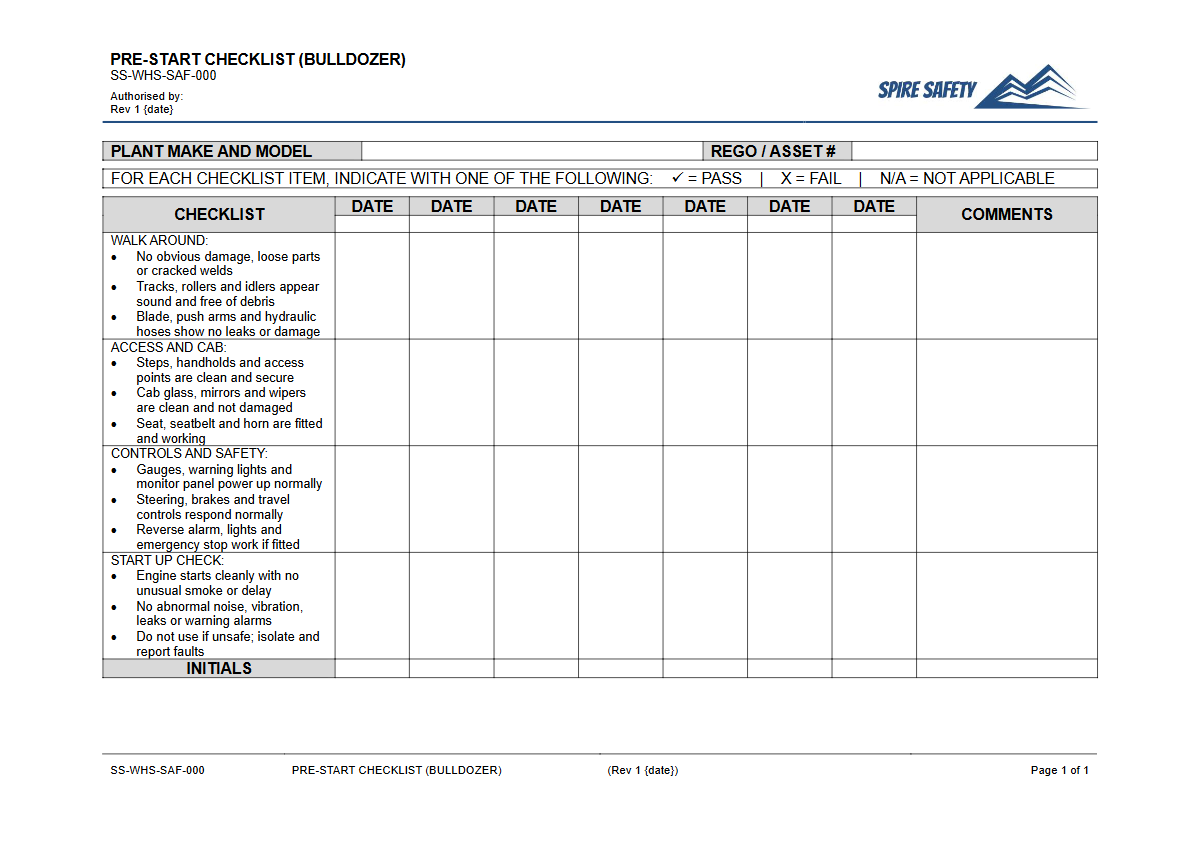
This resource is available as a DOCX file for easy editing and a PDF for straightforward printing. The checklist is structured around key areas of a bulldozer, including the cabin, engine, hydraulics, tracks, and safety features.
To use it effectively, download the DOCX version and adapt it to the specific make and model of the bulldozers used in your operations, as well as the unique conditions and hazards of your worksite.
Important Note: This template is a guide and must be customised to your workplace. We cannot know your specific equipment, site conditions, or internal procedures.
You must review and amend the checklist to ensure it is comprehensive for your context. Similar principles of customisation apply to all heavy machinery, as seen in other resources like our Pre-Start Checklist for Forwarders.
When to use it
A pre-start check should be completed by the operator before the start of every shift or before the equipment is used for the first time each day. If operators change mid-shift, the incoming operator should also conduct a pre-start inspection to verify the machine's condition before they take control.
This consistent frequency helps catch developing faults early and reinforces a culture where safety and operational readiness are priorities.
While daily checks are vital, they should be supplemented by scheduled maintenance and periodic formal reviews of your safety procedures. A comprehensive WHS compliance audit can help identify systemic gaps in your plant and equipment management program, ensuring long-term safety and reliability.
Who should use it
This checklist is designed for use by competent and licensed bulldozer operators. The person operating the machinery is in the best position to assess its immediate condition.
They are responsible for completing the check thoroughly and accurately, and for reporting any identified defects or concerns according to the organisation's procedures. Supervisors or managers should also review completed checklists to monitor compliance, track recurring equipment issues, and authorise necessary maintenance or repairs.
Ensuring operators are not only licensed but also competent for the specific tasks and machinery is a core duty for any Person Conducting a Business or Undertaking (PCBU). If your organisation needs assistance with defining competencies or structuring training programs, our WHS consulting services can provide expert guidance.
You can also explore our wider free WHS resources library for other tools to support your safety processes.
Common mistakes
Common mistakes to avoid
- Skipping checks to save time at the start of a shift.
- Failing to report 'minor' defects which could escalate into major failures.
- "Pencil-whipping" the checklist without physically inspecting the items.
- Using a generic checklist that doesn't cover the specific attachments or model of the bulldozer in use.
Legal references
Legal considerations
The following legal requirements may be relevant to this type of work.
- Work Health and Safety Act (Harmonised) — Provides the primary duties for protecting workers and other people from work health and safety risks.
- Work Health and Safety Regulations (Harmonised) — Sets out requirements supporting the management of workplace hazards and risks.
The following codes may be relevant to this type of work.
- Managing WHS Risks Code of Practice — Provides practical guidance on identifying hazards, assessing risks and applying effective controls.
- Work Health and Safety Consultation, Cooperation and Coordination Code of Practice — Provides practical guidance on consulting workers and coordinating with other duty holders.
- Managing the Work Environment and Facilities Code of Practice — Provides practical guidance on safe work environments, workplace facilities and related controls.
Did you know
Blind Spots
Bulldozers have significant blind spots, particularly to the rear and sides of the machine. Many incidents involving mobile plant occur because the operator could not see a person or obstacle, highlighting the importance of functional cameras, mirrors, and alarms.
Hydraulic Pressure
The hydraulic systems on a bulldozer operate under extreme pressure, often exceeding 2,500 PSI. A pinhole leak in a hydraulic hose can inject fluid into the skin, causing severe injury, making visual inspection for leaks a critical safety check.
FAQ
Frequently asked questions
01What items should be on a bulldozer pre-start checklist?
02How often should a bulldozer pre-start check be performed?
03Who is responsible for completing the bulldozer pre-start check?
04Is this bulldozer pre-start checklist template compliant with Australian WHS laws?
Share this resource
Free Pre-Start Checklist (Bulldozer) Template
Browse Categories
How To Use It
- 1Download and open in Word or PDF.
- 2Replace the placeholders with your business details.
- 3Get it reviewed by a WHS specialist before rollout.
Need it customised?
Our WHS consultants can adapt this template to your site, run a gap analysis, or audit what you already have in place.
Book a Free Consultation WHS consulting servicesor call 1300 156 382