
Free Pre-Start Checklist (Cable Winch) Template
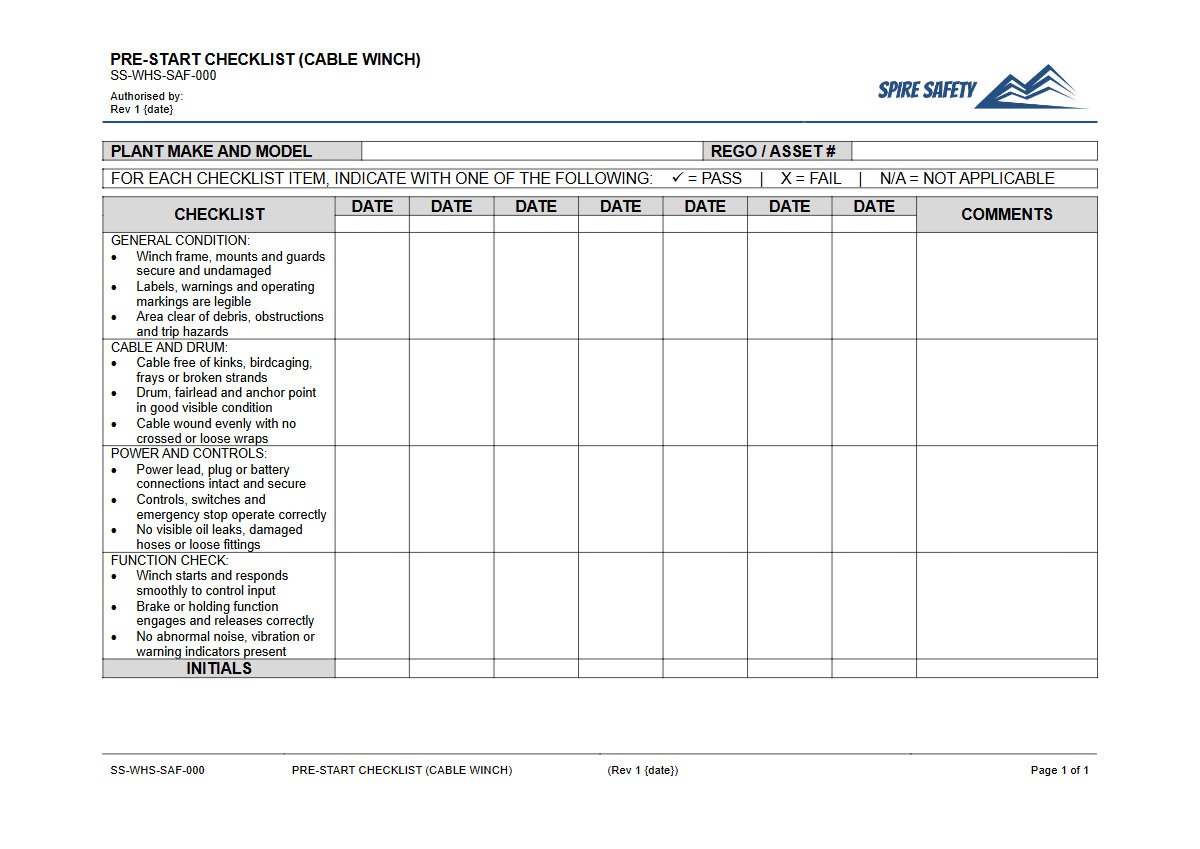
Formalise daily safety inspections for cable winches with our free template. This structured Pre-Start Checklist helps identify hazards and manage WHS risks.
Free Pre-Start Checklist (Cable Winch) Template
DOCX • 125 KB + PDF
Updated Oct 2026
No signup required
Purpose of the Free Pre-Start Checklist (Cable Winch) Template
A cable winch is a powerful piece of equipment used for pulling heavy loads, vehicle recovery, and various industrial applications. Operating this equipment carries significant risks, including wire rope failure, unexpected load movement, and mechanical breakdown.
This free Pre-Start Checklist (Cable winch) Template provides a structured framework for operators to conduct thorough, systematic inspections before each use. Implementing a consistent pre-start process is a fundamental step in proactive risk management, helping to identify potential faults, wear, or damage before they can lead to an incident.
A documented check ensures no critical safety feature is overlooked, promoting safer work practices and demonstrating due diligence.
Regularly completing these checks forms an essential part of your workplace safety procedures. Integrating this practice into broader WHS management systems helps create a culture where safety is prioritised and equipment is maintained in a safe operational state.
The completed checklists also serve as a valuable record of equipment condition over time, aiding in maintenance planning and incident investigations.
Video walkthrough
How to use the Free Pre-Start Checklist (Cable Winch) Template
Using this template is straightforward. First, download the document in your preferred format (DOCX for easy editing or PDF for immediate printing).
The next step is crucial for its effectiveness and relevance to your specific operations. You must adapt the checklist to suit the exact make and model of the cable winch in use at your workplace, as well as the specific tasks it performs and the environment it operates in.
This template is a starting point. We strongly recommend you customise it to reflect the specific make and model of your cable winch, your operational environment, and any unique site-based hazards.
Once customised, ensure all operators are trained on how to properly complete the checklist, what each item means, and the procedure for reporting any identified faults. Keep a record of all completed checklists for auditing and review purposes.
If you need assistance tailoring this or other documents to meet your specific workplace needs, our WHS consulting services can provide expert guidance.
What to Inspect
A thorough check should cover all critical components of the cable winch system. While your customised list will be more specific, key areas to inspect typically include:
- Winch Assembly: Check for secure mounting, cracks in the housing, and any signs of fluid leaks (for hydraulic models).
- Wire Rope: Carefully inspect the entire length of the accessible rope for fraying, kinks, broken strands, corrosion, or crushing. Ensure it is spooled correctly on the drum.
- Hook and Latch: Verify the hook is not bent, cracked, or excessively worn. The safety latch must be present and function correctly, closing fully to secure the load attachment.
- Controls: Test the controls (remote or fixed) to ensure they function as intended without sticking. Check emergency stop functions if fitted.
- Guards and Fairlead: Ensure any guards are securely in place and that the fairlead (roller or hawse) is not damaged and allows the rope to move freely.
When to use it
The pre-start checklist should be completed before the first use of the cable winch on any given day or at the beginning of each shift. It should also be performed after any significant event, such as a suspected overload, shock loading, or after maintenance or repairs have been carried out.
This frequency ensures that the equipment’s condition is verified before it is put under load, minimising the chance of failure during operation. This principle of daily checks applies to a wide range of machinery, from heavy equipment to simpler devices like those covered in our pre-start checklists for bin lifters.
Who should use it
Only workers who are trained, authorised, and deemed competent should operate a cable winch and therefore complete this Pre-Start Checklist. A competent person possesses the necessary knowledge and skills, gained through training and experience, to safely operate the specific equipment and identify potential defects.
Completing the checklist is an active part of the operator's responsibilities, not a passive administrative task. Regular WHS compliance audits can help verify that only authorised personnel are using high-risk plant and that pre-start procedures are being followed correctly.
This checklist is also a valuable tool for supervisors and maintenance personnel. Supervisors can use the completed forms to monitor equipment usage and confirm that safety checks are being performed consistently.
Maintenance teams can use the information to identify recurring issues and schedule preventative maintenance, ensuring the winch remains in safe working order. This approach to preventative checks is common across many types of workshop equipment, as seen in resources like the bench grinder pre-start checklist.
By standardising the inspection process, this template helps ensure a consistent level of safety across your team, regardless of who is operating the equipment. For more templates covering a wide array of plant and equipment, browse our complete free WHS resources library.
Common mistakes
Common mistakes to avoid
- Using a winch with a frayed, kinked, or otherwise damaged wire rope.
- Failing to check that the winch is securely anchored before starting a pull.
- Exceeding the winch's rated capacity or Safe Working Load (SWL).
- Conducting the check from memory instead of using a structured, physical checklist.
Legal references
Legal considerations
The following legal requirements may be relevant to this type of work.
- Work Health and Safety Act (Harmonised) — Provides the primary duties for protecting workers and other people from work health and safety risks.
- Work Health and Safety Regulations (Harmonised) — Sets out requirements supporting the management of workplace hazards and risks.
The following codes may be relevant to this type of work.
- Managing WHS Risks Code of Practice — Provides practical guidance on identifying hazards, assessing risks and applying effective controls.
- Work Health and Safety Consultation, Cooperation and Coordination Code of Practice — Provides practical guidance on consulting workers and coordinating with other duty holders.
- Managing the Work Environment and Facilities Code of Practice — Provides practical guidance on safe work environments, workplace facilities and related controls.
Did you know
Hidden Damage
A wire rope's strength can be reduced by up to 50% from a single sharp kink or tight bend, even if it is straightened out afterwards. The internal damage remains, creating a critical weak point.
The Rule of 5
A common rule of thumb for wire rope safety is to ensure at least 5 full wraps of rope remain on the winch drum when the line is extended to its maximum required working length. This prevents the rope from detaching from the drum anchor under load.
FAQ
Frequently asked questions
01What should be checked on a cable winch before use?
02Is a pre-start checklist legally required for a cable winch in Australia?
03What happens if a fault is found during a pre-start check?
04How often should cable winches be formally inspected?
Share this resource
Free Pre-Start Checklist (Cable Winch) Template
Browse Categories
How To Use It
- 1Download and open in Word or PDF.
- 2Replace the placeholders with your business details.
- 3Get it reviewed by a WHS specialist before rollout.
Need it customised?
Our WHS consultants can adapt this template to your site, run a gap analysis, or audit what you already have in place.
Book a Free Consultation WHS consulting servicesor call 1300 156 382