
Free Pre-Start Checklist (Broach) Template
Download our free Pre-Start Checklist (Broach) Template for Australian workplaces. This customisable DOCX & PDF helps formalise daily equipment checks.
Free Pre-Start Checklist (Broach) Template
DOCX • 125 KB + PDF
Updated Oct 2026
No signup required
Purpose of the Free Pre-Start Checklist (Broach) Template
A broaching machine uses a toothed tool, called a broach, to remove material in a precise and repetitive way. Due to the high forces and sharp tooling involved, ensuring the machine is safe before operation is critical.
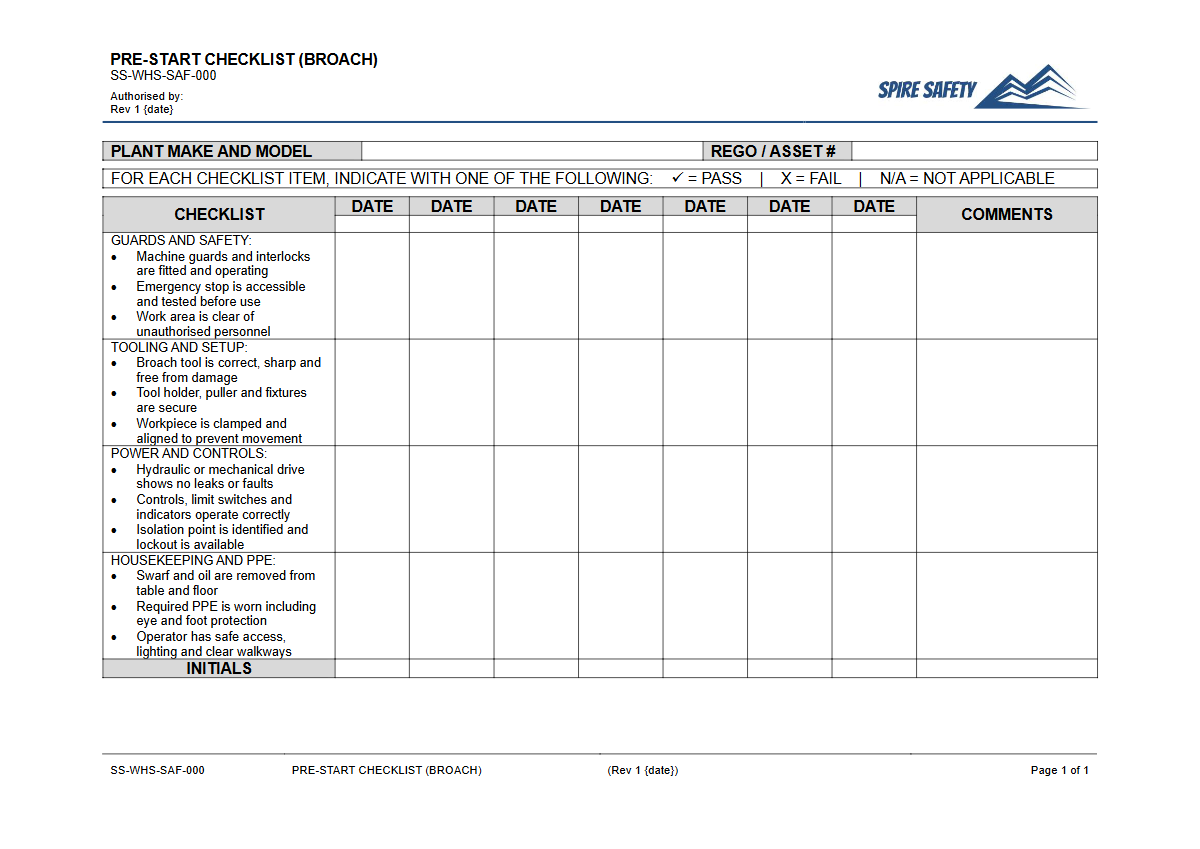
This Free Pre-Start Checklist (Broach) Template provides a structured starting point for formalising these essential safety inspections.
Regular pre-start checks help identify potential faults, damage, or wear and tear before they lead to equipment failure, costly downtime, or serious workplace incidents. By systematically inspecting critical components, you can proactively manage risks associated with moving parts, hydraulic systems, and electrical components.
Integrating these checks is a key part of any preventative maintenance program. You can reinforce these concepts with your team using our Pre-Start Checks and Plant Maintenance Toolbox Talk.
Video walkthrough
How to use the Free Pre-Start Checklist (Broach) Template
Using this template effectively involves more than just downloading it. The checklist should be integrated into your daily operational procedures.
Operators should complete the checklist at the start of each shift or before using the broaching machine for the first time that day. The process involves visually inspecting and testing each item listed and noting its condition.
Any identified defects, faults, or concerns must be immediately reported to a supervisor for corrective action. The machine should not be used until it is deemed safe.
Important: This document is a template only. We have provided a comprehensive list of common inspection points, but you must customise it to suit the specific make and model of your broaching machine, your operational context, and your specific workplace risks.
A generic checklist cannot cover all hazards for all equipment. Integrating customised checklists into a comprehensive WHS management system helps ensure safety procedures are consistently applied.
What a Pre-Start Checklist for a Broach Should Cover
A thorough pre-start inspection for a broaching machine should cover several key areas to ensure its operational safety. While your customised list will be specific, it should generally include checks for:
- Guarding: Ensure all physical guards and safety shields are in place, secure, and free from damage.
- Emergency Stops: Test all e-stops to confirm they function correctly and are easily accessible.
- Tooling and Fixtures: Inspect the broach tool and work-holding fixtures for signs of wear, cracks, or damage.
- Hydraulic and Lubrication Systems: Check for fluid leaks, and verify that fluid levels are within the recommended range.
- Controls: Ensure all operator controls, switches, and displays are functioning as intended.
- Work Area: Confirm the area around the machine is clear of slip or trip hazards, debris, and unnecessary materials.
Looking at checklists for similar processes can provide ideas for customisation. For example, our free Pre-Start Checklist for Air Arc equipment also focuses on tooling and system integrity, though for a different application.
When to use a Pre-Start Checklist
A pre-start checklist for a broach should be completed before every shift or before the first use of the machine on any given day. If the machine is used by multiple operators across different shifts, each new operator should conduct their own check before starting work.
This frequency ensures that any issues that may have developed overnight or during a previous shift are identified before work commences.
Who should use it
The pre-start checklist should be completed by the person operating the broaching machine. They must be trained and competent not only in the machine's operation but also in how to conduct a thorough pre-start inspection. Supervisors have a responsibility to ensure these checks are being completed correctly and that any reported issues are addressed promptly. Documenting operator competency is a vital part of this process; you can see an example of how this is structured in our pipe threader VOC template for a different type of machine tool. Regular reviews of completed checklists can be part of a program of regular WHS compliance auditing to verify that safety procedures are being followed. For more templates and guides, browse our complete free WHS resources library.
Common mistakes
Common mistakes to avoid
- Using a generic checklist without customising it for the specific broaching machine.
- Performing a 'tick and flick' exercise without physically inspecting each item.
- Failing to take immediate corrective action when a fault or defect is identified.
- Not providing adequate training to operators on how to conduct a thorough inspection.
Legal references
Legal considerations
The following legal requirements may be relevant to this type of work.
- Work Health and Safety Act (Harmonised) — Provides the primary duties for protecting workers and other people from work health and safety risks.
- Work Health and Safety Regulations (Harmonised) — Sets out requirements supporting the management of workplace hazards and risks.
The following codes may be relevant to this type of work.
- Managing WHS Risks Code of Practice — Provides practical guidance on identifying hazards, assessing risks and applying effective controls.
- Work Health and Safety Consultation, Cooperation and Coordination Code of Practice — Provides practical guidance on consulting workers and coordinating with other duty holders.
- Managing the Work Environment and Facilities Code of Practice — Provides practical guidance on safe work environments, workplace facilities and related controls.
Did you know
A Precise Process
Broaching is one of the fastest and most accurate methods of machining, capable of producing complex shapes with very fine surface finishes in a single pass.
Inspection is Key
Studies have shown that a significant percentage of incidents involving machinery are linked to inadequate maintenance and a failure to conduct proper pre-operational inspections.
FAQ
Frequently asked questions
01What is a broaching machine?
02Are pre-start equipment checks a legal requirement in Australia?
03Can I use a generic checklist for all my machinery?
04How often should a pre-start checklist itself be reviewed and updated?
Share this resource
Free Pre-Start Checklist (Broach) Template
Browse Categories
How To Use It
- 1Download and open in Word or PDF.
- 2Replace the placeholders with your business details.
- 3Get it reviewed by a WHS specialist before rollout.
Need it customised?
Our WHS consultants can adapt this template to your site, run a gap analysis, or audit what you already have in place.
Book a Free Consultation WHS consulting servicesor call 1300 156 382